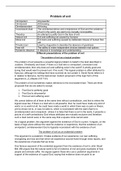
Problem of evil
Omnipotent All-powerful
Omniscient All-knowing
Omnibenevolent All-loving
Inconsistent triad The omnibenevolence and omnipotence of God and the existence
of evil in the world, are said to be mutually incompatible
Theodicy An attempt to justify God in the face of evil
Natural evil Evil and suffering not caused by humans
Moral evil Evil done and suffering caused by deliberate misuse of human free
will
Privatio boni Used by Augustine to describe the absence of goodness
Free will The ability to make independent choices between real options
Epistemic distance A distance in knowledge and understanding
Different presentations of the problem of evil
The problem of evil as a logical problem
The problem of evil presents a powerful logical problem to belief in the God described in
Judaism, Christianity and Islam; if there is a God who is omnipotent, omniscient and
omnibenevolent, then why does evil and suffering exist in the world? A wholly good and
loving God would want to prevent evil, if he could. This logical problem is often attributed to
Epicurus, although his writings that have survived do not contain it. David Hume refers to it
in relation to Epicurus, but the best-known modern proponent of the logic form of this
argument is J.L.Mackie (1917-81)
The problem of evil sometimes makes reference to the inconsistent triad. There are three
proposals that we are asked to accept:
1. That God is perfectly good
2. That God is all-powerful
3. That evil and suffering exist
We cannot believe all of them at the same time without contradiction, and that is where the
logical issue lies. If there is a God who is all-powerful, then he could have made any kind of
world, or no world at all; he could have made a world in which there was no pain or illness,
yet he chose not to, or was not able to, which is inconsistent with the claim that he is
omnibenevolent and omnipotent. Unless it is false that there is evil in the world, it presents a
picture of a self-contradictory God whose attributes are mutually exclusive and therefore
such a God cannot exist, in the same way that a square circle cannot exist.
As a logical problem, this argument against the existence of God is a priori. It argues, on the
basis of logic alone without the need for evidence or experience, that the existence of an
omnipotent, omnibenevolent God is logically inconsistent with the existence of evil.
The problem of evil as an evidential problem
This argument is a posteriori. It takes evidence of our experience; our own suffering,
wrongdoing and loss and that which we experience second-hand through news reports, and
the experiences of people that we know.
One famous exponent of the evidential argument from the existence of evil is John Stuart
Mill. Mill argues that the natural world is full of evidence of evil and gives examples of how
people and animals suffer. He argues against those who use a posteriori arguments in
support of the existence of a good God, saying that evidence does not point to an
, omnibenevolent creator but one who is sadistic and who behaves in all the ways that we
condemn when we see then in human criminals.
Mill argues against supporters of teleological arguments, such as William Paley, who
claimed we only need to look at the world to conclude that it must have been made by the
power of God who cares about us all. Mill argues that the evidence shows nothing of the
kind. If there is a God, he does not seem to be benevolent. We cannot look at him or to
nature as a guide for our own moral behaviour, and we cannot worship him for his goodness.
Responses to the problem of evil
An attempt to justify God in the face of evil and suffering is known as a theodicy. Natural evil
refers to those parts of existence which cause suffering but which do not result from human
wrongdoing. For example, earthquakes, the suffering that other animals inflict on one
another, and many illnesses. Moral evil refers to the evil and suffering which results from
humanity’s choice to do bad rather than good things. The suffering caused by war, bullying,
greed and selfishness for example. Moral evil can also include suffering caused by
humanity’s failure to do good when the opportunity arises, such as the loneliness felt by
many old people or the absence of clean drinking water in some countries even though
richer people could afford to provide it.
This distinction between two different kinds of evil has sometimes been helpful in discussion,
because, although some people might want to argue that humanity and not God should be
blamed for the suffering in the world, it is harder to blame humanity for natural evil and
perhaps instances of natural evil require a different explanation. However, the distinction is
not always helpful. It could be argued that all suffering is the result of moral evil, especially if
the view is taken that the Fall of Adam and Eve was so significant that it corrupted the whole
of the natural order.
Augustine’s theodicy
He disagreed with the thinking of Plato, that everything in the physical world was an
imperfect reflection of the Ideal Forms because Augustine was Christian, he did not believe
that God could make anything imperfect, especially as the creation stories in the Bible
confirmed that ‘God saw all that he has made, and it was very good’.
Augustine had to rule out the possibility that there is evil in the world because God made it.
He argued that evil is not an actual, real quality in its own right; he called it a privatio boni - a
privation of the good. In Augustine’s view, evil did not have its own separate existence or
powerful force, but was a falling away from goodness.
In Augustine’s view, evil first came into the world through the Fall of the angels. He said that
the angels were all created perfect, but that some received less grace than others, as a part
of the variety of things. By ‘grace’, Augustine meant that some of the angels received less
assistance from God in their attempts to be holy.
The angels then fell away from God as a direct result of their misuse of free will. They chose
not to worship God but to rival him. They were trying to become the ‘lord of their own being’
instead of relying on the goodness of God. This was repeated in the Fall of Adam and Eve
as representatives of humanity in the Garden of Eden. all the evil in the world, Augustine
thought, has followed on from here, with the kingdom of the angels who remained perfect
fighting for the good, while those who have fallen try to pervert the world.
Adam and Eve’s act of disobedience was so terrible that it disrupted the whole world; it even
affected the natural world, causing earthquakes, droughts and plagues; everything wrong
Omnipotent All-powerful
Omniscient All-knowing
Omnibenevolent All-loving
Inconsistent triad The omnibenevolence and omnipotence of God and the existence
of evil in the world, are said to be mutually incompatible
Theodicy An attempt to justify God in the face of evil
Natural evil Evil and suffering not caused by humans
Moral evil Evil done and suffering caused by deliberate misuse of human free
will
Privatio boni Used by Augustine to describe the absence of goodness
Free will The ability to make independent choices between real options
Epistemic distance A distance in knowledge and understanding
Different presentations of the problem of evil
The problem of evil as a logical problem
The problem of evil presents a powerful logical problem to belief in the God described in
Judaism, Christianity and Islam; if there is a God who is omnipotent, omniscient and
omnibenevolent, then why does evil and suffering exist in the world? A wholly good and
loving God would want to prevent evil, if he could. This logical problem is often attributed to
Epicurus, although his writings that have survived do not contain it. David Hume refers to it
in relation to Epicurus, but the best-known modern proponent of the logic form of this
argument is J.L.Mackie (1917-81)
The problem of evil sometimes makes reference to the inconsistent triad. There are three
proposals that we are asked to accept:
1. That God is perfectly good
2. That God is all-powerful
3. That evil and suffering exist
We cannot believe all of them at the same time without contradiction, and that is where the
logical issue lies. If there is a God who is all-powerful, then he could have made any kind of
world, or no world at all; he could have made a world in which there was no pain or illness,
yet he chose not to, or was not able to, which is inconsistent with the claim that he is
omnibenevolent and omnipotent. Unless it is false that there is evil in the world, it presents a
picture of a self-contradictory God whose attributes are mutually exclusive and therefore
such a God cannot exist, in the same way that a square circle cannot exist.
As a logical problem, this argument against the existence of God is a priori. It argues, on the
basis of logic alone without the need for evidence or experience, that the existence of an
omnipotent, omnibenevolent God is logically inconsistent with the existence of evil.
The problem of evil as an evidential problem
This argument is a posteriori. It takes evidence of our experience; our own suffering,
wrongdoing and loss and that which we experience second-hand through news reports, and
the experiences of people that we know.
One famous exponent of the evidential argument from the existence of evil is John Stuart
Mill. Mill argues that the natural world is full of evidence of evil and gives examples of how
people and animals suffer. He argues against those who use a posteriori arguments in
support of the existence of a good God, saying that evidence does not point to an
, omnibenevolent creator but one who is sadistic and who behaves in all the ways that we
condemn when we see then in human criminals.
Mill argues against supporters of teleological arguments, such as William Paley, who
claimed we only need to look at the world to conclude that it must have been made by the
power of God who cares about us all. Mill argues that the evidence shows nothing of the
kind. If there is a God, he does not seem to be benevolent. We cannot look at him or to
nature as a guide for our own moral behaviour, and we cannot worship him for his goodness.
Responses to the problem of evil
An attempt to justify God in the face of evil and suffering is known as a theodicy. Natural evil
refers to those parts of existence which cause suffering but which do not result from human
wrongdoing. For example, earthquakes, the suffering that other animals inflict on one
another, and many illnesses. Moral evil refers to the evil and suffering which results from
humanity’s choice to do bad rather than good things. The suffering caused by war, bullying,
greed and selfishness for example. Moral evil can also include suffering caused by
humanity’s failure to do good when the opportunity arises, such as the loneliness felt by
many old people or the absence of clean drinking water in some countries even though
richer people could afford to provide it.
This distinction between two different kinds of evil has sometimes been helpful in discussion,
because, although some people might want to argue that humanity and not God should be
blamed for the suffering in the world, it is harder to blame humanity for natural evil and
perhaps instances of natural evil require a different explanation. However, the distinction is
not always helpful. It could be argued that all suffering is the result of moral evil, especially if
the view is taken that the Fall of Adam and Eve was so significant that it corrupted the whole
of the natural order.
Augustine’s theodicy
He disagreed with the thinking of Plato, that everything in the physical world was an
imperfect reflection of the Ideal Forms because Augustine was Christian, he did not believe
that God could make anything imperfect, especially as the creation stories in the Bible
confirmed that ‘God saw all that he has made, and it was very good’.
Augustine had to rule out the possibility that there is evil in the world because God made it.
He argued that evil is not an actual, real quality in its own right; he called it a privatio boni - a
privation of the good. In Augustine’s view, evil did not have its own separate existence or
powerful force, but was a falling away from goodness.
In Augustine’s view, evil first came into the world through the Fall of the angels. He said that
the angels were all created perfect, but that some received less grace than others, as a part
of the variety of things. By ‘grace’, Augustine meant that some of the angels received less
assistance from God in their attempts to be holy.
The angels then fell away from God as a direct result of their misuse of free will. They chose
not to worship God but to rival him. They were trying to become the ‘lord of their own being’
instead of relying on the goodness of God. This was repeated in the Fall of Adam and Eve
as representatives of humanity in the Garden of Eden. all the evil in the world, Augustine
thought, has followed on from here, with the kingdom of the angels who remained perfect
fighting for the good, while those who have fallen try to pervert the world.
Adam and Eve’s act of disobedience was so terrible that it disrupted the whole world; it even
affected the natural world, causing earthquakes, droughts and plagues; everything wrong