PRACTICE PAPER FOR 2026 SUMMER EXAMS
Please check the examination details below before entering your candidate information
Candidate surname Other names
Centre Number Candidate Number
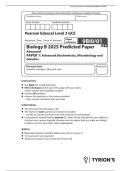
Pearson Edexcel Level 3 GCE
Time: 2 hours Paper
reference 9BN0/01
Biology 2025 Predicted Paper
Advanced
PAPER 1: The Natural Environment and Species
Survival
You must have: Total Marks
Calculator, HB pencil, ruler
Instructions
•• Use black ink or ball-point pen.
Fill in the boxes at the top of this page with your name,
centre number and candidate number.
•• Answer all questions.
Show all your working out in calculations and include units where appropriate.
• Answer the questions in the spaces provided
– there may be more space than you need.
Information
•• The total mark for this paper is 100.
The marks for each question are shown in brackets
– use this as a guide as to how much time to spend on each question.
•• You may use a scientific calculator.
In questions marked with an asterisk (*), marks will be awarded for your ability to
structure your answer logically showing how the points that you make are related or
follow on from each other where appropriate.
Advice
•• Read each question carefully before you start to answer it.
Try to answer every question.
• Check your answers if you have time at the end.
, PRACTICE PAPER FOR 2026 SUMMER EXAMS
1 (a) In an ecosystem, the light energy entering is 6,750,000 kJ m⁻²yr⁻¹. The gross
primary productivity (GPP) is 85,500 kJm⁻²yr⁻¹, and the respiration rate is 52,000
kJm⁻²yr⁻¹.
(i) Calculate the net primary productivity (NPP). Show your working. (2)
(ii) The table below shows energy intake and energy fixed as biomass for different trophic levels:
Trophic Level Energy Intake (kJ m⁻² Energy Fixed as Biomass (kJ m⁻²
yr⁻¹) yr⁻¹)
Primary Consumers 15,200 4,750
Secondary Consumers 1,720 520
Tertiary Consumers 95 28
Calculate the efficiency of energy transfer from primary consumers to secondary consumers. Give
your answer to two significant figures. (3)
, PRACTICE PAPER FOR 2026 SUMMER EXAMS
(b) Explain the importance of nitrogen in the production of plant biomass. (2)
……………………………………………………………………………………………………………
……………………………………………………………………………………………………………
……………………………………………………………………………………………………………
…………………………………………………………..………………………………………………..
(c) Describe one method used to measure the energy content of biomass in an ecosystem. (3)
……………………………………………………………………………………………………………
……………………………………………………………………………………………………………
……………………………………………………………………………………………………………
…………………………………………………………..…………………………..……………………
……………………………………………………………………………………………………………
……………………………………………………………………………………………………………
(Total for Question 1 = 10 marks)
Please check the examination details below before entering your candidate information
Candidate surname Other names
Centre Number Candidate Number
Pearson Edexcel Level 3 GCE
Time: 2 hours Paper
reference 9BN0/01
Biology 2025 Predicted Paper
Advanced
PAPER 1: The Natural Environment and Species
Survival
You must have: Total Marks
Calculator, HB pencil, ruler
Instructions
•• Use black ink or ball-point pen.
Fill in the boxes at the top of this page with your name,
centre number and candidate number.
•• Answer all questions.
Show all your working out in calculations and include units where appropriate.
• Answer the questions in the spaces provided
– there may be more space than you need.
Information
•• The total mark for this paper is 100.
The marks for each question are shown in brackets
– use this as a guide as to how much time to spend on each question.
•• You may use a scientific calculator.
In questions marked with an asterisk (*), marks will be awarded for your ability to
structure your answer logically showing how the points that you make are related or
follow on from each other where appropriate.
Advice
•• Read each question carefully before you start to answer it.
Try to answer every question.
• Check your answers if you have time at the end.
, PRACTICE PAPER FOR 2026 SUMMER EXAMS
1 (a) In an ecosystem, the light energy entering is 6,750,000 kJ m⁻²yr⁻¹. The gross
primary productivity (GPP) is 85,500 kJm⁻²yr⁻¹, and the respiration rate is 52,000
kJm⁻²yr⁻¹.
(i) Calculate the net primary productivity (NPP). Show your working. (2)
(ii) The table below shows energy intake and energy fixed as biomass for different trophic levels:
Trophic Level Energy Intake (kJ m⁻² Energy Fixed as Biomass (kJ m⁻²
yr⁻¹) yr⁻¹)
Primary Consumers 15,200 4,750
Secondary Consumers 1,720 520
Tertiary Consumers 95 28
Calculate the efficiency of energy transfer from primary consumers to secondary consumers. Give
your answer to two significant figures. (3)
, PRACTICE PAPER FOR 2026 SUMMER EXAMS
(b) Explain the importance of nitrogen in the production of plant biomass. (2)
……………………………………………………………………………………………………………
……………………………………………………………………………………………………………
……………………………………………………………………………………………………………
…………………………………………………………..………………………………………………..
(c) Describe one method used to measure the energy content of biomass in an ecosystem. (3)
……………………………………………………………………………………………………………
……………………………………………………………………………………………………………
……………………………………………………………………………………………………………
…………………………………………………………..…………………………..……………………
……………………………………………………………………………………………………………
……………………………………………………………………………………………………………
(Total for Question 1 = 10 marks)