Assignment week 1 ENP 36806
1. Agglomeration externalities (3/10 points)
You probably have had your own experiences with the costs and benefits of urban living. These are
referred to as agglomeration externalities: the costs and benefits associated with the clustering of
people and firms in urban space.
Please provide examples of three agglomeration benefits, as well as three agglomeration costs
that you have experienced in your daily urban life. Explain for each example why these are a
benefit or a cost of agglomeration. (200 words)
2. Governance (3/10 points)
Governance is a concept that is central to this course. In her chapter ‘Governing for Sustainability’
Yvonne Rydin (2010) gives an interpretation of governance as also presented in the introductory
lecture.
Select two key aspects of governance that Rydin presents in her chapter. Why are they key
according to you? (100 words)
Explain what is meant by the term “Governmentalilty” in Rydin’s chapter and how this would
relate to any of the modes of governance explained in Bulkeley and Kern (2006). (150 words)
3. Mechanisms of Air Pollution (4/10 points)
The formation of photochemical smog is a severe problem in many urbanized areas in the world. A
prominent compound of photochemical smog is ozone. Formation of ozone depends on the
availability of sunlight, nitrogen oxides (NOx = NO + NO2) and non-methane hydrocarbons (NMHC).
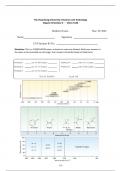
The plot below shows the calculated ozone isopleth plot for the Tokyo metropolis. The contour lines
show the calculated ozone concentration (in parts per billion (ppb)) as a function of the (initial)
concentrations of NOx and NMHC, both in ppb.
, The metropolis of Tokyo wants to reduce ozone levels. What do you think is the best governance
practice of reducing ozone, if only the effects of NOx and NMHC on ozone are considered?
Consider the following situations:
1. NOx = 50 ppb and NMHC = 400 ppb
2. NOx = 30 ppb and NMHC = 700 ppb
Comment on ways of the metropolis to achieve this goal.
Grading factors include: correct examples; correct and well-argued explanation of benefits/costs,
governmentality and modes of governance; Quality of argumentation; use of sources.
1. Agglomeration externalities (3/10 points)
You probably have had your own experiences with the costs and benefits of urban living. These are
referred to as agglomeration externalities: the costs and benefits associated with the clustering of
people and firms in urban space.
Please provide examples of three agglomeration benefits, as well as three agglomeration costs
that you have experienced in your daily urban life. Explain for each example why these are a
benefit or a cost of agglomeration. (200 words)
2. Governance (3/10 points)
Governance is a concept that is central to this course. In her chapter ‘Governing for Sustainability’
Yvonne Rydin (2010) gives an interpretation of governance as also presented in the introductory
lecture.
Select two key aspects of governance that Rydin presents in her chapter. Why are they key
according to you? (100 words)
Explain what is meant by the term “Governmentalilty” in Rydin’s chapter and how this would
relate to any of the modes of governance explained in Bulkeley and Kern (2006). (150 words)
3. Mechanisms of Air Pollution (4/10 points)
The formation of photochemical smog is a severe problem in many urbanized areas in the world. A
prominent compound of photochemical smog is ozone. Formation of ozone depends on the
availability of sunlight, nitrogen oxides (NOx = NO + NO2) and non-methane hydrocarbons (NMHC).
The plot below shows the calculated ozone isopleth plot for the Tokyo metropolis. The contour lines
show the calculated ozone concentration (in parts per billion (ppb)) as a function of the (initial)
concentrations of NOx and NMHC, both in ppb.
, The metropolis of Tokyo wants to reduce ozone levels. What do you think is the best governance
practice of reducing ozone, if only the effects of NOx and NMHC on ozone are considered?
Consider the following situations:
1. NOx = 50 ppb and NMHC = 400 ppb
2. NOx = 30 ppb and NMHC = 700 ppb
Comment on ways of the metropolis to achieve this goal.
Grading factors include: correct examples; correct and well-argued explanation of benefits/costs,
governmentality and modes of governance; Quality of argumentation; use of sources.