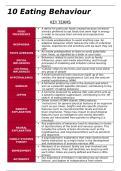
10 Eating Behaviour
KEY TERMS
A desire for particular foods created because ancestral
FOOD animals preferred to eat foods that were high in energy
PREFERENCE in order to increase their survival and reproductive
chances
An innate predisposition to avoid anything new. An
adaptive behaviour which reduces the risks of unfamiliar
NEOPHOBIA
objects, experiences and activities until we learn they are
safe
An innate predisposition to learn to avoid potentially
TASTE AVERSION
toxic foods, as signalled by a bitter or sour taste
Behaviour related to social factors, such as family
SOCIAL influences, peers and media advertising, and through
INFLUENCES processes of modelling and imitation (social learning
theory)
CULTURAL 'Culture' refers to the forms and values that exist within
INFLUENCES any group of people
A small subcortical brain structure made up of two
HYPOTHALAMUS centres: the lateral hypothalamus (LH) and the venture-
medial hypothalamus (VMH)
A hormone produce by cells in the stomach wall which
GHRELIN acts as a powerful appetite stimulant, contributing to the
'on switch' of eating behaviour
A hormone produced by adipose (fat) cells which acts as
LEPTIN a powerful appetite suppressant, contributing to the 'off
switch' of eating behaviour
Genes consist of DNA strands. DNA produces
'instructions' for general physical features of an organism
(such as eye colour, height) and also specific physical
GENETIC features (such as neurotransmitter levels and size of
EXPLANATION brain structures). These may impact on psychological
features (such as intelligence and mental disorder).
Genes are transmitted from parents to offspring (i.e.
inherited)
Any explanation of behaviour (and its disorders) in terms
of (dys)functions of the brain and nervous system. This
NEURAL
includes the activity of brain structures such as the
EXPLANATION
hypothalamus, and neurotransmitters such as serotonin
and dopamine.
A psychodynamic explanation that views dysfunctional
FAMILY SYSTEMS
family interaction as a major factor in the development
THEORY
and maintenance of anorexia nervosa (AN)
Members of an anorexic family are over-involved and
over-protective. Their self-identities are bound up with
ENMESHMENT
each other. Roles are poorly defined and there is little
privacy
Our experience of freedom in deciding how we should
AUTONOMY
behave, and degree of independence from others
, The experience of being in charge of one's own self and
CONTROL (OF behaviour. People with AN are thought to struggle
ANOREXIA) against family dependence for control, as they also do for
autonomy
A way of explaining behaviour that includes both direct
SOCIAL LEARNING
and indterm-15irect reinforcement, combining learning
THEORY
theory with the role of cognitive factors
A consequence of behaviour that increases the likelihood
REINFORCEMENT of that behaviour being repeated. Can be positive or
negative
Communication channels, such as TV, film and books,
MEDIA through which news, entertainment, education and data
are made available
Faulty, biased and irrational ways of thinking that mean
COGNITIVE
we perceive ourselves, other people and the world
DISTORTION
inaccurately and usually negatively
Also called dysfunctional thoughts. In Ellis' model and
therapy, these are defined as thoughts that are likely to
IRRATIONAL
interfere with a person's happiness. Such dysfunctional
BELIEFS
thoughts lead to mental disorders such as depression
and anorexia.
Having too much body fat, often defined as a BMI (weight
OBESITY divided by the square of the person's height) of more
than 30
A cognitive explanation which argues that obesity is the
RESTRAINT
paradoxical outcome of attempts to restrain eating
THEORY
(dieting)
Normal social constraints against certain behaviours can
be weakened by environmental triggers. These
DISINHIBITION
behaviours then appear temporarily socially acceptable
and therefore more likely
From the observer's perspective, modelling is imitating
the behaviour of a role model. From the role model's
MODELLING
perspective, modelling is the precise demonstration of a
specific behaviour that may be imitated by an observer.
Explains how restrained eaters are less sensitive to
BOUNDARY satiety so need more food before feeling full. When they
MODEL break their self-imposed diet boundary they continue to
eat the satiety boundary, making weight gain more likely
A conscious attempt to lose, weight, usually by
restricting how much is eaten. Several biological and
DIETING psychological factors, of the type explored in previous
spreads, influence the success and failure of dieting
attempts
KEY PSYCHOLOGISTS
, STEINER (1977) x2 HARRIS et al. (1990) BIRCH (1999)
SELIGMAN (1971) GARCIA & KOELLING (1966)
Food Preferences: Evolutionary Explanation
Two survival requirements that have to be balanced by evolutionary forces:
KEY TERMS
A desire for particular foods created because ancestral
FOOD animals preferred to eat foods that were high in energy
PREFERENCE in order to increase their survival and reproductive
chances
An innate predisposition to avoid anything new. An
adaptive behaviour which reduces the risks of unfamiliar
NEOPHOBIA
objects, experiences and activities until we learn they are
safe
An innate predisposition to learn to avoid potentially
TASTE AVERSION
toxic foods, as signalled by a bitter or sour taste
Behaviour related to social factors, such as family
SOCIAL influences, peers and media advertising, and through
INFLUENCES processes of modelling and imitation (social learning
theory)
CULTURAL 'Culture' refers to the forms and values that exist within
INFLUENCES any group of people
A small subcortical brain structure made up of two
HYPOTHALAMUS centres: the lateral hypothalamus (LH) and the venture-
medial hypothalamus (VMH)
A hormone produce by cells in the stomach wall which
GHRELIN acts as a powerful appetite stimulant, contributing to the
'on switch' of eating behaviour
A hormone produced by adipose (fat) cells which acts as
LEPTIN a powerful appetite suppressant, contributing to the 'off
switch' of eating behaviour
Genes consist of DNA strands. DNA produces
'instructions' for general physical features of an organism
(such as eye colour, height) and also specific physical
GENETIC features (such as neurotransmitter levels and size of
EXPLANATION brain structures). These may impact on psychological
features (such as intelligence and mental disorder).
Genes are transmitted from parents to offspring (i.e.
inherited)
Any explanation of behaviour (and its disorders) in terms
of (dys)functions of the brain and nervous system. This
NEURAL
includes the activity of brain structures such as the
EXPLANATION
hypothalamus, and neurotransmitters such as serotonin
and dopamine.
A psychodynamic explanation that views dysfunctional
FAMILY SYSTEMS
family interaction as a major factor in the development
THEORY
and maintenance of anorexia nervosa (AN)
Members of an anorexic family are over-involved and
over-protective. Their self-identities are bound up with
ENMESHMENT
each other. Roles are poorly defined and there is little
privacy
Our experience of freedom in deciding how we should
AUTONOMY
behave, and degree of independence from others
, The experience of being in charge of one's own self and
CONTROL (OF behaviour. People with AN are thought to struggle
ANOREXIA) against family dependence for control, as they also do for
autonomy
A way of explaining behaviour that includes both direct
SOCIAL LEARNING
and indterm-15irect reinforcement, combining learning
THEORY
theory with the role of cognitive factors
A consequence of behaviour that increases the likelihood
REINFORCEMENT of that behaviour being repeated. Can be positive or
negative
Communication channels, such as TV, film and books,
MEDIA through which news, entertainment, education and data
are made available
Faulty, biased and irrational ways of thinking that mean
COGNITIVE
we perceive ourselves, other people and the world
DISTORTION
inaccurately and usually negatively
Also called dysfunctional thoughts. In Ellis' model and
therapy, these are defined as thoughts that are likely to
IRRATIONAL
interfere with a person's happiness. Such dysfunctional
BELIEFS
thoughts lead to mental disorders such as depression
and anorexia.
Having too much body fat, often defined as a BMI (weight
OBESITY divided by the square of the person's height) of more
than 30
A cognitive explanation which argues that obesity is the
RESTRAINT
paradoxical outcome of attempts to restrain eating
THEORY
(dieting)
Normal social constraints against certain behaviours can
be weakened by environmental triggers. These
DISINHIBITION
behaviours then appear temporarily socially acceptable
and therefore more likely
From the observer's perspective, modelling is imitating
the behaviour of a role model. From the role model's
MODELLING
perspective, modelling is the precise demonstration of a
specific behaviour that may be imitated by an observer.
Explains how restrained eaters are less sensitive to
BOUNDARY satiety so need more food before feeling full. When they
MODEL break their self-imposed diet boundary they continue to
eat the satiety boundary, making weight gain more likely
A conscious attempt to lose, weight, usually by
restricting how much is eaten. Several biological and
DIETING psychological factors, of the type explored in previous
spreads, influence the success and failure of dieting
attempts
KEY PSYCHOLOGISTS
, STEINER (1977) x2 HARRIS et al. (1990) BIRCH (1999)
SELIGMAN (1971) GARCIA & KOELLING (1966)
Food Preferences: Evolutionary Explanation
Two survival requirements that have to be balanced by evolutionary forces: