
ORGANIC CHEMISTRY I
6A
1. know that a hydrocarbon is a compound of hydrogen and carbon only
- A hydrocarbon is a compound that contains
only the elements hydrogen and carbon.
- Hydrocarbons make up the majority of crude
oil (the source of most fuels and the main raw
material for the chemical industry)
- There are two types of hydrocarbon: aliphatic
and aromatic
- Aliphatic hydrocarbons are carbon chains that
do not have a benzene ring (are not aromatic)
o E.g. propene is an aliphatic
hydrocarbon
- Alicyclic hydrocarbons are a type of aliphatic
compound. They have non-aromatic rings but no side chain.
o E.g. cyclohexane is an alicyclic hydrocarbon.
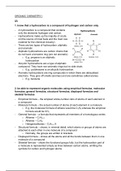
- Aromatic hydrocarbons are ring compounds in which there are delocalised
electrons. They give off smells (aromas) and are sometimes called arenes.
o E.g. benzene
2. be able to represent organic molecules using empirical formulae, molecular
formulae, general formulae, structural formulae, displayed formulae and
skeletal formulae
- Empirical formula – the simplest whole-number ratio of atoms of each element in
a compound
- Molecule formula – the actual number of atoms of each element in a molecule
o E.g. the molecular formula of ethane would be C 2H6 whereas the empirical
formula would be CH3
- General formula – a formula that represents all members of a homologous series
o Alkanes – CnH2n+2
o Alkenes – CnH2n
o Halogenoalkanes – CnH2n+1X
- Structural formula – shows, in minimal detail, which atoms or groups of atoms are
attached to each other in one molecule of a compound
o Normally, the groups are written in brackets
- Displayed formula – shows all the atoms and all the bonds between them in one
molecule of a compound
- Skeletal formula – shows the functional groups fully, but the hydrocarbon part of
a molecule is represented simply as lines between carbon atoms, omitting the
symbols for carbon and hydrogen atoms
6A
1. know that a hydrocarbon is a compound of hydrogen and carbon only
- A hydrocarbon is a compound that contains
only the elements hydrogen and carbon.
- Hydrocarbons make up the majority of crude
oil (the source of most fuels and the main raw
material for the chemical industry)
- There are two types of hydrocarbon: aliphatic
and aromatic
- Aliphatic hydrocarbons are carbon chains that
do not have a benzene ring (are not aromatic)
o E.g. propene is an aliphatic
hydrocarbon
- Alicyclic hydrocarbons are a type of aliphatic
compound. They have non-aromatic rings but no side chain.
o E.g. cyclohexane is an alicyclic hydrocarbon.
- Aromatic hydrocarbons are ring compounds in which there are delocalised
electrons. They give off smells (aromas) and are sometimes called arenes.
o E.g. benzene
2. be able to represent organic molecules using empirical formulae, molecular
formulae, general formulae, structural formulae, displayed formulae and
skeletal formulae
- Empirical formula – the simplest whole-number ratio of atoms of each element in
a compound
- Molecule formula – the actual number of atoms of each element in a molecule
o E.g. the molecular formula of ethane would be C 2H6 whereas the empirical
formula would be CH3
- General formula – a formula that represents all members of a homologous series
o Alkanes – CnH2n+2
o Alkenes – CnH2n
o Halogenoalkanes – CnH2n+1X
- Structural formula – shows, in minimal detail, which atoms or groups of atoms are
attached to each other in one molecule of a compound
o Normally, the groups are written in brackets
- Displayed formula – shows all the atoms and all the bonds between them in one
molecule of a compound
- Skeletal formula – shows the functional groups fully, but the hydrocarbon part of
a molecule is represented simply as lines between carbon atoms, omitting the
symbols for carbon and hydrogen atoms


