OPPORTUNITY THEORIES – positivist
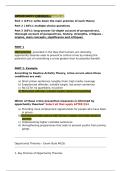
Part 1 (15%): write down the main premise of each theory
Part 2 ( 40%): multiple-choice questions
Part 3 (45%): long-answer (in-depth account of perspectives),
thorough account of perspectives, history, strengths, critiques –
origins, main concepts, significance and critiques
PART 1
Main premise: grounded in the idea that humans act rationally,
opportunity theories seek to prevent & control crime by making the
potential cost of committing a crime greater than its potential benefit
PART 2- Example
According to Routine Activity Theory, crime occurs when three
conditions are met:
a) Short prison sentences; lengthy trials; high media coverage
b) Experienced offender; suitable target; low prison sentences
c) No CCTV; no guardians; no police
d) Motivated offender; suitable target; absence of guardian
Which of these crime prevention measures is informed by
opportunity theories? Select all that apply AFTER Q14
a) Providing more employment opportunities for people who have been
in prison
b) Enclosing private spaces with fences, hedges and other physical
barriers
c) Implementing higher custodial sentences
d) Strengthening programmes that seek to prevent youths from joining
gangs
Opportunity Theories – Exam-Style MCQs
1. Key Premise of Opportunity Theories
, Choose the right answer
Q1. The central premise of opportunity theories is that crime can be
reduced by:
A. Addressing the social causes of crime
B. Increasing rehabilitation and treatment programmes
C. Making the costs of crime outweigh its potential benefits
D. Changing offenders’ identities over the life course
Correct answer: C
Choose all that apply
Q2. Opportunity theories are grounded in the assumption that:
☐ Human beings act rationally
☐ Crime is primarily caused by social inequality
☐ Individuals consider costs and benefits before offending
☐ Crime prevention should focus on reducing opportunities
Correct answers:
☑ Human beings act rationally
☑ Individuals consider costs and benefits before offending
☑ Crime prevention should focus on reducing opportunities
2. Origins: The Classical School of Criminology
Choose the right answer
Q3. Opportunity theories are most directly rooted in which criminological
tradition?
A. Positivist criminology
B. The Classical School of Criminology
C. Critical criminology
D. Chicago School criminology
Correct answer: B
Choose all that apply
Q4. Key principles of the Classical School of Criminology include:
☐ Free will and rational choice
☐ Deterministic explanations of behaviour
☐ Proportional punishment
☐ Emphasis on individual responsibility
Part 1 (15%): write down the main premise of each theory
Part 2 ( 40%): multiple-choice questions
Part 3 (45%): long-answer (in-depth account of perspectives),
thorough account of perspectives, history, strengths, critiques –
origins, main concepts, significance and critiques
PART 1
Main premise: grounded in the idea that humans act rationally,
opportunity theories seek to prevent & control crime by making the
potential cost of committing a crime greater than its potential benefit
PART 2- Example
According to Routine Activity Theory, crime occurs when three
conditions are met:
a) Short prison sentences; lengthy trials; high media coverage
b) Experienced offender; suitable target; low prison sentences
c) No CCTV; no guardians; no police
d) Motivated offender; suitable target; absence of guardian
Which of these crime prevention measures is informed by
opportunity theories? Select all that apply AFTER Q14
a) Providing more employment opportunities for people who have been
in prison
b) Enclosing private spaces with fences, hedges and other physical
barriers
c) Implementing higher custodial sentences
d) Strengthening programmes that seek to prevent youths from joining
gangs
Opportunity Theories – Exam-Style MCQs
1. Key Premise of Opportunity Theories
, Choose the right answer
Q1. The central premise of opportunity theories is that crime can be
reduced by:
A. Addressing the social causes of crime
B. Increasing rehabilitation and treatment programmes
C. Making the costs of crime outweigh its potential benefits
D. Changing offenders’ identities over the life course
Correct answer: C
Choose all that apply
Q2. Opportunity theories are grounded in the assumption that:
☐ Human beings act rationally
☐ Crime is primarily caused by social inequality
☐ Individuals consider costs and benefits before offending
☐ Crime prevention should focus on reducing opportunities
Correct answers:
☑ Human beings act rationally
☑ Individuals consider costs and benefits before offending
☑ Crime prevention should focus on reducing opportunities
2. Origins: The Classical School of Criminology
Choose the right answer
Q3. Opportunity theories are most directly rooted in which criminological
tradition?
A. Positivist criminology
B. The Classical School of Criminology
C. Critical criminology
D. Chicago School criminology
Correct answer: B
Choose all that apply
Q4. Key principles of the Classical School of Criminology include:
☐ Free will and rational choice
☐ Deterministic explanations of behaviour
☐ Proportional punishment
☐ Emphasis on individual responsibility