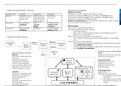
Coding, capacity, duration of memory Explanations for forgetting
Interference theory
Memory store Coding Capacity Duration Interference = when 2 pieces of info are in conflict
Sensory Depends on the High over one Half than a Proactive interference: old memory interferes with new memory
sense; Iconic, hundred million seconds Retroactive interference: new memory interferes with old memory
Echoic etc… cells in one eye Interference is worse with similar memories
storing data McGeoch and McDonald; list of words then another list of words to recall.
Short term Acoustically 7 2 18-30 seconds worst recall with synonyms group
Baddeley Jacobs Peterson and
Miller Peterson Retrieval failure
Long term Semantically Unlimited Up to a lifetime Lack of cues causes retrieval failure
Baddeley Bahrick et Al. Encoding specificity principle; TULVING
- Cues help retrieval.
- Same cues at retrieval and encoding, closer retrieval cue is to
original cue = works better
Multi-store model of memory Some cues have meaning linked to the memory
- Cue = linked to material works better (remembered in meaningful
way)
Some cues have n meaningful link
- State-dependent forgetting; dependant on external/environmental
cues CARTER AND CASSIDY
- Context-dependant forgetting; dependant on internal cue (state of
mind) GODDEN AND BADDELEY
Working memory model: BADDELE
Types of long term memory HITCH
Episodic Model of the short term memory –
Store events (episodes from functions and explains it
our lives)
Episodic memories are Central executive
complex; time stamped, Allocated slave systems
involve several elements Attentional process
such as people, places and Monitors incoming data
behaviours in one memory Limited storage
Conscious effort to recall
Phonological loop
Semantic Auditory info
Stores our knowledge of the Preserves order info arrives
world; like a combo of an 1. Phonological store; words
encyclopaedia and (inner ear)
dictionary 2. Articulatory process; maint
Semantic memories are not rehearsal of sounds you he
time-stamped voice)
Less personal and more
Interference theory
Memory store Coding Capacity Duration Interference = when 2 pieces of info are in conflict
Sensory Depends on the High over one Half than a Proactive interference: old memory interferes with new memory
sense; Iconic, hundred million seconds Retroactive interference: new memory interferes with old memory
Echoic etc… cells in one eye Interference is worse with similar memories
storing data McGeoch and McDonald; list of words then another list of words to recall.
Short term Acoustically 7 2 18-30 seconds worst recall with synonyms group
Baddeley Jacobs Peterson and
Miller Peterson Retrieval failure
Long term Semantically Unlimited Up to a lifetime Lack of cues causes retrieval failure
Baddeley Bahrick et Al. Encoding specificity principle; TULVING
- Cues help retrieval.
- Same cues at retrieval and encoding, closer retrieval cue is to
original cue = works better
Multi-store model of memory Some cues have meaning linked to the memory
- Cue = linked to material works better (remembered in meaningful
way)
Some cues have n meaningful link
- State-dependent forgetting; dependant on external/environmental
cues CARTER AND CASSIDY
- Context-dependant forgetting; dependant on internal cue (state of
mind) GODDEN AND BADDELEY
Working memory model: BADDELE
Types of long term memory HITCH
Episodic Model of the short term memory –
Store events (episodes from functions and explains it
our lives)
Episodic memories are Central executive
complex; time stamped, Allocated slave systems
involve several elements Attentional process
such as people, places and Monitors incoming data
behaviours in one memory Limited storage
Conscious effort to recall
Phonological loop
Semantic Auditory info
Stores our knowledge of the Preserves order info arrives
world; like a combo of an 1. Phonological store; words
encyclopaedia and (inner ear)
dictionary 2. Articulatory process; maint
Semantic memories are not rehearsal of sounds you he
time-stamped voice)
Less personal and more