

Unit 4
Making and testing an organic solid
The assignment’s objective is to synthesise and test aspirin and comparing its
production in a small lab to an industrial production line, comparing efficiency,
equipment and purity testing techniques. The organic solid is a medicine used in
bringing down fevers, reduced pain and inflammations. Aspirin is a painkiller
used for toothaches, headaches and the common colds.
Salicylic acid will be used to test the purity of the aspirin manufactured in the
college laboratories.
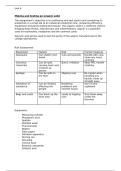
Risk assessment
Equipment Hazard Risk Control measure
Glassware Can shatter and Cuts and wounds Handle with care,
break clean any mess
carefully
Corrosive Can be spilt, Burns, irritation Wear PPE, handle
chemicals causing harm and carefully
irritation to
person
Spillage Can be spilt on Slipping over Be careful when
the floor handling any
liquids, clean up
straight away
Inhalation of Can be inhaled, Breathing Use a fume
substance affecting the problems and cupboard
people internal issues
Bags and coats Can block up the Leads to tripping Tuck them away
work area over under the
benches
Equipment:
- Measuring cylinder
- Phosphoric acid
- Spatula
- Distilled water
- Thermometer
- Beaker
- Filter paper
- Filtration apparatus
- Stirring rod
- Hot plate
- Conical flask
- Ethanoic anhydride
- Salicylic acid
, Unit 4
Method:
- Check to see if all glassware is dry and free from damage
- Using an icebox, chill some bottles of water for later
- In a pear-shaped flask, add excess ethanoic acid to 2g of 2-hydroxybenzoic
acid
- Slowly add 8 drops of concentrated phosphoric acid
- Add anti-bump granules and attach a condenser to reflux the solution for
30 minutes
- Keep the water running and allow it to cool
- Control the vigorous exothermic reaction by slowly adding drops of
distilled water
- Once it is cool, place the flask in an ice bath for crystallisation
- Filter the reaction mixture using pre-wetted filter paper and the Buchner
filter method
- Wash the filtered solid with cold distilled water and put it in boiling water
for crystallisation again
- Filter the solution into a pre-weighed beaker
- Allow the solution to cool
- Leave the product to dry naturally
- Weigh the final product
Aspirin is purified to remove any impurities in the mixture, allowing us to find the
actual product output and percentage yields.
Results
Salicylic acid = limiting reagent
Mass = 6g
Mr = 138
Acetic anhydride = excess
Mass = 10g
Mr = 102
Moles of salicylic acid = 6/138 = 0.04mol
salicylic acid : aspirin = 1:1
Theoretical yield of aspirin = 0.04x102=4.08g
actual mass of aspirin = 3.86g
Percentage yield = (actual yield/ theoretical yield) x 100
Percentage yield = (3.86/4.08) x 100 = 94.61%
The aspirin is 94.61% pure, the percentage yield is a little lower than the
theoretical yield. This means that there are other impurities that remained from
the purification stage that account for the remaining 5.39%. To minimise these
impurities, the filtration and purification stage could be improved and repeated.
Comparison of production of Aspirin in an industrial site and a school
lab
Making and testing an organic solid
The assignment’s objective is to synthesise and test aspirin and comparing its
production in a small lab to an industrial production line, comparing efficiency,
equipment and purity testing techniques. The organic solid is a medicine used in
bringing down fevers, reduced pain and inflammations. Aspirin is a painkiller
used for toothaches, headaches and the common colds.
Salicylic acid will be used to test the purity of the aspirin manufactured in the
college laboratories.
Risk assessment
Equipment Hazard Risk Control measure
Glassware Can shatter and Cuts and wounds Handle with care,
break clean any mess
carefully
Corrosive Can be spilt, Burns, irritation Wear PPE, handle
chemicals causing harm and carefully
irritation to
person
Spillage Can be spilt on Slipping over Be careful when
the floor handling any
liquids, clean up
straight away
Inhalation of Can be inhaled, Breathing Use a fume
substance affecting the problems and cupboard
people internal issues
Bags and coats Can block up the Leads to tripping Tuck them away
work area over under the
benches
Equipment:
- Measuring cylinder
- Phosphoric acid
- Spatula
- Distilled water
- Thermometer
- Beaker
- Filter paper
- Filtration apparatus
- Stirring rod
- Hot plate
- Conical flask
- Ethanoic anhydride
- Salicylic acid
, Unit 4
Method:
- Check to see if all glassware is dry and free from damage
- Using an icebox, chill some bottles of water for later
- In a pear-shaped flask, add excess ethanoic acid to 2g of 2-hydroxybenzoic
acid
- Slowly add 8 drops of concentrated phosphoric acid
- Add anti-bump granules and attach a condenser to reflux the solution for
30 minutes
- Keep the water running and allow it to cool
- Control the vigorous exothermic reaction by slowly adding drops of
distilled water
- Once it is cool, place the flask in an ice bath for crystallisation
- Filter the reaction mixture using pre-wetted filter paper and the Buchner
filter method
- Wash the filtered solid with cold distilled water and put it in boiling water
for crystallisation again
- Filter the solution into a pre-weighed beaker
- Allow the solution to cool
- Leave the product to dry naturally
- Weigh the final product
Aspirin is purified to remove any impurities in the mixture, allowing us to find the
actual product output and percentage yields.
Results
Salicylic acid = limiting reagent
Mass = 6g
Mr = 138
Acetic anhydride = excess
Mass = 10g
Mr = 102
Moles of salicylic acid = 6/138 = 0.04mol
salicylic acid : aspirin = 1:1
Theoretical yield of aspirin = 0.04x102=4.08g
actual mass of aspirin = 3.86g
Percentage yield = (actual yield/ theoretical yield) x 100
Percentage yield = (3.86/4.08) x 100 = 94.61%
The aspirin is 94.61% pure, the percentage yield is a little lower than the
theoretical yield. This means that there are other impurities that remained from
the purification stage that account for the remaining 5.39%. To minimise these
impurities, the filtration and purification stage could be improved and repeated.
Comparison of production of Aspirin in an industrial site and a school
lab


