Cellular
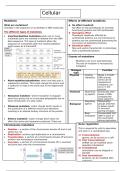
Mutations Control Effects of different mutations
What are mutations? No effect (neutral)
Changes in the sequence of nucleotides in DNA molecules. No effect on the phenotypes as normally
functioning proteins are still synthesised.
The different types of mutations: Damaging effect
Insertion/deletion mutations-when one or more Phenotype negatively effected as
nucleotide pairs are inserted or deleted from the DNA synthesised proteins are non-functional or
base sequence. This type of mutation alters the proteins are not synthesised preventing the
sequence of nucleotides after the insertion/deletion occurrence of essential processes.
point known as a frameshift. Beneficial effect
New and useful characteristic in phenotype
from a synthesised protein.
Causes of mutations
- Mutations can occur spontaneously
- The rate of mutation is increased by
mutagens
Mutagen Function
type
Physical Ionizing Break 1 or both
radiations DNA strands
Point mutation/substitution- when one base pair is some can be
replaced by another. This could change the amino acid repaired but
mutations can
it codes for or keep it the same due to the degenerate
occur in the
nature.
process
Chemical Deaminati Chemically alter
ng agents bases in DNA,
Nonsense mutation- where translation is stopped changing the
early thus giving rise to a truncated polypeptide due to base sequence
early introduction of a stop codon Alkylating Methyl/ethyl
Biological agents groups attached
Missense mutation- codon change which results in to bases results
the production of a different amino acid therefore in incorrect
resulting in an altered tertiary structure of the protein. pairing of bases
Base Incorporated into
analogues DNA in place of
Silence mutation- codon change which does not the usual base
affect the amino acid sequence produced. These are during replication
Viruses Viral DNA may
possible due to the degenerate nature of the genetic
Chromosome mutations Gene regulation
This is required for cells to specialise
Deletion – a section of the chromosome breaks off and is lost
and work in a coordinated way.
within the cell
Duplication- sections get duplicated on a chromosome 1) Transcriptional
Translocation- a section of a chromosome breaks off and joins (genes can be turned on or off)
another non-homologous chromosome 2) Post transcriptional
Inversion- a section of a chromosome breaks off, is reversed (mRNA can be modified which
and joins back onto the chromosome regulates translation)
3) Translational
(translation can be stopped or
started)
4) Post translational
(proteins can be modified after
synthesis)
Mutations Control Effects of different mutations
What are mutations? No effect (neutral)
Changes in the sequence of nucleotides in DNA molecules. No effect on the phenotypes as normally
functioning proteins are still synthesised.
The different types of mutations: Damaging effect
Insertion/deletion mutations-when one or more Phenotype negatively effected as
nucleotide pairs are inserted or deleted from the DNA synthesised proteins are non-functional or
base sequence. This type of mutation alters the proteins are not synthesised preventing the
sequence of nucleotides after the insertion/deletion occurrence of essential processes.
point known as a frameshift. Beneficial effect
New and useful characteristic in phenotype
from a synthesised protein.
Causes of mutations
- Mutations can occur spontaneously
- The rate of mutation is increased by
mutagens
Mutagen Function
type
Physical Ionizing Break 1 or both
radiations DNA strands
Point mutation/substitution- when one base pair is some can be
replaced by another. This could change the amino acid repaired but
mutations can
it codes for or keep it the same due to the degenerate
occur in the
nature.
process
Chemical Deaminati Chemically alter
ng agents bases in DNA,
Nonsense mutation- where translation is stopped changing the
early thus giving rise to a truncated polypeptide due to base sequence
early introduction of a stop codon Alkylating Methyl/ethyl
Biological agents groups attached
Missense mutation- codon change which results in to bases results
the production of a different amino acid therefore in incorrect
resulting in an altered tertiary structure of the protein. pairing of bases
Base Incorporated into
analogues DNA in place of
Silence mutation- codon change which does not the usual base
affect the amino acid sequence produced. These are during replication
Viruses Viral DNA may
possible due to the degenerate nature of the genetic
Chromosome mutations Gene regulation
This is required for cells to specialise
Deletion – a section of the chromosome breaks off and is lost
and work in a coordinated way.
within the cell
Duplication- sections get duplicated on a chromosome 1) Transcriptional
Translocation- a section of a chromosome breaks off and joins (genes can be turned on or off)
another non-homologous chromosome 2) Post transcriptional
Inversion- a section of a chromosome breaks off, is reversed (mRNA can be modified which
and joins back onto the chromosome regulates translation)
3) Translational
(translation can be stopped or
started)
4) Post translational
(proteins can be modified after
synthesis)