

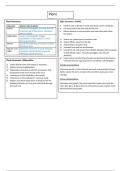
Plant
responses
Plant hormones Plant hormones- AUXINS
Hormone known roles in plants o Made in cells at the tip of roots and shoots and in meristems.
Auxins Control cell elongation prevents leaf fall, o Can move down the stem and up the root.
maintains apical dominance, stimulates o Effects depend on concentration and interaction with other
ethene release hormones.
Gibberellins causes cell elongation, triggers
mobilisation of food stores in a seed 1) Auxins are synthesised in meristem cells.
during germination 2) Auxins diffuse away from the tip.
Ethene Causes fruit ripening, promotes leaf fall in
3) Auxins bind to receptor sites.
deciduous trees
4) Vacuoles form and low pH develops.
Abscisic acid Maintains dormancy of seeds and buds,
5) Low pH of cell walls keeps them flexible allowing cells to expand
(ABA) stimulates cold protective responses
stimulates stomatal closure as they absorb water. Vacuoles get bigger and cell wall
stretches.
6) Large central vacuole formed auxins are destroyed by enzymes.
Plant hormones- Gibberellins Cell walls become rigid and there is no further cell elongation.
1) Seeds absorb water and embryo is activated. At high concentrations:
2) Embryo produces gibberellins.
3) Gibberellins stimulate production of enzymes that Supresses growth of lateral shoots but auxin concentration is lower
break down food stores found in the seed. further down the stem so lateral shoots further down grow more
4) Food stores in the cotyledons- dicot seeds strongly.
5) Food stores in the endosperm- monocot seeds At low concentrations:
6) Embryo uses these food stores to produce ATP for
building materials so it can grow and break through Promotes root growth, the more auxin that reaches the roots the
the seed coat more they grow, if apical shoot is removed less auxin reaches roots
which prevents the growth.
responses
Plant hormones Plant hormones- AUXINS
Hormone known roles in plants o Made in cells at the tip of roots and shoots and in meristems.
Auxins Control cell elongation prevents leaf fall, o Can move down the stem and up the root.
maintains apical dominance, stimulates o Effects depend on concentration and interaction with other
ethene release hormones.
Gibberellins causes cell elongation, triggers
mobilisation of food stores in a seed 1) Auxins are synthesised in meristem cells.
during germination 2) Auxins diffuse away from the tip.
Ethene Causes fruit ripening, promotes leaf fall in
3) Auxins bind to receptor sites.
deciduous trees
4) Vacuoles form and low pH develops.
Abscisic acid Maintains dormancy of seeds and buds,
5) Low pH of cell walls keeps them flexible allowing cells to expand
(ABA) stimulates cold protective responses
stimulates stomatal closure as they absorb water. Vacuoles get bigger and cell wall
stretches.
6) Large central vacuole formed auxins are destroyed by enzymes.
Plant hormones- Gibberellins Cell walls become rigid and there is no further cell elongation.
1) Seeds absorb water and embryo is activated. At high concentrations:
2) Embryo produces gibberellins.
3) Gibberellins stimulate production of enzymes that Supresses growth of lateral shoots but auxin concentration is lower
break down food stores found in the seed. further down the stem so lateral shoots further down grow more
4) Food stores in the cotyledons- dicot seeds strongly.
5) Food stores in the endosperm- monocot seeds At low concentrations:
6) Embryo uses these food stores to produce ATP for
building materials so it can grow and break through Promotes root growth, the more auxin that reaches the roots the
the seed coat more they grow, if apical shoot is removed less auxin reaches roots
which prevents the growth.


