

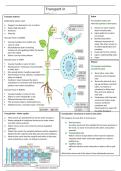
Transport in
plants
Transport systems Xylem
Multicellular plants need: To transport water and
minerals uproots to the leaves.
o Oxygen ( low demand as not as active)
o Water (high demand) o Narrow so water column
o Nutrients doesn’t break easily.
o Minerals o Lignin patterns so xylem
can stretch.
Vascular tissue in LEAVES o Bordered pits allow
Vascular bundles form midrib and sideways movement of
veins of a leaf. water into other vessels as
Dicotyledonous leaf= branching its where lignification isn’t
network of veins getting smaller the further complete.
from the midrib. o Dead cells to form column.
Xylem is on top of the phloem. o Lignin, waterproofing walls
o Open
Vascular tissue in STEM
Phloem
Vascular bundle on outer of stem
Woody plants= continuous ring of bundles To transport assimilates
in older stem around the plant
Non woody plants= bundles separated.
o Sieve tubes: sieve tube
Sclerenchyma on top, phloem, cambium then
elements and companion
xylem on bottom
cells.
Cambium= layer between the xylem
o Sieve tube elements carry
and phloem or meristem cells that divide to
sap up and down and form
produce new xylem and phloem
tubes, no nucleus or
Vascular tissue in ROOTS cytoplasm to allow mass
flow and sieve plates at
Vascular bundle in centre of root. each end.
Xylem in centre shaped like a star. o Companion cells help load
Phloem between arms of xylem. sucrose into tubes, large
This structure helps to withstand forces. nucleus and dense
Endodermis has a meristem layer= pericycle. cytoplasm and
mitochondria to make ATP
for active transport.
Transpiration - Water uptake Transpiration- movement of water in the xylem
1. Mineral ions are absorbed from soil via active transport. This happens by mass flow in 3 processes:
2. Water potential of cytoplasm decreases so water enters
root hair cells by osmosis. 1) Root pressure.
3. Water moves across root cortex by osmosis (apoplast As water moves into the medulla this increases pressure in
pathway). the roots, so water is forced into the xylem and pushed
4. Water then enters the symplast pathway and the apoplast is upwards.
blocked by the casparian strip (this also prevents backflow). 2) Transpiration pull.
5. Mineral ions move into the medulla and xylem to decrease Water is lost by evaporation so then must be replaced;
water potential so water can follow by osmosis. cohesion holds water molecules together in a column
pulling it up.
3) Capillary action.
Adhesion attracts water molecules to xylem walls to pull
up.
Water then moves out of the xylem at low hydrostatic pressure.
plants
Transport systems Xylem
Multicellular plants need: To transport water and
minerals uproots to the leaves.
o Oxygen ( low demand as not as active)
o Water (high demand) o Narrow so water column
o Nutrients doesn’t break easily.
o Minerals o Lignin patterns so xylem
can stretch.
Vascular tissue in LEAVES o Bordered pits allow
Vascular bundles form midrib and sideways movement of
veins of a leaf. water into other vessels as
Dicotyledonous leaf= branching its where lignification isn’t
network of veins getting smaller the further complete.
from the midrib. o Dead cells to form column.
Xylem is on top of the phloem. o Lignin, waterproofing walls
o Open
Vascular tissue in STEM
Phloem
Vascular bundle on outer of stem
Woody plants= continuous ring of bundles To transport assimilates
in older stem around the plant
Non woody plants= bundles separated.
o Sieve tubes: sieve tube
Sclerenchyma on top, phloem, cambium then
elements and companion
xylem on bottom
cells.
Cambium= layer between the xylem
o Sieve tube elements carry
and phloem or meristem cells that divide to
sap up and down and form
produce new xylem and phloem
tubes, no nucleus or
Vascular tissue in ROOTS cytoplasm to allow mass
flow and sieve plates at
Vascular bundle in centre of root. each end.
Xylem in centre shaped like a star. o Companion cells help load
Phloem between arms of xylem. sucrose into tubes, large
This structure helps to withstand forces. nucleus and dense
Endodermis has a meristem layer= pericycle. cytoplasm and
mitochondria to make ATP
for active transport.
Transpiration - Water uptake Transpiration- movement of water in the xylem
1. Mineral ions are absorbed from soil via active transport. This happens by mass flow in 3 processes:
2. Water potential of cytoplasm decreases so water enters
root hair cells by osmosis. 1) Root pressure.
3. Water moves across root cortex by osmosis (apoplast As water moves into the medulla this increases pressure in
pathway). the roots, so water is forced into the xylem and pushed
4. Water then enters the symplast pathway and the apoplast is upwards.
blocked by the casparian strip (this also prevents backflow). 2) Transpiration pull.
5. Mineral ions move into the medulla and xylem to decrease Water is lost by evaporation so then must be replaced;
water potential so water can follow by osmosis. cohesion holds water molecules together in a column
pulling it up.
3) Capillary action.
Adhesion attracts water molecules to xylem walls to pull
up.
Water then moves out of the xylem at low hydrostatic pressure.


