Enzyme
s
Cofactors Types of enzymes
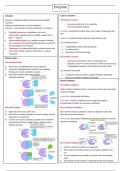
Enzymes= biological catalysts that speed up metabolic Intracellular enzymes
reactions
- Enzymes within cells in its organelle
Enzymes need cofactors for some reactions.
- Part of metabolic pathway
Cofactor= a non-protein molecule attached to an enzyme.
Catabolic- metabolites broken down into smaller components and
Prosthetic groups e.g. anhydrase+ zinc ion in
ATP.
erythrocytes, speeds up the reversible reaction CO2 +
H2O <-> H2CO3. Anabolic- synthesise large molecules using smaller ones.
Non prosthetic groups e.g. amylase enzyme+ chloride
ion in stomach and small intestine speeds up reaction of e.g. Catalase enzyme
starch breakdown to maltose. o 4 polypeptide chains and haem group.
Coenzymes e.g. temporarily bind to enzymes active site
o In small vesicles.
from water soluble vitamins if deficient in a certain
o Protects the cell from damage.
coenzyme.
Extracellular enzymes
Enzyme action
- Enzymes secreted from cells to outside the cell.
Lock and Key Model
- Digestive system= secretes enzymes to line canal to the gut
1) Active site is complementary to the substrate. to breakdown proteins, carbs, lipids and nucleic acids.
2) Temporary hydrogen bonds hold the two together
e.g. amylase and trypsin
forming an enzyme substrate complex.
3) Substrate it broken down into smaller o In digestive system to allow smaller molecules into blood
molecules/product. stream to provide nutrients to the body.
Enzyme inhibitors
Competitive inhibitors
Similar shape to substrate, fits to an enzymes active site preventing
substrate binding.
Irreversible= permanent inactivator.
Reversible= number of collisions can change by changing
concentration of either the enzyme or substrate.
Induced fit model. Non-competitive inhibitors
1) Substrate moves into active site. Not a similar shape to substrate, bind to an allosteric site which
2) Active site of enzyme changes to mould a shape around alters the enzymes active site.
substrate for an exact fit.
3) To form an enzyme substrate complex more closely fit Irreversible= permanent inhibition preventing formation of enzyme
than the lock and key model’s theory, allowing more substrate complexes.
effective binding.
End-Product inhibition
o Enzyme catalysed reactions are regulated.
o The reaction ends when product is no longer needed by the
cell.
o So, the substrate stays bound to enzyme when the reaction
ends.
o The product of one reaction= substrate for the next reaction
s
Cofactors Types of enzymes
Enzymes= biological catalysts that speed up metabolic Intracellular enzymes
reactions
- Enzymes within cells in its organelle
Enzymes need cofactors for some reactions.
- Part of metabolic pathway
Cofactor= a non-protein molecule attached to an enzyme.
Catabolic- metabolites broken down into smaller components and
Prosthetic groups e.g. anhydrase+ zinc ion in
ATP.
erythrocytes, speeds up the reversible reaction CO2 +
H2O <-> H2CO3. Anabolic- synthesise large molecules using smaller ones.
Non prosthetic groups e.g. amylase enzyme+ chloride
ion in stomach and small intestine speeds up reaction of e.g. Catalase enzyme
starch breakdown to maltose. o 4 polypeptide chains and haem group.
Coenzymes e.g. temporarily bind to enzymes active site
o In small vesicles.
from water soluble vitamins if deficient in a certain
o Protects the cell from damage.
coenzyme.
Extracellular enzymes
Enzyme action
- Enzymes secreted from cells to outside the cell.
Lock and Key Model
- Digestive system= secretes enzymes to line canal to the gut
1) Active site is complementary to the substrate. to breakdown proteins, carbs, lipids and nucleic acids.
2) Temporary hydrogen bonds hold the two together
e.g. amylase and trypsin
forming an enzyme substrate complex.
3) Substrate it broken down into smaller o In digestive system to allow smaller molecules into blood
molecules/product. stream to provide nutrients to the body.
Enzyme inhibitors
Competitive inhibitors
Similar shape to substrate, fits to an enzymes active site preventing
substrate binding.
Irreversible= permanent inactivator.
Reversible= number of collisions can change by changing
concentration of either the enzyme or substrate.
Induced fit model. Non-competitive inhibitors
1) Substrate moves into active site. Not a similar shape to substrate, bind to an allosteric site which
2) Active site of enzyme changes to mould a shape around alters the enzymes active site.
substrate for an exact fit.
3) To form an enzyme substrate complex more closely fit Irreversible= permanent inhibition preventing formation of enzyme
than the lock and key model’s theory, allowing more substrate complexes.
effective binding.
End-Product inhibition
o Enzyme catalysed reactions are regulated.
o The reaction ends when product is no longer needed by the
cell.
o So, the substrate stays bound to enzyme when the reaction
ends.
o The product of one reaction= substrate for the next reaction