

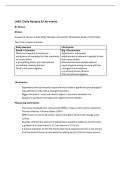
LAB1: Daily Hassles & Life events
B1 Stress
Stress:
Causes of stress include Daily Hassles, Life events, Workplace Stress, Personality
Two main causes of stress:
Daily Hassles Life Events
Small + Common Big + Uncommon
Minor but frequent frustrations + Significant + infrequent
annoyance of everyday life that combines experiences/occasions in people’s lives
to cause stress that cause stress.
e.g forgetting where you have placed Stressful because people expend
something, missing the bus psychological energy to cope with the
Tend to be more negative changed circumstances.
e.g moving house, divorce
Can be positive/negative.
Life Events:
- Experience this as stressful cause we must make a significant psychological
adjustment to cope with a changed situation.
- Bigger the event = more we need to adjust = the more stressful it is.
- Applies to positive (marriage) and negative events (death)
Measuring Life Events:
- The social readjustment rating scale (SRRs), measure life events created by
Thomas Holmes + Richard Rahe (1967)
- SRRs scale is a list of 45 events, each event given several life change units
(LCUs)
- Number reflects the amount of adjustment needed to adapt to the life event
e.g death of a close friend is 37, but divorce is 73 LCUs
- A person indicates all the life events they have experienced over a set period,
and the level of stress is calculated by adding up the LCUs for these events
,Research into Life Events: Rahe Et Al (1970) - do not need to know this in detail.
Aim: Investigate whether scores on the life event questionnaire predicted the onset of
illness
Procedure:
- Approximately 3000 Navy workers studied (3 aircraft carriers) - this can be
applied to the public - generalisation
- Completed SRE (questionnaire used before the SRRS) - outdated as it is using
an old test not the new one
- Every life event in the 6 months before their duty over seas
- On the ship every illness was recorded
- Medical Records were reviewed after the tour, and an independent researcher
calculated an illness score for each participant.
- Staff or PPs were aware of the study but not why – can't be subject to bias, they
can't show demand characteristics, ethics violated because we deceived
them, they can't give formal consent
Results:
- Small but significant correlation (+0.118) between LCU score and illness score
- PPs who had the most stressful events in the 6 months before deployment had
the most illnesses for the 6 months on board, as stress lowered their immune
systems.
Conclusions:
- Rahe et al concluded that life events are reasonably robust predictor of later
stress-related illness.
- Most illnesses were minor as PPs were generally healthy, people in the real
world will be different.
,Daily Hassles – Kanner et al – do not need to know this in detail
Developed as an alternative explanation to the life events explained by Kanner et al
(1981) created the daily hassles questionnaire.
- Suggested that the more day to day events were closely related to stress than
life events.
- Developed a scale that looked at how irritating/annoying these hassles were.
- Uplifts are how often it happens
- 117 hassles (things that have happened to you) – severity
- 135 – frequency (how often it happened)
Aim: Investigate whether daily hassles or life events were a better predictor of
psychological health
Procedure:
- Devised the hassles and uplifts scale – the questionnaire
- 100 PPs aged 45-64 years, cannot generalise to anyone to who is under that
age range.
- Completed the daily hassle questionnaire every month for 9 months, reliable as
it is consistent
- Completed the Hopkins checklist (to measure symptoms of ill health and stress)
- Also completed a measure of live events one month before the study, and after
the end, looking back over 6 months.
Findings:
- Significant correlation between daily hassle frequency and psychological
symptoms
- Daily hassles were significantly stronger predictor of symptoms that life events
Conclusion:
- Daily hassles are more important in predicting illness than life events.
,What are the strengths and weaknesses of using these questionnaires to measure
stress?
Strength Weakness
Point – Both questionnaires use Point – Both of the questionnaire does
numerical data making it easier total up not take individual differences into
and analyse the score. consideration, as each person will take a
situation of stress differently
Evidence – The SRRS scale uses a scale Evidence - The SSRS labels a divorce 73
from 1-120 to depict different levels of on the scale out of 120 meaning that is a
stress for example divorce 73. high stress situation.
Explain - This is useful to the person who Explain - However for example a person
is totalling the score up as it helps them who managed to get out of an abusive
understand the individuals stress levels marriage through divorce is more like to
be relieved than stressed.
strengths and weaknesses of life events as a cause of stress – research into
Strength Weakness
Point - The study can be applied to the Point - Violated ethics procedure as the
public meaning it has generalisability participants did not give formal consent.
Evidence - Approximately 3000 Navy Evidence- Staff and participants were
workers studied (3 aircraft carriers) aware of the study but not why the study
was being done.
Explain - As there were 3000 Explain – This was done to reduce
participants, this large amount suggests demand characteristics however it is a
that the findings can be applied to the violation as no formal consent was given.
public rather than a study that consists of
100 people
Strength + Weakness of daily hassles
Strength Weakness
Point - Point – It has a lack of generalisability.
Evidence - Evidence - 100 PPs aged 45-64 years,
cannot generalise to anyone to who is
under that age range.
Explain - Explain - as the age group was 45-64 the
findings may not be the same as
someone who might be 18.
,Workplace stress
Three factors that cause stress in the workplace: Effects of the Work Environment,
Role Conflict, Level of Control
Work-life Balance Neuroendocrine stress response
Refers to ideal situations where workers Physical reaction to stress in the body
have time for both e.g work and family that affects homeostasis involving the
endocrine system
Effects of the Work Environment
Physical stressors from work environment are temperature and noise
Temperature Noise
- Hot workplaces are associated - Workplaces are full of loud
with negative outcomes such as sounds can be stressful as noise
stress and aggressive behaviours is unpleasant
- Too cold is also stressful as it’s a - Especially uncontrollable noises
negative stimulus leading to are stressful because of a lack of
distress/stress control, key factor in stress
- Hot workplaces are associated
with negative outcomes (stress - Glass et al (1969) asked 60 pp to
and aggressive behaviour, complete cognitive tasks such as
Parsons,2014) and being too cold word searches under one of the 4
can lead to distress/stress conditions, concluded that you
can adapt to high noise levels but
it’s more difficult if it’s
inconsistent
, Role of Conflict
- Occurs when an individual is put in a position that requires them to behave in a
way that they know and believe is not in their best interests.
- e.g working lots of overtime may mean that you do not have much have time to
spend with family. Those in the middle management may feel stressed at having
to balance the needs of a team and the targets set by their boss.
- Pomaki et al (2007) found that role conflict was responsible for emotional
exhaustion, depressive symptoms and even some physical illness in a study of
hospital doctors
Intra-role Conflict
- Intra-role conflict occurs when an employee’s role in the workplace presents
competing demands
- This could happen when roles are poorly defined, and the employee must report
two managers
- Or it could happen when the managers insist that an employee performs
incompatible tasks
Inter-role conflict
- Inter-role conflict occurs when a person has two roles with competing demands
- Often, one role is work-related, and the other is outside the workplace
- For example, a parent may find it stressful to combine childcare with their work
responsibilities
- Or a student with a part time job could find their employer insisting on certain
hours that conflict with college/university time.
Level of Control
- Amount of work that an individual has to do can increase their workplace stress;
having too much or too little can have similar effects
- Breslow & Buell (1960) – found that employees working more than 48 hours a
week were twice likely to develop coronary heart disease (CHD) than those
working 40 hours a week
B1 Stress
Stress:
Causes of stress include Daily Hassles, Life events, Workplace Stress, Personality
Two main causes of stress:
Daily Hassles Life Events
Small + Common Big + Uncommon
Minor but frequent frustrations + Significant + infrequent
annoyance of everyday life that combines experiences/occasions in people’s lives
to cause stress that cause stress.
e.g forgetting where you have placed Stressful because people expend
something, missing the bus psychological energy to cope with the
Tend to be more negative changed circumstances.
e.g moving house, divorce
Can be positive/negative.
Life Events:
- Experience this as stressful cause we must make a significant psychological
adjustment to cope with a changed situation.
- Bigger the event = more we need to adjust = the more stressful it is.
- Applies to positive (marriage) and negative events (death)
Measuring Life Events:
- The social readjustment rating scale (SRRs), measure life events created by
Thomas Holmes + Richard Rahe (1967)
- SRRs scale is a list of 45 events, each event given several life change units
(LCUs)
- Number reflects the amount of adjustment needed to adapt to the life event
e.g death of a close friend is 37, but divorce is 73 LCUs
- A person indicates all the life events they have experienced over a set period,
and the level of stress is calculated by adding up the LCUs for these events
,Research into Life Events: Rahe Et Al (1970) - do not need to know this in detail.
Aim: Investigate whether scores on the life event questionnaire predicted the onset of
illness
Procedure:
- Approximately 3000 Navy workers studied (3 aircraft carriers) - this can be
applied to the public - generalisation
- Completed SRE (questionnaire used before the SRRS) - outdated as it is using
an old test not the new one
- Every life event in the 6 months before their duty over seas
- On the ship every illness was recorded
- Medical Records were reviewed after the tour, and an independent researcher
calculated an illness score for each participant.
- Staff or PPs were aware of the study but not why – can't be subject to bias, they
can't show demand characteristics, ethics violated because we deceived
them, they can't give formal consent
Results:
- Small but significant correlation (+0.118) between LCU score and illness score
- PPs who had the most stressful events in the 6 months before deployment had
the most illnesses for the 6 months on board, as stress lowered their immune
systems.
Conclusions:
- Rahe et al concluded that life events are reasonably robust predictor of later
stress-related illness.
- Most illnesses were minor as PPs were generally healthy, people in the real
world will be different.
,Daily Hassles – Kanner et al – do not need to know this in detail
Developed as an alternative explanation to the life events explained by Kanner et al
(1981) created the daily hassles questionnaire.
- Suggested that the more day to day events were closely related to stress than
life events.
- Developed a scale that looked at how irritating/annoying these hassles were.
- Uplifts are how often it happens
- 117 hassles (things that have happened to you) – severity
- 135 – frequency (how often it happened)
Aim: Investigate whether daily hassles or life events were a better predictor of
psychological health
Procedure:
- Devised the hassles and uplifts scale – the questionnaire
- 100 PPs aged 45-64 years, cannot generalise to anyone to who is under that
age range.
- Completed the daily hassle questionnaire every month for 9 months, reliable as
it is consistent
- Completed the Hopkins checklist (to measure symptoms of ill health and stress)
- Also completed a measure of live events one month before the study, and after
the end, looking back over 6 months.
Findings:
- Significant correlation between daily hassle frequency and psychological
symptoms
- Daily hassles were significantly stronger predictor of symptoms that life events
Conclusion:
- Daily hassles are more important in predicting illness than life events.
,What are the strengths and weaknesses of using these questionnaires to measure
stress?
Strength Weakness
Point – Both questionnaires use Point – Both of the questionnaire does
numerical data making it easier total up not take individual differences into
and analyse the score. consideration, as each person will take a
situation of stress differently
Evidence – The SRRS scale uses a scale Evidence - The SSRS labels a divorce 73
from 1-120 to depict different levels of on the scale out of 120 meaning that is a
stress for example divorce 73. high stress situation.
Explain - This is useful to the person who Explain - However for example a person
is totalling the score up as it helps them who managed to get out of an abusive
understand the individuals stress levels marriage through divorce is more like to
be relieved than stressed.
strengths and weaknesses of life events as a cause of stress – research into
Strength Weakness
Point - The study can be applied to the Point - Violated ethics procedure as the
public meaning it has generalisability participants did not give formal consent.
Evidence - Approximately 3000 Navy Evidence- Staff and participants were
workers studied (3 aircraft carriers) aware of the study but not why the study
was being done.
Explain - As there were 3000 Explain – This was done to reduce
participants, this large amount suggests demand characteristics however it is a
that the findings can be applied to the violation as no formal consent was given.
public rather than a study that consists of
100 people
Strength + Weakness of daily hassles
Strength Weakness
Point - Point – It has a lack of generalisability.
Evidence - Evidence - 100 PPs aged 45-64 years,
cannot generalise to anyone to who is
under that age range.
Explain - Explain - as the age group was 45-64 the
findings may not be the same as
someone who might be 18.
,Workplace stress
Three factors that cause stress in the workplace: Effects of the Work Environment,
Role Conflict, Level of Control
Work-life Balance Neuroendocrine stress response
Refers to ideal situations where workers Physical reaction to stress in the body
have time for both e.g work and family that affects homeostasis involving the
endocrine system
Effects of the Work Environment
Physical stressors from work environment are temperature and noise
Temperature Noise
- Hot workplaces are associated - Workplaces are full of loud
with negative outcomes such as sounds can be stressful as noise
stress and aggressive behaviours is unpleasant
- Too cold is also stressful as it’s a - Especially uncontrollable noises
negative stimulus leading to are stressful because of a lack of
distress/stress control, key factor in stress
- Hot workplaces are associated
with negative outcomes (stress - Glass et al (1969) asked 60 pp to
and aggressive behaviour, complete cognitive tasks such as
Parsons,2014) and being too cold word searches under one of the 4
can lead to distress/stress conditions, concluded that you
can adapt to high noise levels but
it’s more difficult if it’s
inconsistent
, Role of Conflict
- Occurs when an individual is put in a position that requires them to behave in a
way that they know and believe is not in their best interests.
- e.g working lots of overtime may mean that you do not have much have time to
spend with family. Those in the middle management may feel stressed at having
to balance the needs of a team and the targets set by their boss.
- Pomaki et al (2007) found that role conflict was responsible for emotional
exhaustion, depressive symptoms and even some physical illness in a study of
hospital doctors
Intra-role Conflict
- Intra-role conflict occurs when an employee’s role in the workplace presents
competing demands
- This could happen when roles are poorly defined, and the employee must report
two managers
- Or it could happen when the managers insist that an employee performs
incompatible tasks
Inter-role conflict
- Inter-role conflict occurs when a person has two roles with competing demands
- Often, one role is work-related, and the other is outside the workplace
- For example, a parent may find it stressful to combine childcare with their work
responsibilities
- Or a student with a part time job could find their employer insisting on certain
hours that conflict with college/university time.
Level of Control
- Amount of work that an individual has to do can increase their workplace stress;
having too much or too little can have similar effects
- Breslow & Buell (1960) – found that employees working more than 48 hours a
week were twice likely to develop coronary heart disease (CHD) than those
working 40 hours a week


