The latitudinal pattern of radiation: excesses
and deficits
atmosphere: open energy system, receiving energy from both Sun and
Earth through insolation and reradiated long-wave radiation
- insolation: incoming solar radiation
- atmosphere constantly receives solar energy, yet until recently it
was not warming up
- natural balance achieved through inputs (insolation) and outputs
(re-radiation) - achieved through:
● radiation: emission of electromagnetic waves (short- and
long-wave) - most of the sun's radiation is in the form of
short-wave due to its high temperature - visible light and UV
● convection: transfer of heat through a gas or liquid
● conduction: transfer of heat through a solid (contact)
,Insolation
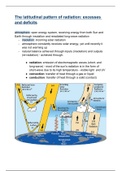
19% - absorbed by atmospheric gases (oxygen and ozone at high
altitudes / CO2 and water vapour at low altitudes)
8% - reflection by atmosphere
23% - reflection by clouds and water droplets
6% - reflection from Earth's surface = planetary albedo
46% - gets through to the Earth's surface
Very hot bodies emit short-wave radiation (Sun), whereas cold
bodies emit long-wave radiation (Earth).
Re-radiation
8% - lost to space
22% - loss of heat due to evaporation and condensation
1% - energy absorbed by clouds and re-radiated back to Earth
1% - condensation carried by turbulence
Greenhouse effect: when outgoing long-wave radiation is trapped by
greenhouse gases in the atmosphere, preventing it from escaping the
Earth.
Variations in insolation
Latitude
- excess of radiation (positive budget) in the tropics
- deficit of radiation (negative budget) at higher latitudes
- neither region is getting hotter or colder - there is a balance
- horizontal transfer of energy from the equator to the poles by
winds and ocean currents ---> gives rise to second energy budget
in atmosphere: horizontal transfer between low latitudes to
compensate for differences in global insolation
, Annual temperature patterns
January
July
January
Highest temperatures overland (< 30 degrees) = Australia and S. Africa
Lower temperatures (> -40 degrees) = Siberia, Greenland and Canadian
Arctic.
and deficits
atmosphere: open energy system, receiving energy from both Sun and
Earth through insolation and reradiated long-wave radiation
- insolation: incoming solar radiation
- atmosphere constantly receives solar energy, yet until recently it
was not warming up
- natural balance achieved through inputs (insolation) and outputs
(re-radiation) - achieved through:
● radiation: emission of electromagnetic waves (short- and
long-wave) - most of the sun's radiation is in the form of
short-wave due to its high temperature - visible light and UV
● convection: transfer of heat through a gas or liquid
● conduction: transfer of heat through a solid (contact)
,Insolation
19% - absorbed by atmospheric gases (oxygen and ozone at high
altitudes / CO2 and water vapour at low altitudes)
8% - reflection by atmosphere
23% - reflection by clouds and water droplets
6% - reflection from Earth's surface = planetary albedo
46% - gets through to the Earth's surface
Very hot bodies emit short-wave radiation (Sun), whereas cold
bodies emit long-wave radiation (Earth).
Re-radiation
8% - lost to space
22% - loss of heat due to evaporation and condensation
1% - energy absorbed by clouds and re-radiated back to Earth
1% - condensation carried by turbulence
Greenhouse effect: when outgoing long-wave radiation is trapped by
greenhouse gases in the atmosphere, preventing it from escaping the
Earth.
Variations in insolation
Latitude
- excess of radiation (positive budget) in the tropics
- deficit of radiation (negative budget) at higher latitudes
- neither region is getting hotter or colder - there is a balance
- horizontal transfer of energy from the equator to the poles by
winds and ocean currents ---> gives rise to second energy budget
in atmosphere: horizontal transfer between low latitudes to
compensate for differences in global insolation
, Annual temperature patterns
January
July
January
Highest temperatures overland (< 30 degrees) = Australia and S. Africa
Lower temperatures (> -40 degrees) = Siberia, Greenland and Canadian
Arctic.