Principles and application of Mass Spectrometry
Basic introduction to MS
Mass spectrometry is
Learning outcome:
1. Basic overview
2. The ion source
3. Mass analyser
4. Principles of operation and key characteristics of mass spectroscopic ion sources (electron
impact, electrospray, MALDI) and mass analysis systems (time of flight, quadrupole, ion trap,
ion cyclotron resonance)
Introduction
Spectrum of masses not light
All other spectroscopy use light except mass spectrometry
Molecule has to be charged & a single molecule i.e. gaseous
How to generate ions?
How to get a non-volatile gaseous molecule charged?
Mass spectrometry is driven by the instrumentation
Calibrate instrument before use, which means find the right magnetic force to give the ions
Mass spectrometry: an overview of the basics
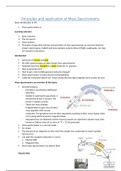
General features:
- Ionisation- acceleration-deflection-
detection.
- Sample is vaporised to gas phase, is
ionised and enters a vacuum. The
ioniser is mainly vacuum.
- These ions may undergo
fragmentation to give ions of lower
mass together with neutral
molecules. The gas phase ions are then separated according to their mass/charge ratios
(m/z) using electrical and/or magnetic fields.
- Separated ions are detected and the masses present are reported in atomic mass units,
known as Daltons mass of an atom of 12C = 12 Da (precisely)
Mass spectrometer is a vaccum inside
Arc shape
The amount of arc depends on how much the sample has accelerated as need a greater
force to turn
Can alter the charged molecules in 2 ways:
1. Electric field
2. Magnetic field
Most mass spectrometer use electric field
Electric field
, The electric field is negative
After the electric field there is a magnet, which bends the path of the ions
Charged particles (only) in electric fields experience forces that are proportional to their
charge
The resulting acceleration of particles is proportional to the force divided by the mass of the
particle and hence to charge/mass
Thus all particles with the same charge/mass ratio should behave similarly and contribute to
a single peak in the mass spectrum.
Remember that opposite charges attract one another, whereas like charges repel
Columbic (charged) forces
Magnetic field
Charged particles in magnetic fields experience forces only when they are already moving.
They are deflected by forces acting at 90 degrees to the direction of motion, causing them to
follow circular paths. As a result get an arc
Particles with a particular mass (momentum)/ charge ratio will follow paths with the same
arc (radius) dependent of mass and charge ratio
Heaviey ions will have more difficulty travelling along the arc than lighter ions.
Analogy=at a turn the van will have more difficulty than the motorcycle to turn.
Information from mass spectra
Molecular mass
Elemental composition
Molecular formula
Fragmentation behaviour can help to distinguish between structures with the same
molecular mass
i.e. sequence of aa in a peptide or protein
good features
very sensitive (10–11-10–18 mol, depending on technique)-as sensitive as the human nose
accurate determination of molecular mass (± 0.1% s easily achieved
rapid analysis in few seconds once sample introduced into the instrument
these aspects make MS suiable for monitoring output of chromatographic column or
electrophoresis gel.
The combination of high performance liquid chromatography and MS is knowns as LC-MS
Disadvantages
Cost over £50, 000
Large
Heavy
Require skilled maintenance to keep vacuum and electrical systems working
Require technician to look after as constantly getting clogged up
These deficiencies are being overcome by improved technology
Methods of ionisation: types of ion source
EI & CI used in hard ionisation technique for small
organic chemicals and always fragment
ESI & MALDI are soft ionisation technique so even I
fragile protein can vaporise and ionise but not
fragment to get molecular ion
Basic introduction to MS
Mass spectrometry is
Learning outcome:
1. Basic overview
2. The ion source
3. Mass analyser
4. Principles of operation and key characteristics of mass spectroscopic ion sources (electron
impact, electrospray, MALDI) and mass analysis systems (time of flight, quadrupole, ion trap,
ion cyclotron resonance)
Introduction
Spectrum of masses not light
All other spectroscopy use light except mass spectrometry
Molecule has to be charged & a single molecule i.e. gaseous
How to generate ions?
How to get a non-volatile gaseous molecule charged?
Mass spectrometry is driven by the instrumentation
Calibrate instrument before use, which means find the right magnetic force to give the ions
Mass spectrometry: an overview of the basics
General features:
- Ionisation- acceleration-deflection-
detection.
- Sample is vaporised to gas phase, is
ionised and enters a vacuum. The
ioniser is mainly vacuum.
- These ions may undergo
fragmentation to give ions of lower
mass together with neutral
molecules. The gas phase ions are then separated according to their mass/charge ratios
(m/z) using electrical and/or magnetic fields.
- Separated ions are detected and the masses present are reported in atomic mass units,
known as Daltons mass of an atom of 12C = 12 Da (precisely)
Mass spectrometer is a vaccum inside
Arc shape
The amount of arc depends on how much the sample has accelerated as need a greater
force to turn
Can alter the charged molecules in 2 ways:
1. Electric field
2. Magnetic field
Most mass spectrometer use electric field
Electric field
, The electric field is negative
After the electric field there is a magnet, which bends the path of the ions
Charged particles (only) in electric fields experience forces that are proportional to their
charge
The resulting acceleration of particles is proportional to the force divided by the mass of the
particle and hence to charge/mass
Thus all particles with the same charge/mass ratio should behave similarly and contribute to
a single peak in the mass spectrum.
Remember that opposite charges attract one another, whereas like charges repel
Columbic (charged) forces
Magnetic field
Charged particles in magnetic fields experience forces only when they are already moving.
They are deflected by forces acting at 90 degrees to the direction of motion, causing them to
follow circular paths. As a result get an arc
Particles with a particular mass (momentum)/ charge ratio will follow paths with the same
arc (radius) dependent of mass and charge ratio
Heaviey ions will have more difficulty travelling along the arc than lighter ions.
Analogy=at a turn the van will have more difficulty than the motorcycle to turn.
Information from mass spectra
Molecular mass
Elemental composition
Molecular formula
Fragmentation behaviour can help to distinguish between structures with the same
molecular mass
i.e. sequence of aa in a peptide or protein
good features
very sensitive (10–11-10–18 mol, depending on technique)-as sensitive as the human nose
accurate determination of molecular mass (± 0.1% s easily achieved
rapid analysis in few seconds once sample introduced into the instrument
these aspects make MS suiable for monitoring output of chromatographic column or
electrophoresis gel.
The combination of high performance liquid chromatography and MS is knowns as LC-MS
Disadvantages
Cost over £50, 000
Large
Heavy
Require skilled maintenance to keep vacuum and electrical systems working
Require technician to look after as constantly getting clogged up
These deficiencies are being overcome by improved technology
Methods of ionisation: types of ion source
EI & CI used in hard ionisation technique for small
organic chemicals and always fragment
ESI & MALDI are soft ionisation technique so even I
fragile protein can vaporise and ionise but not
fragment to get molecular ion