Application of Chromatography
Learning objective:
1. Know the main similarities and differences between commonly used methods for chromatographic separation (size-
exclusion, affinity, ion exchange, gas, thin layer and high performance liquid chromatography).
2. When presented with a separation problem students should be able to suggest appropriate experimental
techniques, justifying their choice.
- e.g. 2 proteins with different molecular weight. What type of chromatography use?
6 types of chromatography
1. size exclusion chromatography
2. affinity chromatography
3. ion exchange chromatography
4. high performance liquid chromatography
5. thin layer chromatography
6. gas chromatography
The similarity between all types of chromatography:
- interchange between mobile and stationary phase
The difference between all types of chromatography:
- Use different principle of interaction
- Different property of the molecule
Why do scientists do chromatography?
1. Purification and separation
- E.g. SEC, Affinity chromatography, preparative HPLC
2. Analysis
Qualitative (e.g. most thin layer chromatography)
- What substances are present?
Quantitative (e.g. most gas chromatography, analytical HPLC)
- How much of each substance is present?
Different stationary phase: different mechanism of protein retention
Depending on the protein property, depends on what type of surface it will bind to
, 1. Size exclusion chromatography
Also known as gel filtration or gel permeation
Separation based on molecular size/shape to certain degree
- Separates according to molecular mass
Larger molecules travel faster down the column due to the pores
Sometimes use a combination of columns
- i.e. first use size followed by ionic
SEC is the most commonly used by biochemists
Stationary phase
- a gel containing pores that are similar in size to the molecules of interest
Smaller molecules are able to enter a greater fraction of the pores in the stationary phase, so elute after large
molecules
Mobile phase
- solvent (typically aqueous for proteins) which dissolves compounds to be separated and which can enter
pores in the gel
Analyte molecules whose size exceeds the exclusion limit for a particular stationary phase are totally excluded from
the pores and flow through the column in the minimum possible elution volume (void volume Vo)
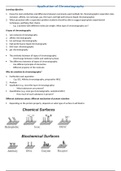
Graph showing
Relationship between molecular weight and elution volume
- Log (Mo.Wt.) = 1/ elution volume
- When molecular weight is in log scale get a straight line
Mass inversely proportional to elution volume
Inversely proportional = one value increases as other value decreases
Elution volume is shown compared to void volume (X-axis)
Assumptions:
1. Globular structure
- Elongated or unfolded protein appear to have larger molecular weight
2. No secondary ionic interactions with stationary phase from charged side-chain on the protein
- Can use high salt in mobile phase to eliminate secondary ionic interaction
Learning objective:
1. Know the main similarities and differences between commonly used methods for chromatographic separation (size-
exclusion, affinity, ion exchange, gas, thin layer and high performance liquid chromatography).
2. When presented with a separation problem students should be able to suggest appropriate experimental
techniques, justifying their choice.
- e.g. 2 proteins with different molecular weight. What type of chromatography use?
6 types of chromatography
1. size exclusion chromatography
2. affinity chromatography
3. ion exchange chromatography
4. high performance liquid chromatography
5. thin layer chromatography
6. gas chromatography
The similarity between all types of chromatography:
- interchange between mobile and stationary phase
The difference between all types of chromatography:
- Use different principle of interaction
- Different property of the molecule
Why do scientists do chromatography?
1. Purification and separation
- E.g. SEC, Affinity chromatography, preparative HPLC
2. Analysis
Qualitative (e.g. most thin layer chromatography)
- What substances are present?
Quantitative (e.g. most gas chromatography, analytical HPLC)
- How much of each substance is present?
Different stationary phase: different mechanism of protein retention
Depending on the protein property, depends on what type of surface it will bind to
, 1. Size exclusion chromatography
Also known as gel filtration or gel permeation
Separation based on molecular size/shape to certain degree
- Separates according to molecular mass
Larger molecules travel faster down the column due to the pores
Sometimes use a combination of columns
- i.e. first use size followed by ionic
SEC is the most commonly used by biochemists
Stationary phase
- a gel containing pores that are similar in size to the molecules of interest
Smaller molecules are able to enter a greater fraction of the pores in the stationary phase, so elute after large
molecules
Mobile phase
- solvent (typically aqueous for proteins) which dissolves compounds to be separated and which can enter
pores in the gel
Analyte molecules whose size exceeds the exclusion limit for a particular stationary phase are totally excluded from
the pores and flow through the column in the minimum possible elution volume (void volume Vo)
Graph showing
Relationship between molecular weight and elution volume
- Log (Mo.Wt.) = 1/ elution volume
- When molecular weight is in log scale get a straight line
Mass inversely proportional to elution volume
Inversely proportional = one value increases as other value decreases
Elution volume is shown compared to void volume (X-axis)
Assumptions:
1. Globular structure
- Elongated or unfolded protein appear to have larger molecular weight
2. No secondary ionic interactions with stationary phase from charged side-chain on the protein
- Can use high salt in mobile phase to eliminate secondary ionic interaction