

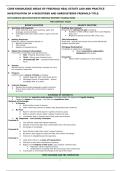
CORE KNOWLEDGE AREAS OF FREEHOLD REAL ESTATE LAW AND PRACTICE
INVESTIGATION OF A REGISTERED AND UNREGISTERED FREEHOLD TITLE:
KEY ELEMENTS AND STRUCTURE OF FREEHOLD PROPERTY TRANSACTIONS
PRE-CONTRACT STAGE
BUYER’S SOLICITOR SELLER’S SOLICITOR
1. Searches and Enquiries: Drafting the Contract:
Order searches (e.g. local authority, water and Prepare draft contract of sale, including:
drainage, environmental). Evidence of title (official copies from Land Registry,
Investigate title and confirm seller’s right to sell the plan, etc.).
land. Replies to standard forms (TA6, TA10, etc.).
2. Raising Enquiries: Title Information:
Raise pre-contract enquiries based on: Prove title – include documents such as the official title
Results of searches. register and title plan.
Title review.
Replies to standard forms. Mortgage Redemption:
If property is subject to a mortgage:
3. Obtain Pre-Contract Information: o Obtain provisional redemption
From seller via standard Law Society forms: statement from lender.
o TA6 – Property Information Form.
o TA10 – Fittings and Contents Form. Execution:
o (If leasehold) TA7 – Leasehold Information Obtain seller’s signature on the contract.
Form.
4. Survey:
Advise client to consider instructing a surveyor to carry
out a physical inspection.
5. Finance:
Confirm buyer's source of funds, including:
o Deposit (typically 10% of purchase price).
o Mortgage finance (if applicable) – ensure
mortgage offer is in place.
6. Contract Review:
Review the contract prepared by seller’s solicitor.
Ensure buyer signs the contract when ready to
proceed.
EXCHANGE OF CONTRACTS
Once contracts are signed by both parties, exchange makes the agreement legally binding.
Contract is dated on exchange – this sets the completion date.
Methods of Exchange:
1. In Person:
o Both solicitors meet in person.
o After confirming contract is dated, they physically swap contracts.
2. By Post:
o Buyer’s solicitor sends buyer’s signed contract by post.
o Seller’s solicitor returns seller’s signed contract by post.
o Completion date is inserted once both parts are received.
3. By Telephone – Law Society Formulae:
Formula A:
o One solicitor holds both signed contracts.
o Solicitor inserts the date upon confirmation from the other party.
o Exchange is immediate.
Formula B:
o Each solicitor holds their client’s signed contract.
o By phone, they agree to insert the date and confirm exchange.
o Common in straightforward transactions.
Formula C:
o Used where there is a chain of transactions.
o Solicitors in the chain coordinate via phone.
o Begins at the bottom of the chain, each solicitor confirms they:
Hold their client’s signed contract.
Undertake to exchange with the next party when authorised.
o Culminates in a Formula B exchange at the top of the chain.
POST EXCHANGE AND PRE COMPLETION
1
, BUYER’S SOLICITORS SELLER’S SOLICITORS
Buyer’s Solicitor Responsibilities: Approve Transfer:
Apply for Pre-Completion Searches: o Approve the TR1 drafted by buyer’s
o OS1 Search – Protects priority of solicitor.
registration for 30 working days. Arrange Execution of TR1:
o K16 Search – Bankruptcy search against o Ensure seller signs the transfer deed in
buyer (and seller if acting for lender). presence of a witness.
Prepare Transfer Deed: Obtain Final Redemption Figure:
o Draft TR1 (Transfer Deed) and send to o Request final figure from seller’s lender for
seller’s solicitor for approval. mortgage repayment.
Mortgage Preparation: Prepare Completion Statement:
o Ensure mortgage funds are requested o Confirm amount due on completion.
from lender in time (usually requires 5 o Deduct redemption figure, agent’s fees,
working days’ notice). legal costs.
Final Completion Statement:
o Prepare statement showing:
Purchase price.
Deductions (e.g. deposit already
paid).
Stamp Duty Land Tax (SDLT).
Legal fees and disbursements.
o Request balance from client to complete.
Arrange for Execution:
o Send TR1 to client for signature in
presence of a witness.
Ensure it is returned before completion
Post-Completion (Buyer’s Solicitor)
1. Pay SDLT:
Submit SDLT return and pay SDLT to HMRC within 14
days of completion.
2. Register the Transaction:
Submit application to HM Land Registry using:
o AP1 form.
o Certified TR1.
o SDLT5 certificate.
o Mortgage deed (if applicable).
Must be done within priority period (30 working days
from date of OS1).
3. Inform Client:
Send updated title documentation once
registration is complete.
2
, PROCESS OF ANALYSING LAND REGISTRY OFFICIAL 1. Dated before 1 December 1990
COPY ENTRIES 2. Contains an adequate description of the land
Official copies will show entries on three registers: 3. Deals with both the legal and equitable interests in
a) The Property register the property
b) The Proprietorship register 4. Casts no doubt on the seller’s title; AND
c) The Charges register 5. Must be at least 15 years old at the date of the
contract
Property register: will always contain a description of land
by reference to address and title plan. Will also indicate if Epitome of title = property’s ownership history
property is leasehold/freehold. Seller will select relevant documents which evidence purchase
It may show that there are easements or rights benefiting the and the Epitome of Title. Epitome is an unbroken chain of
land. ownership from root of title. Includes:
- Root of title and any documents referred to in root of
May show that certain things one might usually expect to title
come with the land, e.g. right to light, right to air over adjacent - Conveyances
land, are excluded from title.
- Seller’s current mortgage and any mortgages not yet
discharged
Proprietorship register: will always identify the current
owners and their address. Will also indicate class of title. - Also include: name changes, death certificated.
Includes: Buyer not entitled to see pre-root documents.
- Class of title held
Epitome will only be photocopy. On completion, buyer
- Name of current holder of the legal estate sends all documents to Land Registry for registration.
- Any restrictions affecting the title
- Any indemnity covenants ISSUES THAT COULD ARISE FROM AN INVESTIGATION
- Any lender restrictions OF TITLE AND FURTHER ACTION REQUIRED
- Any tenants in common restrictions – if there is one,
means property is held as tenants in common not Easements
joint tenants. Most common: right of way, rights of drainage and rights of
support.
Class of title: In register: will be in Charges register, but may also be in
1. Absolute title: the most common and best class. Property register if includes text from conveyance which also
Registered proprietor has vested in them the legal includes benefit of easement.
estate subject only to the entries on the register,
overriding interests. Mines and minerals exceptions and reservations
2. Possessory title: Granted where proprietor is in A mining exception = means that the seller does not own
possession but has lost title deeds or is claiming any mines or minerals underneath the surface of the property
through adverse possession. Means that proprietor is and cannot transfer them to the buyer. Any encroachment on
subject to all adverse interests existing at date of first to them by the buyer will constitute trespass.
registration. - Buyer should be informed as to who is able to
3. Qualified title: granted where there is a specific exercise this right, and if it has ever been exercised in
identified defect which the Registrar feels cannot be past.
overlooked or ‘cured’ by the grant of an absolute title.
Declaration as to the rights of air and land
Charges register: will identify the incumbrances:
(i) Restrictive covenants – e.g. covenant not to erect or Co-ownership
permit to be erected any additional building or Joint tenants: if one dies, automatically passes on to the
structure other.
(ii) Positive covenants – e.g. covenant to maintain Tenants in common: if one dies, does NOT automatically pass
boundary wall to the other but will instead pass through the deceased’s will.
(iii) Mortgages affecting the land
(iv) Leasehold estates relating to land Where one surviving legal owner and the equitable title
(v) Will show registered date and entry date. Choose was held by the co-owners in tenants in common, another
earlier date! legal owner (i.e. a “second trustee”) needs to be appointed
to overreach the equitable interest of the deceased co-owner.
PROCESS OF ANALYSING AN EPITOME OF TITLE AND (i) Appointment of the second trustee can be made in
DEDUCING OWNERSHIP the transfer of the property, OR by a separate
Before investigating an unregistered title, check: deed of appointment.
- Whether title to the property should have already been (ii) As long as the buyer pays purchase price to at least
registered or is subject of a pending application for first two trustees on completion, the equitable interest of
registration. the deceased co-owner will be overreached and buyer
will take property free from it.
- A party may have also lodged a caution against first
(iii) IF deceased co-owner’s interest is passed to the
registration. This means that when application is first
surviving co-owner by will or by the intestacy rules,
lodged, the Land Registry will give the person who lodged
can be proved by producing copies of the grant of
a caution a limited period to establish their rights over
probate and the assent from the PRs to the surviving
the land and if they can’t do it the cautioner will lose their
co-owner as beneficiary.
rights. These checks can be done with an Index Map
(iv) If more than two co-owners, no need to appoint
Search, on Form SIM.
second trustee.
- Whether there is a good root of title.
- Whether there is an unbroken chain of ownership from Covenants
the root to the current seller
- Whether the documents have been stamped correctly Restrictive covenants: Tulk v Moxhay – restrictive covenants
- Whether the seller has the ability to sell the property, will run with the land and will be automatically binding on
AND client, as they ‘touch and concern the land’.
- Whether there are any third-party rights in relation to the
land. Positive covenants: Tulk v Moxhay – positive covenants do
not run with land BUT can do via “chain of indemnity”: Look for
Requirements of a good root of title: indemnity covenants in Proprietorship Register in which case
3
INVESTIGATION OF A REGISTERED AND UNREGISTERED FREEHOLD TITLE:
KEY ELEMENTS AND STRUCTURE OF FREEHOLD PROPERTY TRANSACTIONS
PRE-CONTRACT STAGE
BUYER’S SOLICITOR SELLER’S SOLICITOR
1. Searches and Enquiries: Drafting the Contract:
Order searches (e.g. local authority, water and Prepare draft contract of sale, including:
drainage, environmental). Evidence of title (official copies from Land Registry,
Investigate title and confirm seller’s right to sell the plan, etc.).
land. Replies to standard forms (TA6, TA10, etc.).
2. Raising Enquiries: Title Information:
Raise pre-contract enquiries based on: Prove title – include documents such as the official title
Results of searches. register and title plan.
Title review.
Replies to standard forms. Mortgage Redemption:
If property is subject to a mortgage:
3. Obtain Pre-Contract Information: o Obtain provisional redemption
From seller via standard Law Society forms: statement from lender.
o TA6 – Property Information Form.
o TA10 – Fittings and Contents Form. Execution:
o (If leasehold) TA7 – Leasehold Information Obtain seller’s signature on the contract.
Form.
4. Survey:
Advise client to consider instructing a surveyor to carry
out a physical inspection.
5. Finance:
Confirm buyer's source of funds, including:
o Deposit (typically 10% of purchase price).
o Mortgage finance (if applicable) – ensure
mortgage offer is in place.
6. Contract Review:
Review the contract prepared by seller’s solicitor.
Ensure buyer signs the contract when ready to
proceed.
EXCHANGE OF CONTRACTS
Once contracts are signed by both parties, exchange makes the agreement legally binding.
Contract is dated on exchange – this sets the completion date.
Methods of Exchange:
1. In Person:
o Both solicitors meet in person.
o After confirming contract is dated, they physically swap contracts.
2. By Post:
o Buyer’s solicitor sends buyer’s signed contract by post.
o Seller’s solicitor returns seller’s signed contract by post.
o Completion date is inserted once both parts are received.
3. By Telephone – Law Society Formulae:
Formula A:
o One solicitor holds both signed contracts.
o Solicitor inserts the date upon confirmation from the other party.
o Exchange is immediate.
Formula B:
o Each solicitor holds their client’s signed contract.
o By phone, they agree to insert the date and confirm exchange.
o Common in straightforward transactions.
Formula C:
o Used where there is a chain of transactions.
o Solicitors in the chain coordinate via phone.
o Begins at the bottom of the chain, each solicitor confirms they:
Hold their client’s signed contract.
Undertake to exchange with the next party when authorised.
o Culminates in a Formula B exchange at the top of the chain.
POST EXCHANGE AND PRE COMPLETION
1
, BUYER’S SOLICITORS SELLER’S SOLICITORS
Buyer’s Solicitor Responsibilities: Approve Transfer:
Apply for Pre-Completion Searches: o Approve the TR1 drafted by buyer’s
o OS1 Search – Protects priority of solicitor.
registration for 30 working days. Arrange Execution of TR1:
o K16 Search – Bankruptcy search against o Ensure seller signs the transfer deed in
buyer (and seller if acting for lender). presence of a witness.
Prepare Transfer Deed: Obtain Final Redemption Figure:
o Draft TR1 (Transfer Deed) and send to o Request final figure from seller’s lender for
seller’s solicitor for approval. mortgage repayment.
Mortgage Preparation: Prepare Completion Statement:
o Ensure mortgage funds are requested o Confirm amount due on completion.
from lender in time (usually requires 5 o Deduct redemption figure, agent’s fees,
working days’ notice). legal costs.
Final Completion Statement:
o Prepare statement showing:
Purchase price.
Deductions (e.g. deposit already
paid).
Stamp Duty Land Tax (SDLT).
Legal fees and disbursements.
o Request balance from client to complete.
Arrange for Execution:
o Send TR1 to client for signature in
presence of a witness.
Ensure it is returned before completion
Post-Completion (Buyer’s Solicitor)
1. Pay SDLT:
Submit SDLT return and pay SDLT to HMRC within 14
days of completion.
2. Register the Transaction:
Submit application to HM Land Registry using:
o AP1 form.
o Certified TR1.
o SDLT5 certificate.
o Mortgage deed (if applicable).
Must be done within priority period (30 working days
from date of OS1).
3. Inform Client:
Send updated title documentation once
registration is complete.
2
, PROCESS OF ANALYSING LAND REGISTRY OFFICIAL 1. Dated before 1 December 1990
COPY ENTRIES 2. Contains an adequate description of the land
Official copies will show entries on three registers: 3. Deals with both the legal and equitable interests in
a) The Property register the property
b) The Proprietorship register 4. Casts no doubt on the seller’s title; AND
c) The Charges register 5. Must be at least 15 years old at the date of the
contract
Property register: will always contain a description of land
by reference to address and title plan. Will also indicate if Epitome of title = property’s ownership history
property is leasehold/freehold. Seller will select relevant documents which evidence purchase
It may show that there are easements or rights benefiting the and the Epitome of Title. Epitome is an unbroken chain of
land. ownership from root of title. Includes:
- Root of title and any documents referred to in root of
May show that certain things one might usually expect to title
come with the land, e.g. right to light, right to air over adjacent - Conveyances
land, are excluded from title.
- Seller’s current mortgage and any mortgages not yet
discharged
Proprietorship register: will always identify the current
owners and their address. Will also indicate class of title. - Also include: name changes, death certificated.
Includes: Buyer not entitled to see pre-root documents.
- Class of title held
Epitome will only be photocopy. On completion, buyer
- Name of current holder of the legal estate sends all documents to Land Registry for registration.
- Any restrictions affecting the title
- Any indemnity covenants ISSUES THAT COULD ARISE FROM AN INVESTIGATION
- Any lender restrictions OF TITLE AND FURTHER ACTION REQUIRED
- Any tenants in common restrictions – if there is one,
means property is held as tenants in common not Easements
joint tenants. Most common: right of way, rights of drainage and rights of
support.
Class of title: In register: will be in Charges register, but may also be in
1. Absolute title: the most common and best class. Property register if includes text from conveyance which also
Registered proprietor has vested in them the legal includes benefit of easement.
estate subject only to the entries on the register,
overriding interests. Mines and minerals exceptions and reservations
2. Possessory title: Granted where proprietor is in A mining exception = means that the seller does not own
possession but has lost title deeds or is claiming any mines or minerals underneath the surface of the property
through adverse possession. Means that proprietor is and cannot transfer them to the buyer. Any encroachment on
subject to all adverse interests existing at date of first to them by the buyer will constitute trespass.
registration. - Buyer should be informed as to who is able to
3. Qualified title: granted where there is a specific exercise this right, and if it has ever been exercised in
identified defect which the Registrar feels cannot be past.
overlooked or ‘cured’ by the grant of an absolute title.
Declaration as to the rights of air and land
Charges register: will identify the incumbrances:
(i) Restrictive covenants – e.g. covenant not to erect or Co-ownership
permit to be erected any additional building or Joint tenants: if one dies, automatically passes on to the
structure other.
(ii) Positive covenants – e.g. covenant to maintain Tenants in common: if one dies, does NOT automatically pass
boundary wall to the other but will instead pass through the deceased’s will.
(iii) Mortgages affecting the land
(iv) Leasehold estates relating to land Where one surviving legal owner and the equitable title
(v) Will show registered date and entry date. Choose was held by the co-owners in tenants in common, another
earlier date! legal owner (i.e. a “second trustee”) needs to be appointed
to overreach the equitable interest of the deceased co-owner.
PROCESS OF ANALYSING AN EPITOME OF TITLE AND (i) Appointment of the second trustee can be made in
DEDUCING OWNERSHIP the transfer of the property, OR by a separate
Before investigating an unregistered title, check: deed of appointment.
- Whether title to the property should have already been (ii) As long as the buyer pays purchase price to at least
registered or is subject of a pending application for first two trustees on completion, the equitable interest of
registration. the deceased co-owner will be overreached and buyer
will take property free from it.
- A party may have also lodged a caution against first
(iii) IF deceased co-owner’s interest is passed to the
registration. This means that when application is first
surviving co-owner by will or by the intestacy rules,
lodged, the Land Registry will give the person who lodged
can be proved by producing copies of the grant of
a caution a limited period to establish their rights over
probate and the assent from the PRs to the surviving
the land and if they can’t do it the cautioner will lose their
co-owner as beneficiary.
rights. These checks can be done with an Index Map
(iv) If more than two co-owners, no need to appoint
Search, on Form SIM.
second trustee.
- Whether there is a good root of title.
- Whether there is an unbroken chain of ownership from Covenants
the root to the current seller
- Whether the documents have been stamped correctly Restrictive covenants: Tulk v Moxhay – restrictive covenants
- Whether the seller has the ability to sell the property, will run with the land and will be automatically binding on
AND client, as they ‘touch and concern the land’.
- Whether there are any third-party rights in relation to the
land. Positive covenants: Tulk v Moxhay – positive covenants do
not run with land BUT can do via “chain of indemnity”: Look for
Requirements of a good root of title: indemnity covenants in Proprietorship Register in which case
3


