

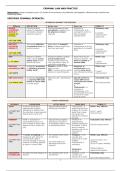
CRIMINAL LAW AND PRACTICE
Magistrates: power to sentence up to 12 months if two summary only offences tried together, otherwise top 6 months max.
sentencing power.
SPECIFIED CRIMINAL OFFENCES:
OFFENCES AGAINST THE PERSON
Offence DEFINITION Actus reus Mens rea PENALTY
SIMPLE Causing another Causing someone to fear Intention or Summary only
(COMMON) person to apprehend immediate unlawful force. recklessness as to
ASSAULT – immediate unlawful No physical contact causing the victim to
6 months'
Assault by personal violence. required. fear immediate
imprisonment
beating unlawful force.
and/or fine
s.39 CJA 1988
and common law
BATTERY The actual infliction Application of unlawful Intention or Summary only
(PHYSICAL of unlawful force on force, however slight (e.g., recklessness as to the
ASSAULT) another person. touching, pushing). application of unlawful
6 months'
force.
imprisonment
s.39 CJA 1988 and/or fine
and common law
ABH Assault or battery Assault or battery causing Same mens rea as Either way
which causes actual actual bodily harm – assault or battery – no
bodily harm (more includes minor fractures, need to intend or
s. 47 OAPA 5 years’
than trivial hurt). cuts, psychiatric injury (if foresee ABH.
imprisonment
medically recognised).
Malicious Unlawfully wounding Wound = break in both Intention or Either way
wounding or GBH or inflicting grievous layers of skin. recklessness as to
bodily harm. GBH = serious harm (can be causing some harm
5 years’
physical or psychological). (not necessarily serious
s.20 OAPA imprisonment
harm).
GBH with intent – Unlawfully wounding Same as s.20 – wounding or Specific intent to Indictable only
or causing GBH with GBH. cause GBH (or to
intent to cause GBH resist/prevent lawful
s.18 OAPA 1861 Life imprisonment
or resist arrest arrest).
or
‘Maliciously’ i.e.
intention or
recklessness as to
actual bodily harm plus
an intent to resist /
prevent arrest.
THEFT OFFENCES:
OFFENCE DEFINITION ACTUS REUS MENS REA PENALTY
THEFT A person dishonestly Appropriating property “Dishonestly” Either way offence
appropriates property belonging to another subjective test and
belonging to another with requires D’s honest
s.1 THEFT ACT Up to 7 years’
the intention of permanently belief that he was
1968 - imprisonment
depriving the other of it not owner and
taking item without
consent
ROBBERY Theft + using force + Appropriating property Intention of Indictable only offence
immediately before or at belonging to another + appropriating
time of theft to effect theft; immediately before using property belonging
s.8 THEFT ACT Max life imprisonment
degree of force matter for or threatening force to another. If force
1968
jury was for another
purpose, will not be
convicted of
robbery
BURGLARY To enter a building as a (1) Unlawful entry must Trespass = civil Either way offence
trespasser with intent to be effective concept and
commit theft, GBH or requires D to enter
s.9 THEFT ACT Up to 10 years: non –
criminal damage or having building
1968 (2) Some degree of dwelling
entered a building, attempt intentionally or
permanent structure Up to 14 years: dwelling
to steal or commit GBH recklessly
required
Related offence:
Subjective
aggravated burglary
standard
AGGRAVATE As above but with weapon or (1) Unlawful entry must Trespass = civil Indictable only
D BURGLARY firearm: be effective concept and
requires D to enter
Up to life imprisonment
1
, s.10 THEFT To enter a building as a (2) Some degree of building
ACT 1968 trespasser with intent to permanent structure intentionally or
commit theft, GBH or required recklessly
criminal damage or having
entered a building, attempt
(3) has weapon / Subjective standard
to steal or commit GBH +
firearm
has weapon / firearm
CRIMINAL DAMAGE
OFFENCE DEFINITION ACTUS REUS MENS REA PENALTY
SIMPLE CRIMINAL Where without lawful (1) Destroy or damage (1) Intentionally or Either way
DAMAGE excuse, destroy or property which must recklessly (subjective offence, but under
S.1(1) CDA 1971 damage property be tangible test) £5k damage will be
belonging to another, tried summarily. If
intentionally or damage by arson,
Damage does not D will have lawful
recklessly then either way
need to be permanent, excuse where:
offence.
but must be more than
merely trivial or
(a) Believed owner
nominal damage If tried on
would have
found where object indictment, max.
consented, enough
has value and sentence is 10
that belief was
usefulness impaired. years.
honestly held, will
be defence if
(2) belonging to honest mistake.
another
(b) If D acted to
protect property
AGGRAVATED Where destroy property Same as criminal (1) D intends by Indictable only
CRIMINAL DAMAGE with intent or reckless damage, BUT does not destruction or damage
as to whether life of matter who property to endanger life of
Maximum – life
someone else would be belongs to (point (2) another, or is reckless
s.1(2) CDA 1971 imprisonment
endangered above irrelevant)
(2) must be
Endangerment of connection between
life must result from destruction / damage
damage or to property and
destruction of intention
property, not
merely danger
Lawful excuse (as
itself.
above) has limited
application
Must have intention /
be reckless that by
destruction of
property, life would be
endangered. Ie. If
AWARE that would
cause destruction.
ARSON Destroying property by Triable either way
fire when committing
aggravated criminal
s.1(3) CDA 1971 Where aggravated
damage.
arson = indictable
Can be either simple
Maximum – life
criminal damage or
imprisonment.
aggravated criminal
damage
HOMICIDE
OFFENCE DEFINITION ACTUS REUS MENS REA PENALTY
MURDER The unlawful killing of a (1) Unlawful killing (1) Intention to kill Mandatory life
human being with (not in self-defence or imprisonment
malice afterthought lawful act). (Judge sets a
COMMON LAW OR
minimum tariff
(2) Victim must be a under the Criminal
2
, human being. (2) intention to Justice Act 2003).
cause grievous
(3) Death must be bodily harm (GBH)
caused by the
defendant’s act or
omission.
(4) Must occur
under the Queen’s
peace (not wartime
combat).
LOSS OF CONTROL: A killing that would be Mandatory life (1) Intent to kill or Discretionary life
murder but for a loss of imprisonment (Judge cause GBH (same as sentence or a lesser
control due to a sets a minimum tariff murder). term.
Voluntary
qualifying trigger. under the Criminal
Manslaughter
Justice Act 2003). (2) BUT must result
from a qualifying
trigger.
(3) A person of D’s sex
and age with normal
tolerance and self-
restraint would have
reacted similarly.
DIMINISHED A killing where D (1) Unlawful killing. (1) D must have an Discretionary life
RESPONSIBILITY: suffered an abnormality abnormality of sentence or a lesser
of mental functioning (2) D must suffer mental functioning term.
that substantially from an abnormality (e.g., schizophrenia,
Voluntary
impaired their of mental depression, PTSD).
Manslaughter
responsibility. functioning.
(2) This must
(3) Abnormality must substantially impair
arise from a D’s ability to form
recognised medical rational judgment
condition. or self-control.
(4) Abnormality must (3) It must provide
substantially impair an explanation for
D’s ability to the killing.
understand their
conduct, form
rational judgment,
or exercise self-
control.
UNLAWFUL ACT Where D causes death (1) D must commit an (1) Intention to Maximum life
MANSLAUGHTER: by an unlawful and unlawful act (not an commit the imprisonment
dangerous act. omission). unlawful act (but no (discretionary).
need to intend death
Involuntary
(2) Act must be or serious harm).
Manslaughter
objectively
dangerous. (2) Act must be
dangerous by
(3) Must cause objective standards.
death.
GROSS NEGLIGENCE Where D owes a duty of (1) D must owe a (1) D must be Maximum life
MANSLAUGHTER: care, breaches that duty duty of care grossly negligent as imprisonment
grossly, and causes to the risk of death (discretionary).
death. (2) Must breach that
Involuntary
duty in a grossly (2) Risk of death
Manslaughter
negligent way. must be
foreseeable.
(3) Breach must
cause death.
(4) Conduct must be
so gross as to be
criminal.
CORPORATE Where an organisation’s (1) Organisation must (1) Senior Unlimited fine for
MANSLAUGHTER gross negligence leads owe a duty of care to management’s failure corporations;
to death. the deceased. must amount to remedial orders may
gross negligence. be imposed.
(2) Must breach that
duty in a grossly (2) Failure must
negligent way. create a serious risk
of death.
(3) Breach must cause
death.
3
Magistrates: power to sentence up to 12 months if two summary only offences tried together, otherwise top 6 months max.
sentencing power.
SPECIFIED CRIMINAL OFFENCES:
OFFENCES AGAINST THE PERSON
Offence DEFINITION Actus reus Mens rea PENALTY
SIMPLE Causing another Causing someone to fear Intention or Summary only
(COMMON) person to apprehend immediate unlawful force. recklessness as to
ASSAULT – immediate unlawful No physical contact causing the victim to
6 months'
Assault by personal violence. required. fear immediate
imprisonment
beating unlawful force.
and/or fine
s.39 CJA 1988
and common law
BATTERY The actual infliction Application of unlawful Intention or Summary only
(PHYSICAL of unlawful force on force, however slight (e.g., recklessness as to the
ASSAULT) another person. touching, pushing). application of unlawful
6 months'
force.
imprisonment
s.39 CJA 1988 and/or fine
and common law
ABH Assault or battery Assault or battery causing Same mens rea as Either way
which causes actual actual bodily harm – assault or battery – no
bodily harm (more includes minor fractures, need to intend or
s. 47 OAPA 5 years’
than trivial hurt). cuts, psychiatric injury (if foresee ABH.
imprisonment
medically recognised).
Malicious Unlawfully wounding Wound = break in both Intention or Either way
wounding or GBH or inflicting grievous layers of skin. recklessness as to
bodily harm. GBH = serious harm (can be causing some harm
5 years’
physical or psychological). (not necessarily serious
s.20 OAPA imprisonment
harm).
GBH with intent – Unlawfully wounding Same as s.20 – wounding or Specific intent to Indictable only
or causing GBH with GBH. cause GBH (or to
intent to cause GBH resist/prevent lawful
s.18 OAPA 1861 Life imprisonment
or resist arrest arrest).
or
‘Maliciously’ i.e.
intention or
recklessness as to
actual bodily harm plus
an intent to resist /
prevent arrest.
THEFT OFFENCES:
OFFENCE DEFINITION ACTUS REUS MENS REA PENALTY
THEFT A person dishonestly Appropriating property “Dishonestly” Either way offence
appropriates property belonging to another subjective test and
belonging to another with requires D’s honest
s.1 THEFT ACT Up to 7 years’
the intention of permanently belief that he was
1968 - imprisonment
depriving the other of it not owner and
taking item without
consent
ROBBERY Theft + using force + Appropriating property Intention of Indictable only offence
immediately before or at belonging to another + appropriating
time of theft to effect theft; immediately before using property belonging
s.8 THEFT ACT Max life imprisonment
degree of force matter for or threatening force to another. If force
1968
jury was for another
purpose, will not be
convicted of
robbery
BURGLARY To enter a building as a (1) Unlawful entry must Trespass = civil Either way offence
trespasser with intent to be effective concept and
commit theft, GBH or requires D to enter
s.9 THEFT ACT Up to 10 years: non –
criminal damage or having building
1968 (2) Some degree of dwelling
entered a building, attempt intentionally or
permanent structure Up to 14 years: dwelling
to steal or commit GBH recklessly
required
Related offence:
Subjective
aggravated burglary
standard
AGGRAVATE As above but with weapon or (1) Unlawful entry must Trespass = civil Indictable only
D BURGLARY firearm: be effective concept and
requires D to enter
Up to life imprisonment
1
, s.10 THEFT To enter a building as a (2) Some degree of building
ACT 1968 trespasser with intent to permanent structure intentionally or
commit theft, GBH or required recklessly
criminal damage or having
entered a building, attempt
(3) has weapon / Subjective standard
to steal or commit GBH +
firearm
has weapon / firearm
CRIMINAL DAMAGE
OFFENCE DEFINITION ACTUS REUS MENS REA PENALTY
SIMPLE CRIMINAL Where without lawful (1) Destroy or damage (1) Intentionally or Either way
DAMAGE excuse, destroy or property which must recklessly (subjective offence, but under
S.1(1) CDA 1971 damage property be tangible test) £5k damage will be
belonging to another, tried summarily. If
intentionally or damage by arson,
Damage does not D will have lawful
recklessly then either way
need to be permanent, excuse where:
offence.
but must be more than
merely trivial or
(a) Believed owner
nominal damage If tried on
would have
found where object indictment, max.
consented, enough
has value and sentence is 10
that belief was
usefulness impaired. years.
honestly held, will
be defence if
(2) belonging to honest mistake.
another
(b) If D acted to
protect property
AGGRAVATED Where destroy property Same as criminal (1) D intends by Indictable only
CRIMINAL DAMAGE with intent or reckless damage, BUT does not destruction or damage
as to whether life of matter who property to endanger life of
Maximum – life
someone else would be belongs to (point (2) another, or is reckless
s.1(2) CDA 1971 imprisonment
endangered above irrelevant)
(2) must be
Endangerment of connection between
life must result from destruction / damage
damage or to property and
destruction of intention
property, not
merely danger
Lawful excuse (as
itself.
above) has limited
application
Must have intention /
be reckless that by
destruction of
property, life would be
endangered. Ie. If
AWARE that would
cause destruction.
ARSON Destroying property by Triable either way
fire when committing
aggravated criminal
s.1(3) CDA 1971 Where aggravated
damage.
arson = indictable
Can be either simple
Maximum – life
criminal damage or
imprisonment.
aggravated criminal
damage
HOMICIDE
OFFENCE DEFINITION ACTUS REUS MENS REA PENALTY
MURDER The unlawful killing of a (1) Unlawful killing (1) Intention to kill Mandatory life
human being with (not in self-defence or imprisonment
malice afterthought lawful act). (Judge sets a
COMMON LAW OR
minimum tariff
(2) Victim must be a under the Criminal
2
, human being. (2) intention to Justice Act 2003).
cause grievous
(3) Death must be bodily harm (GBH)
caused by the
defendant’s act or
omission.
(4) Must occur
under the Queen’s
peace (not wartime
combat).
LOSS OF CONTROL: A killing that would be Mandatory life (1) Intent to kill or Discretionary life
murder but for a loss of imprisonment (Judge cause GBH (same as sentence or a lesser
control due to a sets a minimum tariff murder). term.
Voluntary
qualifying trigger. under the Criminal
Manslaughter
Justice Act 2003). (2) BUT must result
from a qualifying
trigger.
(3) A person of D’s sex
and age with normal
tolerance and self-
restraint would have
reacted similarly.
DIMINISHED A killing where D (1) Unlawful killing. (1) D must have an Discretionary life
RESPONSIBILITY: suffered an abnormality abnormality of sentence or a lesser
of mental functioning (2) D must suffer mental functioning term.
that substantially from an abnormality (e.g., schizophrenia,
Voluntary
impaired their of mental depression, PTSD).
Manslaughter
responsibility. functioning.
(2) This must
(3) Abnormality must substantially impair
arise from a D’s ability to form
recognised medical rational judgment
condition. or self-control.
(4) Abnormality must (3) It must provide
substantially impair an explanation for
D’s ability to the killing.
understand their
conduct, form
rational judgment,
or exercise self-
control.
UNLAWFUL ACT Where D causes death (1) D must commit an (1) Intention to Maximum life
MANSLAUGHTER: by an unlawful and unlawful act (not an commit the imprisonment
dangerous act. omission). unlawful act (but no (discretionary).
need to intend death
Involuntary
(2) Act must be or serious harm).
Manslaughter
objectively
dangerous. (2) Act must be
dangerous by
(3) Must cause objective standards.
death.
GROSS NEGLIGENCE Where D owes a duty of (1) D must owe a (1) D must be Maximum life
MANSLAUGHTER: care, breaches that duty duty of care grossly negligent as imprisonment
grossly, and causes to the risk of death (discretionary).
death. (2) Must breach that
Involuntary
duty in a grossly (2) Risk of death
Manslaughter
negligent way. must be
foreseeable.
(3) Breach must
cause death.
(4) Conduct must be
so gross as to be
criminal.
CORPORATE Where an organisation’s (1) Organisation must (1) Senior Unlimited fine for
MANSLAUGHTER gross negligence leads owe a duty of care to management’s failure corporations;
to death. the deceased. must amount to remedial orders may
gross negligence. be imposed.
(2) Must breach that
duty in a grossly (2) Failure must
negligent way. create a serious risk
of death.
(3) Breach must cause
death.
3


