

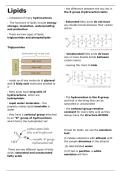
Lipids
– the difference between the two lies in
the R group (hydrocarbon tails)
: composed of many hydrocarbons
: The functions of lipids include energy : Saturated fatty acids do not have
storage, insulation, waterproofing any double bonds between their carbon
and protection atoms
: There are two types of lipids:
triglycerides and phospholipids
Triglycerides
: Unsaturated fatty acids do have
one or more double bonds between
carbon atoms
- causing the chain to kink
- made up of one molecule of glycerol
with 3 fatty acid molecules bonded to
it
: Fatty acids have long tails of
hydrocarbons, which are
hydrophobic : The hydrocarbon is the R-group
and that is the thing that can be
: repel water molecules – this saturated or unsaturated
property makes lipids insoluble in
water – the carboxyl group remains
constant for every fatty acid as they
: they have a carboxyl group attached always have the structure RCOOH
to an “R” group of hydrocarbons
which forms the hydrophobic tail
To test for lipids, we use the emulsion
test:
(1) Shake substance with ethanol until
the sample dissolves in the ethanol
(2) Add distilled water
There are two different types of fatty
(3) If test is positive, a white
acids: saturated and unsaturated
emulsion will form
fatty acids
– the difference between the two lies in
the R group (hydrocarbon tails)
: composed of many hydrocarbons
: The functions of lipids include energy : Saturated fatty acids do not have
storage, insulation, waterproofing any double bonds between their carbon
and protection atoms
: There are two types of lipids:
triglycerides and phospholipids
Triglycerides
: Unsaturated fatty acids do have
one or more double bonds between
carbon atoms
- causing the chain to kink
- made up of one molecule of glycerol
with 3 fatty acid molecules bonded to
it
: Fatty acids have long tails of
hydrocarbons, which are
hydrophobic : The hydrocarbon is the R-group
and that is the thing that can be
: repel water molecules – this saturated or unsaturated
property makes lipids insoluble in
water – the carboxyl group remains
constant for every fatty acid as they
: they have a carboxyl group attached always have the structure RCOOH
to an “R” group of hydrocarbons
which forms the hydrophobic tail
To test for lipids, we use the emulsion
test:
(1) Shake substance with ethanol until
the sample dissolves in the ethanol
(2) Add distilled water
There are two different types of fatty
(3) If test is positive, a white
acids: saturated and unsaturated
emulsion will form
fatty acids


