BLP WS7
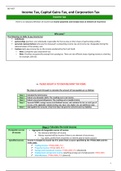
Income Tax, Capital Gains Tax, and Corporation Tax
Income tax
There is no statutory definition of income but income payments and receipts have an element of recurrence
Who pays?
The following are liable to pay income tax:
ü individuals;
ü partnerships (partners are individually responsible for the tax due on their share of partnership profits);
ü personal representatives (who pay the deceased’s outstanding income tax and income tax chargeable during the
administration of the estate); and
ü trustees (who pay income tax on the income produced by the trust fund).
´ Note: Companies pay corporation tax.
´ Note: Charities are generally exempt from paying tax. There are tax-efficient ways of giving money to charities,
for example, Gift Aid.
® PLEASE ADJUST % TO YOUR RELEVANT TAX YEARS.
The steps to work through to calculate the amount of tax payable are as follows:
Step 1 Calculate the total income
Step 2 Deduct any allowable reliefs: The resulting sum is net income
Step 3 Deduct any personal allowances: The resulting sum is taxable income
Step 4 Separate NSNDI, savings income and dividend income, and calculate the tax on each type of
income at the applicable rate(s) (starting rate, basic rate, higher rate and additional rate)
Step 5 Add together the amounts of tax from Step 4 (to give the overall income tax liability)
Step 1: Calculate the total income
Chargeable sources ® Aggregate all chargeable sources of income.
of income • No statutory definition of income.
• Money received will be income if there is an element of recurrence.
o E.g. salary, profits from a business or interest paid on bank account.
Specified sources Income is charged to income tax if it comes from a source specified by the ITTOIA 2005 and the
ITEPA 2003.
ü Trading income: ITTOIA 2005, Pt 2
ü Property income: ITTOIA 2005, Pt 3
ü Savings and investment income: ITTOIA 2005, Pt 4 (dividends)
ü Employment and pension income (anything arising out of employment): ITEPA 2003
ü Miscellaneous: ITTOIA 2005, Pt 5 (interest)
1
Income Tax, Capital Gains Tax, and Corporation Tax
Income tax
There is no statutory definition of income but income payments and receipts have an element of recurrence
Who pays?
The following are liable to pay income tax:
ü individuals;
ü partnerships (partners are individually responsible for the tax due on their share of partnership profits);
ü personal representatives (who pay the deceased’s outstanding income tax and income tax chargeable during the
administration of the estate); and
ü trustees (who pay income tax on the income produced by the trust fund).
´ Note: Companies pay corporation tax.
´ Note: Charities are generally exempt from paying tax. There are tax-efficient ways of giving money to charities,
for example, Gift Aid.
® PLEASE ADJUST % TO YOUR RELEVANT TAX YEARS.
The steps to work through to calculate the amount of tax payable are as follows:
Step 1 Calculate the total income
Step 2 Deduct any allowable reliefs: The resulting sum is net income
Step 3 Deduct any personal allowances: The resulting sum is taxable income
Step 4 Separate NSNDI, savings income and dividend income, and calculate the tax on each type of
income at the applicable rate(s) (starting rate, basic rate, higher rate and additional rate)
Step 5 Add together the amounts of tax from Step 4 (to give the overall income tax liability)
Step 1: Calculate the total income
Chargeable sources ® Aggregate all chargeable sources of income.
of income • No statutory definition of income.
• Money received will be income if there is an element of recurrence.
o E.g. salary, profits from a business or interest paid on bank account.
Specified sources Income is charged to income tax if it comes from a source specified by the ITTOIA 2005 and the
ITEPA 2003.
ü Trading income: ITTOIA 2005, Pt 2
ü Property income: ITTOIA 2005, Pt 3
ü Savings and investment income: ITTOIA 2005, Pt 4 (dividends)
ü Employment and pension income (anything arising out of employment): ITEPA 2003
ü Miscellaneous: ITTOIA 2005, Pt 5 (interest)
1