
Viruses
Viruses are organisms on the border between living and non-living.
They are not ‘real’ as they have no cytoplasm or cell organelles.
They cannot make their own protein therefore they are not true cells
To continue their life cycle they must inhibit another living organism – called their host. The virus will
effectively destroy its host to make new viruses
All viruses have a protein coat (capsid) that surrounds a nucleic acid. The nucleic acid varies depending on
the type of virus.
There are two types of viruses to know:
Bacteriophages
The human immunodeficiency virus (HIV)
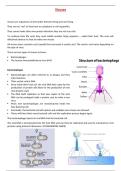
Bacteriophages
Bacteriophages are often referred to as phages and they
infect bacteria.
Their nucleic acid is DNA
Once inside their host cell, the viral DNA that codes for the
production of protein will allow for the production of new
viral protein coats
The DNA itself replicates so that new copies of the viral
DNA can be packaged inside a protein coat to make a new
virus
Many new bacteriophages are manufactured inside the
host bacterial cell
Eventually, the bacterial cell will rupture and multiple new viruses are released.
These will then infect more bacterial cells and the replication process begins again.
The bacteriophage injects its viral DNA into the bacterial cell.
The viral DNA is incorporated into the host DNA and can then be replicated and used to manufacture viral
proteins using bacterial ribosomes. (ICOSAHEDRON SHAPE)
Viruses are organisms on the border between living and non-living.
They are not ‘real’ as they have no cytoplasm or cell organelles.
They cannot make their own protein therefore they are not true cells
To continue their life cycle they must inhibit another living organism – called their host. The virus will
effectively destroy its host to make new viruses
All viruses have a protein coat (capsid) that surrounds a nucleic acid. The nucleic acid varies depending on
the type of virus.
There are two types of viruses to know:
Bacteriophages
The human immunodeficiency virus (HIV)
Bacteriophages
Bacteriophages are often referred to as phages and they
infect bacteria.
Their nucleic acid is DNA
Once inside their host cell, the viral DNA that codes for the
production of protein will allow for the production of new
viral protein coats
The DNA itself replicates so that new copies of the viral
DNA can be packaged inside a protein coat to make a new
virus
Many new bacteriophages are manufactured inside the
host bacterial cell
Eventually, the bacterial cell will rupture and multiple new viruses are released.
These will then infect more bacterial cells and the replication process begins again.
The bacteriophage injects its viral DNA into the bacterial cell.
The viral DNA is incorporated into the host DNA and can then be replicated and used to manufacture viral
proteins using bacterial ribosomes. (ICOSAHEDRON SHAPE)


