

Welch1
On this page, you find all documents, package deals, and flashcards offered by seller Welch1.
- 279
- 0
- 4
Community
- Followers
- Following
9 Reviews received
285 items
Pharmacotherapeutics for advanced nurse practitioner prescribers - Chapter 48 Summary and Notes
Overview Pharmacokinetics and pharmacodynamics in women Factors that influence medication administration Factors that influence positive outcomes Common problems Gay and lesbian health Women as Patients Prescribing during childbearing years Constant awareness of possible pregnancy Lactation requires careful prescribing. Women are at risk for violence. All women should be screened. Women live longer than men. Live alone Poverty Changes in cognitive and physical functioning...
- Book
- Summary
- • 18 pages •
Overview Pharmacokinetics and pharmacodynamics in women Factors that influence medication administration Factors that influence positive outcomes Common problems Gay and lesbian health Women as Patients Prescribing during childbearing years Constant awareness of possible pregnancy Lactation requires careful prescribing. Women are at risk for violence. All women should be screened. Women live longer than men. Live alone Poverty Changes in cognitive and physical functioning...
Anatomy and Physiology II 102: Chapter 2 question set, all problem sets, questions and answers
Question 1 The Brain 1. List the four parts of the human brain. The human brain is made up of the cerebral hemispheres, diencephalon, brain stem, and cerebellum. 2. Describe the number, location and function of the brain ventricles. There are four ventricles in the interior of the brain, chambers filled with cerebrospinal fluid which is produced there. 3. Label the ventricles. See figure in module. 4. Describe the brain meninges and the layers. The meninges are three layers of connecti...
- Exam (elaborations)
- • 14 pages •
Question 1 The Brain 1. List the four parts of the human brain. The human brain is made up of the cerebral hemispheres, diencephalon, brain stem, and cerebellum. 2. Describe the number, location and function of the brain ventricles. There are four ventricles in the interior of the brain, chambers filled with cerebrospinal fluid which is produced there. 3. Label the ventricles. See figure in module. 4. Describe the brain meninges and the layers. The meninges are three layers of connecti...
Anatomy & Physiology II 102: Module 1 Exam - all problem sets, questions and answers
Problem Set 1: 1. The function of the nervous system is to integrate and control the other body systems. Explain how the nervous system does this. The nervous system receives and processes information and sends out signals to the muscle and glands to elicit an appropriate response. In this way the nervous system integrates and controls the other systems of the human body 2. List the 2 parts of the central nervous system. brain and spinal cord 3. How are the parts of the central nervous syst...
- Exam (elaborations)
- • 14 pages •
Problem Set 1: 1. The function of the nervous system is to integrate and control the other body systems. Explain how the nervous system does this. The nervous system receives and processes information and sends out signals to the muscle and glands to elicit an appropriate response. In this way the nervous system integrates and controls the other systems of the human body 2. List the 2 parts of the central nervous system. brain and spinal cord 3. How are the parts of the central nervous syst...
Anatomy & Physiology II 102: Chapter 2 Question Set
Question 1 The Brain 1. List the four parts of the human brain. The human brain is made up of the cerebral hemispheres, diencephalon, brain stem, and cerebellum. 2. Describe the number, location and function of the brain ventricles. There are four ventricles in the interior of the brain, chambers filled with cerebrospinal fluid which is produced there. 3. Label the ventricles. See figure in module. 4. Describe the brain meninges and the layers. The meninges are three layers of connecti...
- Exam (elaborations)
- • 14 pages •
Question 1 The Brain 1. List the four parts of the human brain. The human brain is made up of the cerebral hemispheres, diencephalon, brain stem, and cerebellum. 2. Describe the number, location and function of the brain ventricles. There are four ventricles in the interior of the brain, chambers filled with cerebrospinal fluid which is produced there. 3. Label the ventricles. See figure in module. 4. Describe the brain meninges and the layers. The meninges are three layers of connecti...
Anatomy and Physiology II 102: Module 2 test
Question 1 This layer of the meninges is tightly attached to the brain. Pia mater (menix) Question 2 The _______ fissure separates the right and left cerebral hemispheres. Median longitudinal Question 3 What is the purpose of the blood-brain barrier? Describe its maintenance from a cellular level. The blood-brain barrier is a diffusion barrier which prevents most particles from entering the central nervous system tissue, keeping the brain and spinal cord separate from general blood...
- Exam (elaborations)
- • 12 pages •
Question 1 This layer of the meninges is tightly attached to the brain. Pia mater (menix) Question 2 The _______ fissure separates the right and left cerebral hemispheres. Median longitudinal Question 3 What is the purpose of the blood-brain barrier? Describe its maintenance from a cellular level. The blood-brain barrier is a diffusion barrier which prevents most particles from entering the central nervous system tissue, keeping the brain and spinal cord separate from general blood...
Anatomy and Physiology II 102: Neurology Review Questions (Intro to Nervous System)
Intro to Nervous System 1. The function of the nervous system is to integrate and control the other body systems. Explain how the nervous system does this. Nervous system processes information and sends out signals to the muscles and glands, which causes a response. 2. List the 2 parts of the central nervous system. Brain and the spinal cord 3. How are the parts of the central nervous system protected? Brain is protected by the skull, and the spinal cord is protected by the vertebrae...
- Exam (elaborations)
- • 32 pages •
Intro to Nervous System 1. The function of the nervous system is to integrate and control the other body systems. Explain how the nervous system does this. Nervous system processes information and sends out signals to the muscles and glands, which causes a response. 2. List the 2 parts of the central nervous system. Brain and the spinal cord 3. How are the parts of the central nervous system protected? Brain is protected by the skull, and the spinal cord is protected by the vertebrae...
Behavioral Exam 1 Study Guide: Chapter 1: Mental Health and Mental Disorders
Key Terms: Cultural syndrome – a cluster or group of co-occurring symptoms found in a specific cultural group, community, or context DSM-5 – abbreviation for the Diagnostic and Statistical Manual of Mental Disorders 5th edition; provides revised diagnostic criteria for mental disorders Epidemiology – the study of patterns of disease distribution and determinants of health within populations; contributes to the overall understanding of the mental health status of population groups or ag...
- Exam (elaborations)
- • 40 pages •
Key Terms: Cultural syndrome – a cluster or group of co-occurring symptoms found in a specific cultural group, community, or context DSM-5 – abbreviation for the Diagnostic and Statistical Manual of Mental Disorders 5th edition; provides revised diagnostic criteria for mental disorders Epidemiology – the study of patterns of disease distribution and determinants of health within populations; contributes to the overall understanding of the mental health status of population groups or ag...
Anatomy and Physiology II: Module 3 Reproductive System Exam
Problem Set 1: 1. What is the general term used to describe animal sex cells? What are the specific male and female sex cells called? sex cells are the gametes, males are (sperm) sprematocytes, females are (eggs) oocytes 2. How does it happen that an offspring has a different combination of genes than either parent? When a male and a female reproduce sexually, an offspring is form and inherits a set of genes from the mom and a set of genes from the dad. This results in a different combina...
- Exam (elaborations)
- • 36 pages •
Problem Set 1: 1. What is the general term used to describe animal sex cells? What are the specific male and female sex cells called? sex cells are the gametes, males are (sperm) sprematocytes, females are (eggs) oocytes 2. How does it happen that an offspring has a different combination of genes than either parent? When a male and a female reproduce sexually, an offspring is form and inherits a set of genes from the mom and a set of genes from the dad. This results in a different combina...
Anatpomy and Physiology 2 Pre Exam: All questions and Answers (Scored A)
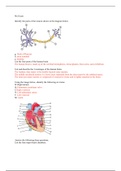
Pre Exam Identify the parts of the neuron shown in the diagram below g. Node of Ranvier h. axon terminal a. dendrite List the four parts of the human brain The human brain is made up of the cerebral hemispheres, diencephalon, brain stem, and cerebellum. List and describe the 3 meninges of the human brain. The leathery dura mater is the double-layered outer meninx. The middle arachnoid meninx is a loose layer separated from the dura mater by the subdural space. The inner pia mater menin...
- Exam (elaborations)
- • 21 pages •
Pre Exam Identify the parts of the neuron shown in the diagram below g. Node of Ranvier h. axon terminal a. dendrite List the four parts of the human brain The human brain is made up of the cerebral hemispheres, diencephalon, brain stem, and cerebellum. List and describe the 3 meninges of the human brain. The leathery dura mater is the double-layered outer meninx. The middle arachnoid meninx is a loose layer separated from the dura mater by the subdural space. The inner pia mater menin...
ATI RN Pharmacology (8.0) Test Bank, Latest 2020 complete solutions. Already rated grade A.
ATI RN Pharmacology (8.0) Test Bank, Latest 2020 complete solutions. Already rated grade A. 1. A provider prescribes phenobarbital for a client who has a seizure disorder. The medication has a long half-life of 4 days. How many times per day should the nurse expect to administer this medication? A. One B. Two C. Three D. Four 2. A nurse educator is reviewing medication metabolism at an in-service presentation. Which of the following factors should the educator include as a rea...
- Exam (elaborations)
- • 2 pages •
ATI RN Pharmacology (8.0) Test Bank, Latest 2020 complete solutions. Already rated grade A. 1. A provider prescribes phenobarbital for a client who has a seizure disorder. The medication has a long half-life of 4 days. How many times per day should the nurse expect to administer this medication? A. One B. Two C. Three D. Four 2. A nurse educator is reviewing medication metabolism at an in-service presentation. Which of the following factors should the educator include as a rea...
Factors that inhibit HRD managers from developing strategic planning approach to training
Oregon Construction Contractors CCB Test 2022 (verified answers)
Oregon Construction Contractors CCB Test 2022 (verified answers)
Oregon Construction Contractors CCB Test 2022 (verified answers)
TGMT4130 Final Exam (Questions & Answers) / Updated 2022