Multitasking and Multi-user Systems (Linux)
Introduction:
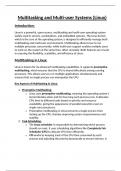
Linux is a powerful, open-source, multitasking and multi-user operating system
widely used in servers, workstations, and embedded systems. The Linux kernel,
which is the core of the operating system, is designed to efficiently manage both
multitasking and multi-user environments. Multitasking allows Linux to run
multiple processes concurrently, while multi-user support enables multiple users
to work on the system at the same time, often remotely. Both features are crucial
in ensuring the flexibility, scalability, and efficiency of Linux.
Multitasking in Linux:
Linux is known for its advanced multitasking capabilities. It supports preemptive
multitasking, which ensures that the CPU is shared effectively among running
processes. This allows users to run multiple applications simultaneously and
ensures that no single process can monopolize the CPU.
Key Aspects of Multitasking in Linux:
1. Preemptive Multitasking:
o Linux uses preemptive multitasking, meaning the operating system’s
kernel decides when and for how long each process runs. It allocates
CPU time to different tasks based on priority and resource
availability, giving the appearance of parallel execution even on
single-core processors.
o Preemptive multitasking in Linux prevents a single process from
locking up the CPU, thereby improving system responsiveness and
stability.
2. Task Scheduling:
o The Linux scheduler is responsible for determining which process
should run next. It uses scheduling algorithms like Completely Fair
Scheduler (CFS) to allocate CPU time efficiently.
o CFS works by keeping track of the CPU time consumed by each
process and adjusting the priority dynamically to ensure fairness. It
, also tries to minimize the latency for interactive applications like text
editors and web browsers.
o Linux supports real-time scheduling for high-priority tasks that need
precise timing, such as in industrial applications or robotics.
3. Process Management:
o In Linux, each running program is called a process. Processes are
managed by the kernel, which ensures that each has access to the
necessary resources, such as memory and CPU time.
o The Linux kernel uses Process Control Blocks (PCBs) to store
information about each process, including its state, memory
allocation, and CPU register values. Each process is assigned a unique
process ID (PID).
o The ps command can be used to list all running processes on the
system, while the kill command can be used to terminate
unresponsive processes.
4. Context Switching:
o Context switching in Linux involves saving the state of the current
process and loading the state of another process. This is an essential
feature of multitasking systems and ensures that the operating
system can switch between processes seamlessly.
o The Linux kernel performs context switching frequently, enabling
multiple processes to run on the same CPU without interfering with
each other.
5. Multithreading:
o Linux supports multithreading, allowing a single process to be
divided into multiple threads that can be executed concurrently.
Threads within a process share the same memory space but operate
independently.
o Multithreading is particularly useful for tasks like web servers or
database management systems, where multiple concurrent
operations (e.g., serving multiple users or processing transactions)
need to be performed.
o The Linux kernel ensures thread management through thread
libraries such as POSIX Threads (pthreads), which provide
synchronization mechanisms like mutexes and semaphores to
prevent conflicts between threads.
Introduction:
Linux is a powerful, open-source, multitasking and multi-user operating system
widely used in servers, workstations, and embedded systems. The Linux kernel,
which is the core of the operating system, is designed to efficiently manage both
multitasking and multi-user environments. Multitasking allows Linux to run
multiple processes concurrently, while multi-user support enables multiple users
to work on the system at the same time, often remotely. Both features are crucial
in ensuring the flexibility, scalability, and efficiency of Linux.
Multitasking in Linux:
Linux is known for its advanced multitasking capabilities. It supports preemptive
multitasking, which ensures that the CPU is shared effectively among running
processes. This allows users to run multiple applications simultaneously and
ensures that no single process can monopolize the CPU.
Key Aspects of Multitasking in Linux:
1. Preemptive Multitasking:
o Linux uses preemptive multitasking, meaning the operating system’s
kernel decides when and for how long each process runs. It allocates
CPU time to different tasks based on priority and resource
availability, giving the appearance of parallel execution even on
single-core processors.
o Preemptive multitasking in Linux prevents a single process from
locking up the CPU, thereby improving system responsiveness and
stability.
2. Task Scheduling:
o The Linux scheduler is responsible for determining which process
should run next. It uses scheduling algorithms like Completely Fair
Scheduler (CFS) to allocate CPU time efficiently.
o CFS works by keeping track of the CPU time consumed by each
process and adjusting the priority dynamically to ensure fairness. It
, also tries to minimize the latency for interactive applications like text
editors and web browsers.
o Linux supports real-time scheduling for high-priority tasks that need
precise timing, such as in industrial applications or robotics.
3. Process Management:
o In Linux, each running program is called a process. Processes are
managed by the kernel, which ensures that each has access to the
necessary resources, such as memory and CPU time.
o The Linux kernel uses Process Control Blocks (PCBs) to store
information about each process, including its state, memory
allocation, and CPU register values. Each process is assigned a unique
process ID (PID).
o The ps command can be used to list all running processes on the
system, while the kill command can be used to terminate
unresponsive processes.
4. Context Switching:
o Context switching in Linux involves saving the state of the current
process and loading the state of another process. This is an essential
feature of multitasking systems and ensures that the operating
system can switch between processes seamlessly.
o The Linux kernel performs context switching frequently, enabling
multiple processes to run on the same CPU without interfering with
each other.
5. Multithreading:
o Linux supports multithreading, allowing a single process to be
divided into multiple threads that can be executed concurrently.
Threads within a process share the same memory space but operate
independently.
o Multithreading is particularly useful for tasks like web servers or
database management systems, where multiple concurrent
operations (e.g., serving multiple users or processing transactions)
need to be performed.
o The Linux kernel ensures thread management through thread
libraries such as POSIX Threads (pthreads), which provide
synchronization mechanisms like mutexes and semaphores to
prevent conflicts between threads.