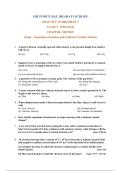
Barron's CCRN Review Test Prep.
Barron's CCRN Review Test Prep. Describe normal heart sounds. - S1 - Lub - Caused by closure of AV valves - Loudest at apex of the heart (midclavicular, 5th intercostal space) - Marks end of diastole, beginning of systole S2 - Dub - Caused by closure of semilunar (aortic, pulmonic) valves - Loudest at the base (right sternal border, 2nd intercostal space) - Marks end of systole, beginning of diastole - Louder with pulmonary embolism Describe the heart auscultatory points on the chest wall and associated valves. - The base of the heart is the aortic area, where S2 is loudest. It is as the 2nd intercostal space, right sternal border. The apex of the heart is the mitral area, where S1 is loudest. Anatomically, it is at the 5th ICS, midclavicular. What are abnormal heart sounds in adults? - S3 S4 pericardial friction rub murmur Describe the S3 heart sound. - - caused by a rapid rush of blood into a dilated ventricle occurs early in diastole, right after S3 - heard best at the apex with the bell of the stethoscope - associated with heart failure; may occur before crackles - ventricular gallop, "Kentucky" Caused by: pulmonary hypertension and cor pulmonale mitral, aortic, or tricuspid insufficiency Describe the S4 heart sound. - - caused by atrial contraction of blood into a noncompliant ventricle - occurs right before S1 - best heart at the apex with the bell of the stethoscope - associated with MI, infarction, HTN, ventricular hypertrophy, and aortic stenosis - atrial gallop, "Tennessee" In atrial fibrillation, what heart sounds cannot be heard? Why? - S4 There is no atrial contraction. What is the formula for pulse pressure? What is a normal value
Escuela, estudio y materia
- Institución
- Barron\'s CCRN
- Grado
- Barron\'s CCRN
Información del documento
- Subido en
- 27 de septiembre de 2023
- Número de páginas
- 72
- Escrito en
- 2023/2024
- Tipo
- Examen
- Contiene
- Preguntas y respuestas
Temas