
Hazards
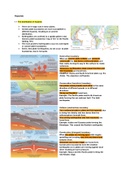
1.1 The distribution of hazards
● There are 8 major and 8 minor plates.
● Certain plate boundaries are more susceptible to
different hazards, resulting in an uneven
distribution.
● Earthquakes are confined to a spatial pattern near
tectonic plate boundaries (‘ring of fire’ in the Pacific
holding 70%)
● The most powerful earthquakes occur at convergent
or conservative boundaries.
● Some, intra-plate earthquakes, do not occur at plate
boundaries, due to hot spots.
Destructive boundary:
When an oceanic plate collides and subducts
underneath the less dense continental plate and
then melts, forcing its way to the surface to create
volcanoes.
Volcanoes, earthquakes, deep ocean trenches and
fold mountains are found here.
EXAMPLE: Nazca and South American plate e.g. the
Andes. The Japanese earthquake.
Conservative (transform) boundary:
Two plates moving beside each other in the same
direction at different speeds or in different
directions.
Strong earthquakes found here.
Example: The Pacific plate and North American
plate forming the san andreas fault. The Haiti
earthquake.
Collision (destructive) boundary:
Two continental plates collide and fold upwards due
to being low density and less dense than the
asthenosphere beneath them.
Very strong earthquakes and fold mountains are
found here.
Example: Indian and Eurasian plate forming the
Himalayas. This caused the Kashmir earthquake.
Constructive (divergent) boundary:
When two plates are moving apart with magma
upwelling and creating new, thin and dense land
between them.
Volcanoes and ocean ridges are found here.
Constructive boundaries have the smallest
earthquake as no plates are moving against each
other resulting in lower pressure.
Example: Nazca and the Pacific plate forming the
mid Atlantic ridge.
,Hotspots form volcanoes away from
margins due to weak crust and a
hot thermal plume of magma
pushing up against the weak
lithosphere crust that thus melts
creating volcanoes. As the tectonic
plate moves over the hotspot more
volcanoes form, leaving old oceanic
volcanoes to cool and subside
forming older islands. E.g. Hawaii
islands in the Pacific plate.
1.2a The theory of plate tectonics
1. The earth's structure
Magma is a liquid form of rock, composed of multipleminerals also containing gas
Lava is erupted magma which has de-gassed
Mineral is any element or compound which occurs naturally within the Earth’s crust or mantle
Rock is solid magma or lava, composed usually of multipleminerals
The earth's structure
The chemical layering:
Crust:
● Is the very thin outer solid rock layer (5-75 km
thick), which is the coolest layer.
● It has two different types of crustof differing
densities (continental 35% and oceanic 65%).
The continental crust (landmasses) is much
thicker and less dense than the oceanic (the
ocean floor).
● The majority of the continental crust isigneous
rock (volcanic) the base, built on by
sedimentary/metamorphic rocks. The oceanic
crust is basalt.
● Only the newer oceanic crust can be renewed
and destroyed.
Example: A continental plate is the Eurasian and an oceanic is the Pacific.
Mantle:
● This consists of silicon and oxygen and is less dense than the core.
● It is the thickest layer (⅔ of the earth's mass).
● The top layer of the mantle is brittleand sticks to the bottom of the crust(creating the
lithosphere).
● The section below this is warmer and therefore more malleable and is where the majority of
the convection currents that drive plate movement occur (the Asthenosphere)
The core:
● The outer core, consisting of iron, is less dense and a bit cooler (4000 degrees) than the inner
core and liquid. It is where we get our magnetic field as the convection molten currents
circulate around the solid core).
● The inner core, consisting of nickel, is 4700 degrees, it is under the immense pressure of the
earth resulting it to be solid.
, The mechanical layering:
Lithosphere (the crust and upper mantle, the world's plates):
● The earth’s crust is firmly joined to the mantle that lies immediately beneath it. In many places
the top 100km of mantle is just as strong and rigid as the crust (this layer is the lisothere).
● It is strong and rigid throughout, 20-50km thick in the oceans and 150km thick under the
continents.
● Each tectonic plate is a lithospheric slab which moves as the mantle beneath it is weaker.
Asthenosphere (the mobile part of the mantle):
● The asthenosphere starts at 7-50km until 250-400km depth.
● The base is the point at which certain minerals have cooled sufficiently to crystallise.
● The upper limit is the point at which all minerals have crystallised.
● Some minerals are solid and some liquid. They behave with high plasticity and therefore differ
from the lithosphere (brittle) and the upper mantle (molten, fluid).
● The upper part of the convection cell exists in theasthenosphere explaining why crustal
plates ‘stick’ to the convection currents below.
● There is an emerging theory that the crust is part of the convection cell and that the
subducting plate pulls down with the convection (slab pull).
Mesosphere (deep mantle):
● This moves less than the asthenosphere due to composition, but circulates a few cm a year.
● It is not a liquid, but conducts heat through this process. Hot mantle rises upwards and
transfers heat to the base of the lithosphere. Mantle that has lost heat becomes slightly
denser and slowly sinks downwards again.
2. Continental drift theory
Wegners theory is that all continents were a single supercontinent called pangea. These
continents then broke away from each other and drifted apart.
The evidence:
● Similar rock formations are found oceans apart from each other in areas that
would match up if the continents were joined.
● Glaciers found at the bottom of countries in the South,would have had to
originate from land mass not oceans. Thus, showing they were originally joined
up to the arctic.
● Fossils of the same plants have been found on almostall continents, suggesting
that they all once had similar climates, as well as reptile fossils being found
across different continents. These reptiles could not swim suggesting that these
continents were joined up allowing travel between them.
3. Convection currents and slab pull theory
● Convection currents are a circular pattern that forms when matter close to
the core heats and then cools, changing the material’s density resulting in
it sinking.
● It is a solid ductile rock (magma that moves to carry this heat in the
asthenosphere, it is not molten).
● This is the force responsible for moving Earth’s tectonic plates.
Further theories:
Ridge Push: Newly-formed plates at oceanic ridges are warm, and so have a
higher elevation at the oceanic ridge than the colder, more dense plate
material further away. Then gravity causes the higher plate at the ridge to
push away the lithosphere that lies further from the ridge.
1.1 The distribution of hazards
● There are 8 major and 8 minor plates.
● Certain plate boundaries are more susceptible to
different hazards, resulting in an uneven
distribution.
● Earthquakes are confined to a spatial pattern near
tectonic plate boundaries (‘ring of fire’ in the Pacific
holding 70%)
● The most powerful earthquakes occur at convergent
or conservative boundaries.
● Some, intra-plate earthquakes, do not occur at plate
boundaries, due to hot spots.
Destructive boundary:
When an oceanic plate collides and subducts
underneath the less dense continental plate and
then melts, forcing its way to the surface to create
volcanoes.
Volcanoes, earthquakes, deep ocean trenches and
fold mountains are found here.
EXAMPLE: Nazca and South American plate e.g. the
Andes. The Japanese earthquake.
Conservative (transform) boundary:
Two plates moving beside each other in the same
direction at different speeds or in different
directions.
Strong earthquakes found here.
Example: The Pacific plate and North American
plate forming the san andreas fault. The Haiti
earthquake.
Collision (destructive) boundary:
Two continental plates collide and fold upwards due
to being low density and less dense than the
asthenosphere beneath them.
Very strong earthquakes and fold mountains are
found here.
Example: Indian and Eurasian plate forming the
Himalayas. This caused the Kashmir earthquake.
Constructive (divergent) boundary:
When two plates are moving apart with magma
upwelling and creating new, thin and dense land
between them.
Volcanoes and ocean ridges are found here.
Constructive boundaries have the smallest
earthquake as no plates are moving against each
other resulting in lower pressure.
Example: Nazca and the Pacific plate forming the
mid Atlantic ridge.
,Hotspots form volcanoes away from
margins due to weak crust and a
hot thermal plume of magma
pushing up against the weak
lithosphere crust that thus melts
creating volcanoes. As the tectonic
plate moves over the hotspot more
volcanoes form, leaving old oceanic
volcanoes to cool and subside
forming older islands. E.g. Hawaii
islands in the Pacific plate.
1.2a The theory of plate tectonics
1. The earth's structure
Magma is a liquid form of rock, composed of multipleminerals also containing gas
Lava is erupted magma which has de-gassed
Mineral is any element or compound which occurs naturally within the Earth’s crust or mantle
Rock is solid magma or lava, composed usually of multipleminerals
The earth's structure
The chemical layering:
Crust:
● Is the very thin outer solid rock layer (5-75 km
thick), which is the coolest layer.
● It has two different types of crustof differing
densities (continental 35% and oceanic 65%).
The continental crust (landmasses) is much
thicker and less dense than the oceanic (the
ocean floor).
● The majority of the continental crust isigneous
rock (volcanic) the base, built on by
sedimentary/metamorphic rocks. The oceanic
crust is basalt.
● Only the newer oceanic crust can be renewed
and destroyed.
Example: A continental plate is the Eurasian and an oceanic is the Pacific.
Mantle:
● This consists of silicon and oxygen and is less dense than the core.
● It is the thickest layer (⅔ of the earth's mass).
● The top layer of the mantle is brittleand sticks to the bottom of the crust(creating the
lithosphere).
● The section below this is warmer and therefore more malleable and is where the majority of
the convection currents that drive plate movement occur (the Asthenosphere)
The core:
● The outer core, consisting of iron, is less dense and a bit cooler (4000 degrees) than the inner
core and liquid. It is where we get our magnetic field as the convection molten currents
circulate around the solid core).
● The inner core, consisting of nickel, is 4700 degrees, it is under the immense pressure of the
earth resulting it to be solid.
, The mechanical layering:
Lithosphere (the crust and upper mantle, the world's plates):
● The earth’s crust is firmly joined to the mantle that lies immediately beneath it. In many places
the top 100km of mantle is just as strong and rigid as the crust (this layer is the lisothere).
● It is strong and rigid throughout, 20-50km thick in the oceans and 150km thick under the
continents.
● Each tectonic plate is a lithospheric slab which moves as the mantle beneath it is weaker.
Asthenosphere (the mobile part of the mantle):
● The asthenosphere starts at 7-50km until 250-400km depth.
● The base is the point at which certain minerals have cooled sufficiently to crystallise.
● The upper limit is the point at which all minerals have crystallised.
● Some minerals are solid and some liquid. They behave with high plasticity and therefore differ
from the lithosphere (brittle) and the upper mantle (molten, fluid).
● The upper part of the convection cell exists in theasthenosphere explaining why crustal
plates ‘stick’ to the convection currents below.
● There is an emerging theory that the crust is part of the convection cell and that the
subducting plate pulls down with the convection (slab pull).
Mesosphere (deep mantle):
● This moves less than the asthenosphere due to composition, but circulates a few cm a year.
● It is not a liquid, but conducts heat through this process. Hot mantle rises upwards and
transfers heat to the base of the lithosphere. Mantle that has lost heat becomes slightly
denser and slowly sinks downwards again.
2. Continental drift theory
Wegners theory is that all continents were a single supercontinent called pangea. These
continents then broke away from each other and drifted apart.
The evidence:
● Similar rock formations are found oceans apart from each other in areas that
would match up if the continents were joined.
● Glaciers found at the bottom of countries in the South,would have had to
originate from land mass not oceans. Thus, showing they were originally joined
up to the arctic.
● Fossils of the same plants have been found on almostall continents, suggesting
that they all once had similar climates, as well as reptile fossils being found
across different continents. These reptiles could not swim suggesting that these
continents were joined up allowing travel between them.
3. Convection currents and slab pull theory
● Convection currents are a circular pattern that forms when matter close to
the core heats and then cools, changing the material’s density resulting in
it sinking.
● It is a solid ductile rock (magma that moves to carry this heat in the
asthenosphere, it is not molten).
● This is the force responsible for moving Earth’s tectonic plates.
Further theories:
Ridge Push: Newly-formed plates at oceanic ridges are warm, and so have a
higher elevation at the oceanic ridge than the colder, more dense plate
material further away. Then gravity causes the higher plate at the ridge to
push away the lithosphere that lies further from the ridge.


