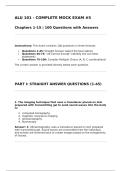
ALU 101 - COMPLETE MOCK EXAM #3
Chapters 1-15 | 100 Questions with Answers
Instructions: This exam contains 100 questions in three formats:
Questions 1-45: Straight Answer (select the best option)
Questions 46-75: "All-Correct-Except" (identify the one false
statement)
Questions 76-100: Complex Multiple Choice (A, B, C combinations)
The correct answer is provided directly below each question.
PART I: STRAIGHT ANSWER QUESTIONS (1-45)
1. The imaging modality that uses a rotating beam of x-rays to
produce cross-sectional, two-dimensional images is:
1. magnetic resonance imaging
2. computed tomography
3. fluoroscopy
4. ultrasonography
Answer: 2. Computed tomography (CT) scans are created by passing a
rotating beam of x-rays into the individual and obtaining thousands of
point images at specific depths, producing cross-sectional, two-
dimensional images.
2. The endoscopic procedure that allows visualization of the
esophagus, stomach, and duodenum is:
, 1. colonoscopy
2. bronchoscopy
3. esophagogastroduodenoscopy (EGD)
4. cystoscopy
Answer: 3. Gastroscopy and esophagogastroduodenoscopy (EGD) permit
visualization of the esophagus, stomach, and duodenum to look for
inflammation, erosions, tumors, polyps, or ulcerations.
3. The test that measures the velocity and direction of blood flow
within the heart and blood vessels by measuring changes in
sound-wave frequency is:
1. duplex scan
2. Doppler ultrasonography
3. M-mode echocardiography
4. real-time ultrasound
Answer: 2. Doppler ultrasonography is used to measure the velocity and
direction of blood flow within the heart and blood vessels by measuring
changes in pitch (sound-wave frequency).
4. The term for the rupture of red blood cells that releases
hemoglobin into collected serum is:
1. lipemia
2. glycolysis
3. hemolysis
4. turbidity
Answer: 3. Hemolysis is the rupture of red blood cells, which releases
hemoglobin and other cell contents into the collected serum. It is typically
caused by delays in handling blood samples.
5. The condition in which the body's cells are not able to
effectively use insulin is called:
1. insulin deficiency
, 2. insulin resistance
3. beta cell dysfunction
4. hyperinsulinemia
Answer: 2. In type 2 diabetes, the pancreas usually still produces some
insulin, but the body's cells are not able to effectively use the insulin, a
condition known as insulin resistance.
6. The difference between systolic and diastolic blood pressure is
called:
1. mean arterial pressure
2. pulse pressure
3. central venous pressure
4. wedge pressure
Answer: 2. Pulse pressure (PP) is the difference between the systolic and
diastolic blood pressure. Increased pulse pressure (>40 mmHg) can add
prognostic information for cardiovascular risk.
7. The term for the extent to which cancer cells differ from normal
cells is:
1. staging
2. grading
3. differentiation
4. metastasis
Answer: 3. Differentiation is the extent to which cancer cells differ from
normal cells; the more poorly differentiated the cancer cells are from
normal cells, the more aggressive the cancer is, with a less favorable
prognosis.
8. The presence of red and white blood cell casts in the urine
indicates:
1. urinary tract infection
2. kidney tubule pathology
, 3. bladder cancer
4. dehydration
Answer: 2. Red and white cell casts occur when large numbers of these
cells are present in the tubules of the kidneys, become packed tightly
together into a mass, and then pass into the urine, indicating kidney
tubule pathology.
9. The federal agency responsible for determining the cause of an
aircraft accident in the United States is the:
1. FAA
2. NTSB
3. DOT
4. NASA
Answer: 2. The National Transportation Safety Board (NTSB) is
responsible for determining the cause of an accident and for providing
safety recommendations to the FAA or other entities.
10. The type of error that occurs when a laboratory test result
fails to detect the proposed insured's true condition of disease is
called a:
1. false positive
2. true positive
3. false negative
4. true negative
Answer: 3. A false negative occurs when a test result fails to detect the
proposed insured's true condition of disease or abnormal health.
11. The cardiac test that measures the pumping ability of the
heart by calculating the percentage of blood delivered with each
heartbeat is the:
1. stress test
2. ejection fraction
Chapters 1-15 | 100 Questions with Answers
Instructions: This exam contains 100 questions in three formats:
Questions 1-45: Straight Answer (select the best option)
Questions 46-75: "All-Correct-Except" (identify the one false
statement)
Questions 76-100: Complex Multiple Choice (A, B, C combinations)
The correct answer is provided directly below each question.
PART I: STRAIGHT ANSWER QUESTIONS (1-45)
1. The imaging modality that uses a rotating beam of x-rays to
produce cross-sectional, two-dimensional images is:
1. magnetic resonance imaging
2. computed tomography
3. fluoroscopy
4. ultrasonography
Answer: 2. Computed tomography (CT) scans are created by passing a
rotating beam of x-rays into the individual and obtaining thousands of
point images at specific depths, producing cross-sectional, two-
dimensional images.
2. The endoscopic procedure that allows visualization of the
esophagus, stomach, and duodenum is:
, 1. colonoscopy
2. bronchoscopy
3. esophagogastroduodenoscopy (EGD)
4. cystoscopy
Answer: 3. Gastroscopy and esophagogastroduodenoscopy (EGD) permit
visualization of the esophagus, stomach, and duodenum to look for
inflammation, erosions, tumors, polyps, or ulcerations.
3. The test that measures the velocity and direction of blood flow
within the heart and blood vessels by measuring changes in
sound-wave frequency is:
1. duplex scan
2. Doppler ultrasonography
3. M-mode echocardiography
4. real-time ultrasound
Answer: 2. Doppler ultrasonography is used to measure the velocity and
direction of blood flow within the heart and blood vessels by measuring
changes in pitch (sound-wave frequency).
4. The term for the rupture of red blood cells that releases
hemoglobin into collected serum is:
1. lipemia
2. glycolysis
3. hemolysis
4. turbidity
Answer: 3. Hemolysis is the rupture of red blood cells, which releases
hemoglobin and other cell contents into the collected serum. It is typically
caused by delays in handling blood samples.
5. The condition in which the body's cells are not able to
effectively use insulin is called:
1. insulin deficiency
, 2. insulin resistance
3. beta cell dysfunction
4. hyperinsulinemia
Answer: 2. In type 2 diabetes, the pancreas usually still produces some
insulin, but the body's cells are not able to effectively use the insulin, a
condition known as insulin resistance.
6. The difference between systolic and diastolic blood pressure is
called:
1. mean arterial pressure
2. pulse pressure
3. central venous pressure
4. wedge pressure
Answer: 2. Pulse pressure (PP) is the difference between the systolic and
diastolic blood pressure. Increased pulse pressure (>40 mmHg) can add
prognostic information for cardiovascular risk.
7. The term for the extent to which cancer cells differ from normal
cells is:
1. staging
2. grading
3. differentiation
4. metastasis
Answer: 3. Differentiation is the extent to which cancer cells differ from
normal cells; the more poorly differentiated the cancer cells are from
normal cells, the more aggressive the cancer is, with a less favorable
prognosis.
8. The presence of red and white blood cell casts in the urine
indicates:
1. urinary tract infection
2. kidney tubule pathology
, 3. bladder cancer
4. dehydration
Answer: 2. Red and white cell casts occur when large numbers of these
cells are present in the tubules of the kidneys, become packed tightly
together into a mass, and then pass into the urine, indicating kidney
tubule pathology.
9. The federal agency responsible for determining the cause of an
aircraft accident in the United States is the:
1. FAA
2. NTSB
3. DOT
4. NASA
Answer: 2. The National Transportation Safety Board (NTSB) is
responsible for determining the cause of an accident and for providing
safety recommendations to the FAA or other entities.
10. The type of error that occurs when a laboratory test result
fails to detect the proposed insured's true condition of disease is
called a:
1. false positive
2. true positive
3. false negative
4. true negative
Answer: 3. A false negative occurs when a test result fails to detect the
proposed insured's true condition of disease or abnormal health.
11. The cardiac test that measures the pumping ability of the
heart by calculating the percentage of blood delivered with each
heartbeat is the:
1. stress test
2. ejection fraction