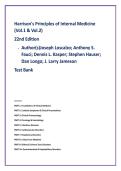
Harrison's Principles of Internal Medicine
(Vol.1 & Vol.2)
22nd Edition
• Author(s)Joseph Loscalzo; Anthony S.
Fauci; Dennis L. Kasper; Stephen Hauser;
Dan Longo; J. Larry Jameson
Test Bank
Covered
PART 1: Foundations of Clinical Medicine
PART 2: Cardinal Symptoms & Clinical Presentations
PART 3: Clinical Pharmacology
PART 4: Oncology & Hematology
PART 5: Infectious Diseases
PART 6: Cardiovascular Disorders
PART 7: Respiratory Disorders
PART 8: Critical Care Medicine
PART 9: Kidney & Urinary Tract Disorders
PART 10: Gastrointestinal & Hepatobiliary Disorders
,PART 11: Immune-Mediated & Rheumatologic Disorders
PART 12: Endocrinology & Metabolism
PART 13: Neurologic & Psychiatric Disorders
PART 14: Toxicology & Environmental Injury
PART 15: Environmental & Occupational Medicine
PART 16: Genetics, Precision & Systems Medicine
PART 17–20: Special & Emerging Topics
Nursing Examination MCQs
Harrison’s Principles of Internal Medicine, 22nd ed.
Chapters 1–13
1.
Which principle best defines the modern practice of medicine
as described in Harrison’s?
A. Disease-centered treatment based solely on pathology
B. Patient-centered care integrating science, compassion, and
ethics
C. Algorithm-driven decision-making without clinician judgment
D. Exclusive reliance on population-based guidelines
Correct Answer: B
Rationale: Harrison’s emphasizes that modern medical practice
integrates scientific evidence, ethical reasoning, and
,compassionate, patient-centered care rather than focusing
solely on disease pathology.
Citation: Harrison’s Principles of Internal Medicine, 22nd ed.,
Chapter 1: The Practice of Medicine
2.
Which nursing action best aligns with health promotion
principles?
A. Treating illness after symptoms develop
B. Educating patients on lifestyle modification to reduce disease
risk
C. Focusing exclusively on pharmacologic therapy
D. Deferring prevention counseling until discharge
Correct Answer: B
Rationale: Health promotion prioritizes preventive education
and lifestyle interventions to reduce disease burden before
illness occurs.
Citation: Harrison’s Principles of Internal Medicine, 22nd ed.,
Chapter 2: Promoting Good Health
3.
, A patient expresses concern that vaccines are unsafe due to
misinformation. What is the most appropriate nursing
response?
A. Dismiss the concern as unfounded
B. Provide evidence-based education addressing safety and
efficacy
C. Advise avoiding vaccination entirely
D. Refer the patient to social media resources
Correct Answer: B
Rationale: Harrison’s highlights respectful, evidence-based
communication as essential in addressing vaccine hesitancy.
Citation: Harrison’s Principles of Internal Medicine, 22nd ed.,
Chapter 3: Vaccine Opposition and Hesitancy
4.
Clinical decision-making is optimized when nurses and
clinicians:
A. Follow protocols without deviation
B. Rely solely on diagnostic testing
C. Integrate clinical judgment with patient values and evidence
D. Prioritize cost over patient outcomes
Correct Answer: C
Rationale: Effective clinical decisions incorporate evidence-
based medicine, clinician expertise, and patient preferences.
(Vol.1 & Vol.2)
22nd Edition
• Author(s)Joseph Loscalzo; Anthony S.
Fauci; Dennis L. Kasper; Stephen Hauser;
Dan Longo; J. Larry Jameson
Test Bank
Covered
PART 1: Foundations of Clinical Medicine
PART 2: Cardinal Symptoms & Clinical Presentations
PART 3: Clinical Pharmacology
PART 4: Oncology & Hematology
PART 5: Infectious Diseases
PART 6: Cardiovascular Disorders
PART 7: Respiratory Disorders
PART 8: Critical Care Medicine
PART 9: Kidney & Urinary Tract Disorders
PART 10: Gastrointestinal & Hepatobiliary Disorders
,PART 11: Immune-Mediated & Rheumatologic Disorders
PART 12: Endocrinology & Metabolism
PART 13: Neurologic & Psychiatric Disorders
PART 14: Toxicology & Environmental Injury
PART 15: Environmental & Occupational Medicine
PART 16: Genetics, Precision & Systems Medicine
PART 17–20: Special & Emerging Topics
Nursing Examination MCQs
Harrison’s Principles of Internal Medicine, 22nd ed.
Chapters 1–13
1.
Which principle best defines the modern practice of medicine
as described in Harrison’s?
A. Disease-centered treatment based solely on pathology
B. Patient-centered care integrating science, compassion, and
ethics
C. Algorithm-driven decision-making without clinician judgment
D. Exclusive reliance on population-based guidelines
Correct Answer: B
Rationale: Harrison’s emphasizes that modern medical practice
integrates scientific evidence, ethical reasoning, and
,compassionate, patient-centered care rather than focusing
solely on disease pathology.
Citation: Harrison’s Principles of Internal Medicine, 22nd ed.,
Chapter 1: The Practice of Medicine
2.
Which nursing action best aligns with health promotion
principles?
A. Treating illness after symptoms develop
B. Educating patients on lifestyle modification to reduce disease
risk
C. Focusing exclusively on pharmacologic therapy
D. Deferring prevention counseling until discharge
Correct Answer: B
Rationale: Health promotion prioritizes preventive education
and lifestyle interventions to reduce disease burden before
illness occurs.
Citation: Harrison’s Principles of Internal Medicine, 22nd ed.,
Chapter 2: Promoting Good Health
3.
, A patient expresses concern that vaccines are unsafe due to
misinformation. What is the most appropriate nursing
response?
A. Dismiss the concern as unfounded
B. Provide evidence-based education addressing safety and
efficacy
C. Advise avoiding vaccination entirely
D. Refer the patient to social media resources
Correct Answer: B
Rationale: Harrison’s highlights respectful, evidence-based
communication as essential in addressing vaccine hesitancy.
Citation: Harrison’s Principles of Internal Medicine, 22nd ed.,
Chapter 3: Vaccine Opposition and Hesitancy
4.
Clinical decision-making is optimized when nurses and
clinicians:
A. Follow protocols without deviation
B. Rely solely on diagnostic testing
C. Integrate clinical judgment with patient values and evidence
D. Prioritize cost over patient outcomes
Correct Answer: C
Rationale: Effective clinical decisions incorporate evidence-
based medicine, clinician expertise, and patient preferences.