
Summary Management and Organization
Week 1. Introduction | Ch. 7 &8
4 & 5 February 2019
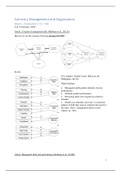
Article. Concept of managerial skills (Hoffman et al., 2012A)
How do we see the concept of having managerial skills?
Results
Five samples: Ireland, Israel, Malaysia, the
Philippines, the US
Major findings:
• Managerial skills predict attitudes, but not
performance
• Attitudes predict performance
• Pressuring skills were negatively related to
attitudes
• Model was culturally universal; “a consistent
pattern of skills that seem to reinforce the need for
the same “basic” management skills in each
culture” (p. 390)
Article. Managerial skills and performance (Hoffman et al., 2012B)
1
, • Samples: 39 cultures, 16.795 managers
• Major findings:
o Effect of culture depends on managerial skills
o Again, no effect for team effectiveness
From another article (Ratiu et al., 2016), it seems that managerial skills are difficult to coach. The pre-
and post-intervention doesn’t show a significant difference.
Individuals in an organization (Bennett et al. 2017)
2
,We know a lot about individuals. What do we see? → Stressors in a job. Mediation between variables.
• Inputs: stressors (challenge/hindrance stressors, job resources).
• Mediators: psychological detachment, relaxation, mastery, control.
• Outcomes: fatigue and vigor.
Wojdylo et al. (2016): what we also know about individuals.
• Action orientation: personality trait, ability to react after a failure
• Work craving: working as an addiction
• Symptoms: headaches, suicidal thoughts, fatigue
See figure next page
But, we can’t do predictions based on only individual
factors, because we also need to take the organizational
factors into account. When studying individual factors,
we cannot forget those organizational factors.
For example. Workaholism: this is something that
affects/gets affected by either the organization or the
individual, or both. That’s why you have to ask yourself:
- What is the impact of the organization?
- Trait or interaction Trait x Environment?
- Is competitiveness a causal factor?
Motivation
How can you influence motivation? → interesting examples in the book.
Fulfil the table: behavioral indicators of motivation.
Intensity (short term effects) Direction (towards/against) Persistence (long term effects)
Goes to work everyday of the Positive direction (+) Dedicated to go to work
month everyday
Short break Positive direction (+) Five minutes every hour
everyday
Can’t say no to tasks from Negative direction (-) Everyday multiple times
colleagues when they ask for
help
Two differences between intensity and persistence:
- Intensity has short term effects, persistence long term effects.
- Intensity does not take into account different obstacles, but persistence does.
Sources of motivation:
3
, Self-determination theory:
• Basic needs (this is what people motivate to work):
o Competence
o Relatedness
o Autonomy
• Controlled versus autonomous motivation: autonomous motivation → intrinsic motivation
(based on something you really love), controlled motivation → extrinsic motivation
• Vitality: if the three basic needs are fulfilled, vitality is the highest. Take into account
individual preferences. Vitality is keeping the balance, to what extent you can satisfy the need
(not in the book, but important).
• Well-being
• Practical and critical theory
• How can that be applied to the course assignments?
Self-determination theory in work context (Deci et al. 2017)
Important: objective vs. subjective. → Subjective is higher, because someone usually tends to
overestimate the relationship between their intrinsic motivation and performance.
The motivations can lead – organizational variables taken into account – to vitality, well-being and
good work behavior (Deci et al. 2017).
4



