
PSYCHOPATHOLOGY
Definitions of abnormality:
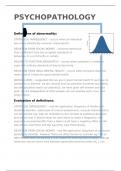
STATISTICAL INFREQUENCY – occurs when an individual
has a less statistically common characteristic
DEVIATION FROM SOCIAL NORMS – concerns behaviour
that is different from the accepted standards of
behaviour in a community or society
FAILURE TO FUNCTION ADEQUATELY – occurs when someone is unable to
cope with ordinary demands of day-to-day living
DEVIATION FROM IDEAL MENTAL HEALTH – occurs when someone does not
meet a set of criteria for good mental health.
JAHODA (1958) – suggested that we are in good mental health if; we have no
symptoms or distress, we are rational and can perceive ourselves accurately,
we self-actualise (reach our potential), we have good self-esteem and lack
guilt, we are independent of other people, we successfully work, love, and
enjoy leisure
Evaluation of definitions:
STATISTCAL INFREQUENCY – real life application (diagnosis of intellectual
disability disorder, useful part of clinical assessment), unusual characteristics
can be positive (eg. high IQ, limitation to the concept of statistical deviation
and means that it should never be used alone to make a diagnosis), not
everyone unusual benefits from a label (could have a negative effect on the
way others view them and the way they view themselves)
DEVIATION FROM SOCIAL NORMS – real life application (diagnosis of antisocial
personality disorder, however there are other factors to consider eg. FFA so
DSM should never be used as a sole reason for defining abnormality), cultural
relativism (social norms vary between generations/communities etc.), can
, lead to human rights abuses (in history, many social norms were there to
maintain control over minority groups – ethnicity, gender etc.)
FAILURE TO FUNCTION ADEQUATELY – patient’s perspective (attempts to
include/acknowledge the subjective experience of the individual, useful
criterion for assessing abnormality), it is hard to say when someone is really
failing to function when they are just deviating from social norms (if we treat
these behaviours as ‘failures’ of adequate functioning, we risk limiting
personal freedom and discriminating against minority groups), relies on
subjective judgements (someone has to judge whether a patient is distressed
or distressing, the principle remains that a psychiatrist has the right to judge
in general)
DEVIATION FROM IDEAL MENTAL HEALTH – comprehensive definitions (covers
a broad range of criteria for mental health), cultural relativism (some ideas
are culture bound, eg. self-actualisation only desired in individualist cultures),
unreasonably high standard set for mental health (difficult for many people to
attain all of the criteria)
Rosenhan (1973) – on being sane in insane places:
PARTICIPANTS – 8 sane people acted as ‘pseudo-patients’,
Rosenhan was one of these patients, none of the hospital staff
were informed about the research, and the research took place
in 12 different hospitals which were located in five different
states across the US
PROCEDURE – on arrival the participants told the admissions officer that they
were ‘hearing voices’, including words such as ‘empty’ ‘hollow’ and ‘thud’
(hearing voices is a symptom of schizophrenia), they also pretended to be
worried about the meaning of life (simulated existential crisis), none of their
life histories were abnormal in any way, all but one of the participants were
admitted, once admitted they continued to behave entirely as normal, one of
the conditions of taking part in the study was that they would have to get out
by convincing the hospital staff that they were sane
RESULTS – when they were released it was with the label ‘schizophrenia in
remission’, suggesting the staff had no idea they were normal people, the
2


