

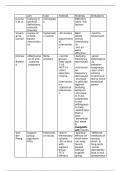
aim type method findings limitations
Juvone bullying in monograp Different
n et al general, h roles, risk
definitions, factors
relevant
theories
Vreem review of Systemati -26 studies Best: -hard to
an & school- c review - whole implement
Carroll based experiment school
interventio al interventio
ns interventio ns
n -not all
were
effective
Jiminez effectivene Meta -control -bullying -great
- ss of anti- analysis group+ frequency heterogene
Barber bullying -kids aged decreased ity
o programs 7-16 - between
-RCT’s+ victimizati subgroups
-strict on -less strict
selection frequency criteria
criteria decreased could have
- -increase led to more
interventio in attitude statistical
n+ against power
-statistical bullying
inferences behavior
+ -increase
in trust,
cooperatio
n and
willingness
to help
-lasted less
than a
year
-beneficial
but weak
&
insignific
ant results
Van support Interventi -dutch -positive -different
der group on study elementary effects on methods of
Ploeg approach, schools short-term testing
KiVa -38 victims -on long- short- &
with terem, long-term
support people -social
group without desirability
-571 support bias (=not
without group anonymous
, improved reporting)
more
-no effect
on well-
being
-support
group led
to more
defenders
-general
empathy
increases,
less
positive
effect on
bullies
BULLYING BEHAVIOR AT SCHOOL – JUVONEN ET AL.
*targeted intimidation or humiliation
*power imbalance between perpetrator and victim
*20-25% of youths are directly involved in bullying
*4-9%=perpetrators; 9-25%=victims
temporal stability:
*most consistent evidence regarding discontinuous trajectories
– desistance from physical aggression over time (=bullies grew
out of their tendency to bully by adolescence)
*research suggests more instability than stability (influenced
by changing factors, such as school transitions)
forms & functions:
*name-calling, physical attacks, spreading rumors,..
*physical attacks – reaction to provocation
*physical aggression – intimidation of peers
*takes a direct or an indirect form
*direct: physical aggression, threats, name-calling
intimidation, humiliation, belittling someone
*indirect: spreading rumors, backstabbing, exclusion from
the group relational manipulation; damage the targets’
social reputation, deflate the social status
*no reliable age differences in the use of direct vs indirect
tactics (some forms are just not studied in children; or reflects
the heterogeneity of the types of behavior that are grouped
together)
*physical aggression is associated with males (every age,
social group, ethnicity and cultures), relational forms of
aggression are associated with females
, *evolutional – girls attack the reputations of other girls that
are in a better position to compete for males
bullies
motives for bullying:
*demands sophisticated social skills
*bullies are thought to be cold & calculating, lacking empathy
and resorting to coercive strategies to dominate peers
*frequently have high social status aggression is a way to
establish dominance
*more prevalent during early adolescence (in line with previous
research)
*bullying behaviors appear to be guided by social dominance &
peak at times of social reorganization
cognitive biases in bullies:
*inflated perception of themselves (peer status, but also
academic and athletic competencies)
*lower on depression, social anxiety and loneliness
*hostile attributional bias (perceiving ambiguous situations
as reflecting hostile peer intent)
*blaming & aggressing against others instead of accepting
personal responsibility for negative events
*social feedback that bullies receive is more positive than
negative
*when peers do not challenge bullies’ aggressive behaviors,
bullying is maintained and reinforced
victims
*adjustment problems, anxiety, depressed mood
subtypes:
*submissive (= anxious, insecure, sensitive, lack of confidence)
*provocative (= aggressive, emotion regulation & attention
problems, ADHD) like bullies
*compared to bullies & victims, the comorbid bully-victim do
not show any social benefits associated with the high status of
bullying
risk factors:
*obesity
*off-time pubertal maturation
*disabilities
*LGBTQ
any condition that makes children stand out from their peers
*emotional/ behavioral problems
*depression (because of lack of friends)
, *peers/friends often do not stand up against bullies, yet social
support is crucial role in how victims are affected
consequences:
*internalizing problems
*lack of social connections
*higher prevalence of anxiety-related disorders
*higher risk for depression, specific phobias and panic disorder
& suicide-related behaviors
*increases in daily levels of anxiety
mediating mechanisms underlying psychosocial problems:
*overactive HPA axis, high cortisol academic struggle
interventions:
*school-wide interventions:
-assume bullying is a systematic, social problem & that finding
a solution is a collective responsibility
would require changing the school climate (raising
awareness, increased monitoring)
-good results but usually small effects
-hard to implement
*targeted interventions:
-focus on perpetrators and victims
-designed to counter dysfunctional thoughts (e.g.: hostile
attribution bias) and behaviors in bullies
-positive effects but short-term
-long-term research is needed
VAN DER PLOEG
*KiVa is based on the idea that bullying is a group
phenomenon with different roles, rather than being just
between bully and victim
study:
*looked at 1 – reducing victimization
2 – increasing defense
3 – improving the victim’s school welfare
*support group approach – trainers form groups of 6-8
children (incl. bully, accomplices, defenders, friends of the
victim, and prosocial classmates, not the victim themself)
*discussion meetings after which group members fill in
reports
*aim: to create a mutual sense of concern for the well-being of
the victim
results:
Juvone bullying in monograp Different
n et al general, h roles, risk
definitions, factors
relevant
theories
Vreem review of Systemati -26 studies Best: -hard to
an & school- c review - whole implement
Carroll based experiment school
interventio al interventio
ns interventio ns
n -not all
were
effective
Jiminez effectivene Meta -control -bullying -great
- ss of anti- analysis group+ frequency heterogene
Barber bullying -kids aged decreased ity
o programs 7-16 - between
-RCT’s+ victimizati subgroups
-strict on -less strict
selection frequency criteria
criteria decreased could have
- -increase led to more
interventio in attitude statistical
n+ against power
-statistical bullying
inferences behavior
+ -increase
in trust,
cooperatio
n and
willingness
to help
-lasted less
than a
year
-beneficial
but weak
&
insignific
ant results
Van support Interventi -dutch -positive -different
der group on study elementary effects on methods of
Ploeg approach, schools short-term testing
KiVa -38 victims -on long- short- &
with terem, long-term
support people -social
group without desirability
-571 support bias (=not
without group anonymous
, improved reporting)
more
-no effect
on well-
being
-support
group led
to more
defenders
-general
empathy
increases,
less
positive
effect on
bullies
BULLYING BEHAVIOR AT SCHOOL – JUVONEN ET AL.
*targeted intimidation or humiliation
*power imbalance between perpetrator and victim
*20-25% of youths are directly involved in bullying
*4-9%=perpetrators; 9-25%=victims
temporal stability:
*most consistent evidence regarding discontinuous trajectories
– desistance from physical aggression over time (=bullies grew
out of their tendency to bully by adolescence)
*research suggests more instability than stability (influenced
by changing factors, such as school transitions)
forms & functions:
*name-calling, physical attacks, spreading rumors,..
*physical attacks – reaction to provocation
*physical aggression – intimidation of peers
*takes a direct or an indirect form
*direct: physical aggression, threats, name-calling
intimidation, humiliation, belittling someone
*indirect: spreading rumors, backstabbing, exclusion from
the group relational manipulation; damage the targets’
social reputation, deflate the social status
*no reliable age differences in the use of direct vs indirect
tactics (some forms are just not studied in children; or reflects
the heterogeneity of the types of behavior that are grouped
together)
*physical aggression is associated with males (every age,
social group, ethnicity and cultures), relational forms of
aggression are associated with females
, *evolutional – girls attack the reputations of other girls that
are in a better position to compete for males
bullies
motives for bullying:
*demands sophisticated social skills
*bullies are thought to be cold & calculating, lacking empathy
and resorting to coercive strategies to dominate peers
*frequently have high social status aggression is a way to
establish dominance
*more prevalent during early adolescence (in line with previous
research)
*bullying behaviors appear to be guided by social dominance &
peak at times of social reorganization
cognitive biases in bullies:
*inflated perception of themselves (peer status, but also
academic and athletic competencies)
*lower on depression, social anxiety and loneliness
*hostile attributional bias (perceiving ambiguous situations
as reflecting hostile peer intent)
*blaming & aggressing against others instead of accepting
personal responsibility for negative events
*social feedback that bullies receive is more positive than
negative
*when peers do not challenge bullies’ aggressive behaviors,
bullying is maintained and reinforced
victims
*adjustment problems, anxiety, depressed mood
subtypes:
*submissive (= anxious, insecure, sensitive, lack of confidence)
*provocative (= aggressive, emotion regulation & attention
problems, ADHD) like bullies
*compared to bullies & victims, the comorbid bully-victim do
not show any social benefits associated with the high status of
bullying
risk factors:
*obesity
*off-time pubertal maturation
*disabilities
*LGBTQ
any condition that makes children stand out from their peers
*emotional/ behavioral problems
*depression (because of lack of friends)
, *peers/friends often do not stand up against bullies, yet social
support is crucial role in how victims are affected
consequences:
*internalizing problems
*lack of social connections
*higher prevalence of anxiety-related disorders
*higher risk for depression, specific phobias and panic disorder
& suicide-related behaviors
*increases in daily levels of anxiety
mediating mechanisms underlying psychosocial problems:
*overactive HPA axis, high cortisol academic struggle
interventions:
*school-wide interventions:
-assume bullying is a systematic, social problem & that finding
a solution is a collective responsibility
would require changing the school climate (raising
awareness, increased monitoring)
-good results but usually small effects
-hard to implement
*targeted interventions:
-focus on perpetrators and victims
-designed to counter dysfunctional thoughts (e.g.: hostile
attribution bias) and behaviors in bullies
-positive effects but short-term
-long-term research is needed
VAN DER PLOEG
*KiVa is based on the idea that bullying is a group
phenomenon with different roles, rather than being just
between bully and victim
study:
*looked at 1 – reducing victimization
2 – increasing defense
3 – improving the victim’s school welfare
*support group approach – trainers form groups of 6-8
children (incl. bully, accomplices, defenders, friends of the
victim, and prosocial classmates, not the victim themself)
*discussion meetings after which group members fill in
reports
*aim: to create a mutual sense of concern for the well-being of
the victim
results:


