
Marketing performance – exam notes
Article 1: Katsikeas et al. (2016) – Assessing performance outcomes in marketing
Introduction
- Research problem
o Little conceptual development and no systematic examination of how
researchers in marketing should conceptualize and measure performance
outcomes associated with firms marketing
Method
- Theory-based performance evaluation framework and examine assessment of such
performances in outcomes
- N=998 empirical studies published in top 15 marketing journals
o Articles eligible for inclusion had to
Examine performance outcomes resulting from procession and
deployment of firms marketing resources (brand equity, customer
relationships) and/or program related activities (advertising, product
development etc.)
Be empirical in nature, using primary and/or secondary data as
opposed to purely conceptual studies
Identify at least one marketing related independent variable associated
with at least one dependent variable measuring performance outcomes
Be published during 1981-2014
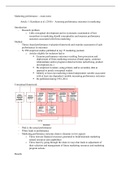
Conceptual framework
- Pink is the actual performance
- White leads to performance
- Marketing performance outcome chain is dynamic in two aspects
o Firms reinvest financial resources generated to build/maintain marketing
related resources and capabilities
o Firms learn by going through the chain in ways that leads to adjustment of
their selection and management of future marketing resources and marketing
program actions
Results
, - Large number of different performance outcome measures used in prior empirical
research may be only weakly related to another
- Authors identify significant problems in how performance outcomes in marketing are
commonly conceptualized and operationalized
- Study revealed several theoretically and managerially important performance areas in
which empirical knowledge of marketing’s impact is limited or absent
- Most widely used measures of marketing performance outcomes are accounting
indicators of profit and sales revenue and market share which is a product market
performance indicator.
- Rapid rise in interest in its financial performance outcomes of marketing, emphasis on
shareholders. Within customer mindset aspect customer satisfaction is the dominant
measure used
- Little is empirically known about what drives Brand Equity and CLV
- Most widely used at product market level is market share
- Measures related to profit and sales revenue are the wo most widely used accounting
performance outcome indicators
- Rapid and recent rise in use of stock market related measures of performance, driven
largely by the top three marketing journals of the last decade
- Rapid rise in interest in assessing marketing performance outcomes
- Results provide strongest evidence to data that any assumption of strong positive
correlation between different aspects of performance is often false
Guidelines for assessment of marketing performance
- Marketing needs a core set of agree-on, common priority conceptualizations and
operationalizations for marketing performance outcomes
o Avoid (implicitly or explicitly) conceptualizing and operationalize
performance as a global latent construct.
o Clearly depict the conceptualization of performance adopted in the theoretical
development of the study and provide a rationale for the conceptualization
adopted.
o Select one or more indicators from within each chosen performance aspect to
operationalize the performance conceptualization adopted.
o Do not expect relationships between independent variables and indicators of
different aspects of performance to necessarily converge.
o Make explicit referent and time horizon choices associated with the measures
of performance outcomes employed and provide a rationale for the
appropriateness of these choices
o Theorize and hypothesize expected cause-and-effect relationships that are
specific to and tightly connected with the particular performance aspects and
indicators selected.
o Report sample sizes and correlations, including those between the dependent
variables measuring performance that are employed when using more than one
marketing performance indicator.
Critical remarks
- Analyzing conceptualization and operationalization of performance adopted in
empirical studies requires a well-defined and theoretically anchored evaluative
framework 5 critical issues to be considered
o Theoretical rationale: is performance formally defined and conceptual
rationale provided?
, o Conceptual approach to treatment of performance: how the performance
construct is viewed theoretically and treated empirically
Latent construct: general conception of performance assumes that
various elements or dimensions are linked and that they covary
Separate constructs: distinct aspects or dimensions of performance
exist but theoretical arguments and empirical analyses pertain to
specific aspects or dimensions
Aggregate: viewed as well-defined composite of mathematical
combination of various performance items or dimensions which are not
assumed to covary
o Aspects of performance assessed: type of performance outcome assessed
Customer mindset
Customer behavior
Customer level performance
Product market performance
Accounting performance
Financial market performance
o Referents of performance: standards against which performance is judged
Absolute: performance assessed as a stand-alone variable
Temporal: performance outcome relative to performance on the same
criterion at a certain point in time
Inputs: performance outcome relative to consumed resources
Competition-industry: performance outcome assessed relative to
performance on same outcome of other firms
Firms goals: performance outcome assessed relative to the firms
desired or planned performance level on the same outcome
Stock market: firms stock price relative to the entire stock market
o Time horizon: temporal perspective reflected in the outcome measures
Historical: assessment of performance over period of time in past
relative to that of independent variable
Current: assessment of performance over period of time in present
relative to that of independent variable
Future: assessment of performance over period of time in future
relative to that of independent variable
Managerial implications
- Use at least one metric in each of the six performance categories
- Pay attention to causal relationships between these aspects and realize some may be
negative
, Article 2: Kierca et al. (2005) - Market Orientation: A Meta-Analytic Review and
Assessment of Its Antecedents and Impact on Performance
Introduction
- Antecedent variable: variable that occurs before independent and dependent variable
and can help explain the relationship between the two
- Two types of market orientation in this article
o Behavioral: focuses on organizational activities that are related to the
generation and dissemination of and responsiveness to market intelligence
o Cultural: focuses on organizational norms and values that encourage behaviors
that are consistent with market orientation
- Antecedents of market orientation – 3 categories
o Top management factors
Shape the values and orientation of an organization
o Interdepartmental factors
Include interdepartmental connectedness and conflict
o Organizational systems
Consists of two structural variables
Formalization
Centralization
Two employee ranked systems
Market based reward systems
Market oriented training
- The consequences - 4 categories:
o Organizational performance
Cost-based performance measures
Revenue based performance measures
o Customer consequence
Perceived quality of products/services that a firm produce
Customer loyalty
Customer satisfaction within the organizations products and services
o Innovation consequence
Firms innovativeness and new product performance
o Employee consequence
Organizational commitment
Team spirit
Customer orientation
Role conflict
Job satisfaction
- Hypotheses
o The market orientation performance relationship is stronger for revenue based
performance measures than for cost based performance measures (DOES NOT
VARY)
o The market orientation performance relationship is stronger for subjective
measures of performance than for objective measures of performance
(SUPPORT)
Article 1: Katsikeas et al. (2016) – Assessing performance outcomes in marketing
Introduction
- Research problem
o Little conceptual development and no systematic examination of how
researchers in marketing should conceptualize and measure performance
outcomes associated with firms marketing
Method
- Theory-based performance evaluation framework and examine assessment of such
performances in outcomes
- N=998 empirical studies published in top 15 marketing journals
o Articles eligible for inclusion had to
Examine performance outcomes resulting from procession and
deployment of firms marketing resources (brand equity, customer
relationships) and/or program related activities (advertising, product
development etc.)
Be empirical in nature, using primary and/or secondary data as
opposed to purely conceptual studies
Identify at least one marketing related independent variable associated
with at least one dependent variable measuring performance outcomes
Be published during 1981-2014
Conceptual framework
- Pink is the actual performance
- White leads to performance
- Marketing performance outcome chain is dynamic in two aspects
o Firms reinvest financial resources generated to build/maintain marketing
related resources and capabilities
o Firms learn by going through the chain in ways that leads to adjustment of
their selection and management of future marketing resources and marketing
program actions
Results
, - Large number of different performance outcome measures used in prior empirical
research may be only weakly related to another
- Authors identify significant problems in how performance outcomes in marketing are
commonly conceptualized and operationalized
- Study revealed several theoretically and managerially important performance areas in
which empirical knowledge of marketing’s impact is limited or absent
- Most widely used measures of marketing performance outcomes are accounting
indicators of profit and sales revenue and market share which is a product market
performance indicator.
- Rapid rise in interest in its financial performance outcomes of marketing, emphasis on
shareholders. Within customer mindset aspect customer satisfaction is the dominant
measure used
- Little is empirically known about what drives Brand Equity and CLV
- Most widely used at product market level is market share
- Measures related to profit and sales revenue are the wo most widely used accounting
performance outcome indicators
- Rapid and recent rise in use of stock market related measures of performance, driven
largely by the top three marketing journals of the last decade
- Rapid rise in interest in assessing marketing performance outcomes
- Results provide strongest evidence to data that any assumption of strong positive
correlation between different aspects of performance is often false
Guidelines for assessment of marketing performance
- Marketing needs a core set of agree-on, common priority conceptualizations and
operationalizations for marketing performance outcomes
o Avoid (implicitly or explicitly) conceptualizing and operationalize
performance as a global latent construct.
o Clearly depict the conceptualization of performance adopted in the theoretical
development of the study and provide a rationale for the conceptualization
adopted.
o Select one or more indicators from within each chosen performance aspect to
operationalize the performance conceptualization adopted.
o Do not expect relationships between independent variables and indicators of
different aspects of performance to necessarily converge.
o Make explicit referent and time horizon choices associated with the measures
of performance outcomes employed and provide a rationale for the
appropriateness of these choices
o Theorize and hypothesize expected cause-and-effect relationships that are
specific to and tightly connected with the particular performance aspects and
indicators selected.
o Report sample sizes and correlations, including those between the dependent
variables measuring performance that are employed when using more than one
marketing performance indicator.
Critical remarks
- Analyzing conceptualization and operationalization of performance adopted in
empirical studies requires a well-defined and theoretically anchored evaluative
framework 5 critical issues to be considered
o Theoretical rationale: is performance formally defined and conceptual
rationale provided?
, o Conceptual approach to treatment of performance: how the performance
construct is viewed theoretically and treated empirically
Latent construct: general conception of performance assumes that
various elements or dimensions are linked and that they covary
Separate constructs: distinct aspects or dimensions of performance
exist but theoretical arguments and empirical analyses pertain to
specific aspects or dimensions
Aggregate: viewed as well-defined composite of mathematical
combination of various performance items or dimensions which are not
assumed to covary
o Aspects of performance assessed: type of performance outcome assessed
Customer mindset
Customer behavior
Customer level performance
Product market performance
Accounting performance
Financial market performance
o Referents of performance: standards against which performance is judged
Absolute: performance assessed as a stand-alone variable
Temporal: performance outcome relative to performance on the same
criterion at a certain point in time
Inputs: performance outcome relative to consumed resources
Competition-industry: performance outcome assessed relative to
performance on same outcome of other firms
Firms goals: performance outcome assessed relative to the firms
desired or planned performance level on the same outcome
Stock market: firms stock price relative to the entire stock market
o Time horizon: temporal perspective reflected in the outcome measures
Historical: assessment of performance over period of time in past
relative to that of independent variable
Current: assessment of performance over period of time in present
relative to that of independent variable
Future: assessment of performance over period of time in future
relative to that of independent variable
Managerial implications
- Use at least one metric in each of the six performance categories
- Pay attention to causal relationships between these aspects and realize some may be
negative
, Article 2: Kierca et al. (2005) - Market Orientation: A Meta-Analytic Review and
Assessment of Its Antecedents and Impact on Performance
Introduction
- Antecedent variable: variable that occurs before independent and dependent variable
and can help explain the relationship between the two
- Two types of market orientation in this article
o Behavioral: focuses on organizational activities that are related to the
generation and dissemination of and responsiveness to market intelligence
o Cultural: focuses on organizational norms and values that encourage behaviors
that are consistent with market orientation
- Antecedents of market orientation – 3 categories
o Top management factors
Shape the values and orientation of an organization
o Interdepartmental factors
Include interdepartmental connectedness and conflict
o Organizational systems
Consists of two structural variables
Formalization
Centralization
Two employee ranked systems
Market based reward systems
Market oriented training
- The consequences - 4 categories:
o Organizational performance
Cost-based performance measures
Revenue based performance measures
o Customer consequence
Perceived quality of products/services that a firm produce
Customer loyalty
Customer satisfaction within the organizations products and services
o Innovation consequence
Firms innovativeness and new product performance
o Employee consequence
Organizational commitment
Team spirit
Customer orientation
Role conflict
Job satisfaction
- Hypotheses
o The market orientation performance relationship is stronger for revenue based
performance measures than for cost based performance measures (DOES NOT
VARY)
o The market orientation performance relationship is stronger for subjective
measures of performance than for objective measures of performance
(SUPPORT)




