Cell biology
Week 1: microscope and cells
Microscope:
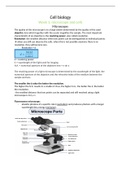
The quality of the microscope is to a large extent determined by the quality of the used
objective lens which together with the ocular magnifies the sample. The most important
characteristic of an objective is the resolving power, also called resolution.
Resolution: the smallest distance when two points can be distinguished as individual points.
when you still can observe the cells, when this is not possible anymore there is no
resolution, they will become one.
- Resolution = d
d = resolving power
λ = wavelength of the light used for imaging
N.A. = numerical aperture of the objective lens = n sin a
The resolving power of a light microscope is determined by the wavelength of the light, the
numerical aperture of the objective and the refractive index of the medium between the
sample and lens.
The smaller the d value the better the resolution.
The higher the N.A. results in a smaller d. thus, the higher N.A., the better the d, the better
the resolution.
- the smallest distance that two points can be separated and still resolved using a light
microscope is 0.2 μm.
Fluorescence microscopy:
- absorbs photons of a specific color (excitation) and produces photons with a longer
wavelength/less energy (emission).
, Cellular organization prokaryotes:
Prokaryotes are unicellular organisms without a membrane bound nucleus.
- Bacteria
- Archaea
Bacterial cell consists of:
- Plasma membrane: made up from a bilayer of phosphides and proteins.
It separates the cell from its surroundings.
Allows selective transport in and out of the cell.
- Cell wall: surrounds the plasma membrane.
§Is different in prokaryotes and eukaryotes.
- Cytoplasm: located inside the plasma membrane.
Consists of liquid cytosol with cellular components, such as ribosomes.
- DNA: holds genetic information.
Is located in a region of the cytoplasm the nucleoid isn’t surrounded by a
membrane.
Most DNA is circular.
- Ribosomes: serve as the place of protein synthesis.
Are located and dispersed in the cytoplasm.
- Flagellum: rotates as a propeller to enable the cell to move forward
Cellular organization Eukaryotes:
Eukaryotic cells are typically much larger than prokaryotic cells, they consist of:
- The nucleus: here, the DNA is located.
It is surrounded by a double membrane that has many openings nuclear pores.
Contains heterochromatin, this is tightly packed DNA, is darker and close to the
membrane.
Contains euchromatin, this is and is lightly packed form of chromatin (DNA, RNA and
protein), is light under the microscope.
- Mitochondria: cellular respiration takes place, which provides energy in the form of
ATP.
Has 2 membranes.
Are endosymbionts an organelle that lives within the body of another organism in
a mutualistic relationship.
- Endoplasmic reticulum (ER): plays a role in protein synthesis, protein modification
and lipid synthesis.
Doesn’t contain DNA.
- Golgi apparatus: proteins are packed into membrane vesicles before they’re sent to
their final destination.
is the most omnipresent in all eukaryotic cells.
- Endosomes: contain molecules that arrive in endocytic vesicles.
Early endosomes late endosomes.
early endosomes act as a sorting station for molecules that have been taken up
from the extracellular space.
, Molecules that need to be broken down are transported from late endosomes to
lysosomes.
- Lysosomes: contain hydrolytic enzymes to break down cellular components.
- Peroxisomes: play an important role in the degradation of lipids and neutralization
of toxins, such as alcohol. During the degradation, hydrogen peroxide is produced.
This is toxic, but peroxisomes contain enzymes that degrade hydrogen peroxide.
- plants contain chloroplasts, in which photosynthesis takes place. They are a kind of
plastid; plastids are responsible for photosynthesis and storage of products.
- Nucleolus: an area inside the nucleus.
Contains the DNA that codes for parts of the ribosomes.
rRNA is here synthesized.
, Week 2: DNA: replication, transcription, and translation
DNA:
- DNA is a polymer.
- The polymer is built from nucleotides (A,C,G,T).
- Each nucleotide has a base, a sugar and a phosphate.
- The polymer has a direction, (5’ to 3’)
- Base complementarity ensures formation of a double helix.
C with G and A with T. The stripes between the c and the g and the a and the t are
the hydrogen bonds. The more bonds, the stronger the connection between the two.
Thus, the connection between C and G is stronger (3 bonds) than the connections
between A and T (2 bonds).
- The backbone of a DNA chain (built from phosphates and deoxyribose) connects
nucleotides via their sugar and phosphate group.
Two chains of DNA wind around each other and the bases are located in the interior of the
double helix
- The helix has a major and a minor groove. The surfaces of these grooves are formed
by the sides of the base pairs. The major groove occurs where the backbones are far
apart, the minor groove occurs where they are close together.
DNA replication:
- Where? In the Nucleus (eukaryotic cells).
- When? During Interphase (before mitosis or meiosis).
‘Key’ players for DNA replication: enzymes
- Helicase unzipping the two strands of DNA. It breaks through the hydrogen bonds
that holds the DNA bases together.
- DNA-polymerase the builder. Replicates DNA molecules to build a new strand of
DNA.
- Primase: the initializer. It makes the primer so that DNA polymerase can figure out
where to go to start. The primer is made of RNA.
- Ligase: the gluer. Glues DNA fragments together.
Week 1: microscope and cells
Microscope:
The quality of the microscope is to a large extent determined by the quality of the used
objective lens which together with the ocular magnifies the sample. The most important
characteristic of an objective is the resolving power, also called resolution.
Resolution: the smallest distance when two points can be distinguished as individual points.
when you still can observe the cells, when this is not possible anymore there is no
resolution, they will become one.
- Resolution = d
d = resolving power
λ = wavelength of the light used for imaging
N.A. = numerical aperture of the objective lens = n sin a
The resolving power of a light microscope is determined by the wavelength of the light, the
numerical aperture of the objective and the refractive index of the medium between the
sample and lens.
The smaller the d value the better the resolution.
The higher the N.A. results in a smaller d. thus, the higher N.A., the better the d, the better
the resolution.
- the smallest distance that two points can be separated and still resolved using a light
microscope is 0.2 μm.
Fluorescence microscopy:
- absorbs photons of a specific color (excitation) and produces photons with a longer
wavelength/less energy (emission).
, Cellular organization prokaryotes:
Prokaryotes are unicellular organisms without a membrane bound nucleus.
- Bacteria
- Archaea
Bacterial cell consists of:
- Plasma membrane: made up from a bilayer of phosphides and proteins.
It separates the cell from its surroundings.
Allows selective transport in and out of the cell.
- Cell wall: surrounds the plasma membrane.
§Is different in prokaryotes and eukaryotes.
- Cytoplasm: located inside the plasma membrane.
Consists of liquid cytosol with cellular components, such as ribosomes.
- DNA: holds genetic information.
Is located in a region of the cytoplasm the nucleoid isn’t surrounded by a
membrane.
Most DNA is circular.
- Ribosomes: serve as the place of protein synthesis.
Are located and dispersed in the cytoplasm.
- Flagellum: rotates as a propeller to enable the cell to move forward
Cellular organization Eukaryotes:
Eukaryotic cells are typically much larger than prokaryotic cells, they consist of:
- The nucleus: here, the DNA is located.
It is surrounded by a double membrane that has many openings nuclear pores.
Contains heterochromatin, this is tightly packed DNA, is darker and close to the
membrane.
Contains euchromatin, this is and is lightly packed form of chromatin (DNA, RNA and
protein), is light under the microscope.
- Mitochondria: cellular respiration takes place, which provides energy in the form of
ATP.
Has 2 membranes.
Are endosymbionts an organelle that lives within the body of another organism in
a mutualistic relationship.
- Endoplasmic reticulum (ER): plays a role in protein synthesis, protein modification
and lipid synthesis.
Doesn’t contain DNA.
- Golgi apparatus: proteins are packed into membrane vesicles before they’re sent to
their final destination.
is the most omnipresent in all eukaryotic cells.
- Endosomes: contain molecules that arrive in endocytic vesicles.
Early endosomes late endosomes.
early endosomes act as a sorting station for molecules that have been taken up
from the extracellular space.
, Molecules that need to be broken down are transported from late endosomes to
lysosomes.
- Lysosomes: contain hydrolytic enzymes to break down cellular components.
- Peroxisomes: play an important role in the degradation of lipids and neutralization
of toxins, such as alcohol. During the degradation, hydrogen peroxide is produced.
This is toxic, but peroxisomes contain enzymes that degrade hydrogen peroxide.
- plants contain chloroplasts, in which photosynthesis takes place. They are a kind of
plastid; plastids are responsible for photosynthesis and storage of products.
- Nucleolus: an area inside the nucleus.
Contains the DNA that codes for parts of the ribosomes.
rRNA is here synthesized.
, Week 2: DNA: replication, transcription, and translation
DNA:
- DNA is a polymer.
- The polymer is built from nucleotides (A,C,G,T).
- Each nucleotide has a base, a sugar and a phosphate.
- The polymer has a direction, (5’ to 3’)
- Base complementarity ensures formation of a double helix.
C with G and A with T. The stripes between the c and the g and the a and the t are
the hydrogen bonds. The more bonds, the stronger the connection between the two.
Thus, the connection between C and G is stronger (3 bonds) than the connections
between A and T (2 bonds).
- The backbone of a DNA chain (built from phosphates and deoxyribose) connects
nucleotides via their sugar and phosphate group.
Two chains of DNA wind around each other and the bases are located in the interior of the
double helix
- The helix has a major and a minor groove. The surfaces of these grooves are formed
by the sides of the base pairs. The major groove occurs where the backbones are far
apart, the minor groove occurs where they are close together.
DNA replication:
- Where? In the Nucleus (eukaryotic cells).
- When? During Interphase (before mitosis or meiosis).
‘Key’ players for DNA replication: enzymes
- Helicase unzipping the two strands of DNA. It breaks through the hydrogen bonds
that holds the DNA bases together.
- DNA-polymerase the builder. Replicates DNA molecules to build a new strand of
DNA.
- Primase: the initializer. It makes the primer so that DNA polymerase can figure out
where to go to start. The primer is made of RNA.
- Ligase: the gluer. Glues DNA fragments together.