Corporate Finance Lecture 1:
CHAPTER 1 Introduction to Corporate Finance
Accounting vs Finance
- Records the past Discounting future cash flows
- Works with real amounts Works with forecasts
So in finance we need to forecast… but how good are we at forecasting?
Investment
What long-term investments will you make?
Financing
Where will you get long-term financing for your long-term projects?
Working Capital Management (Liquidity)
How will you manage your everyday activities?
The financial manager (CFO) is responsible for:
Capital budgeting
Responsible for investment decisions
Capital structure
Responsible for financing decisions
Working capital management
Responsible for short-term financial planning
- Oversee accounting and audit function in firm
- Ensure the financial welfare of the firm
There are four financial goals, namely profitability, liquidity, independence, and security. Profitability is the
most important goal. The ultimate goal of any private corporation is to maximize its profit. You have to be
liquid to run the organization, but you need to be profitable in order to earn liquidity.
The goal of financial management is to
- Manage risk
- Maximize share price
- Avoid financial distress
This leads to the maximization of the shareholder (stakeholder) value
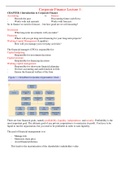
,How cash flows…
The firms interacts in an environment
and that environment is important. We
need to look at that.
Primary vs secondary markets
In primary markets (first time sold):
- Securities are sold to investors
- Money that is raised goes to
issuing firm
First share issue is called an Initial
Public Offering
Second share issue is called a Seasoned Offering
In secondary markets (shares were already on the market):
- Investors trade securities with each other
- Money that is raised goes to seller of securities
- Share prices
CHAPTER 3 Financial Statement Analysis
The annual report consists of the statement of financial position (balance sheet), income statement, and the
statement of cash flows.
The balance sheet equation: assets = liabilities + equity
The Statement of Financial Position
The net working capital is the money that we can currently operate with. That is the difference between
current assets and current liabilities (CA – CL). You always need to make sure that this number is positive.
Positive net working capital means that enough cash will be available to pay off liabilities arising
Market value vs book value
Book value is based on accounting figures drawn from accounting standards. Market value is based on
prices or market valuations.
The income statement (revenues – expenses = income)
(opbrengsten & kosten; resultatenrekening)
EBT = Earnings Before Taxes Deducted = net income
before tax
EBIT = Earnings Before Interests and Taxes
EBITD(A) = Earnings Before Interests and Taxes
Depreciation, Amortization
,Taxes
Average Tax Rates
- Percentage of income that is paid in taxes
- Tax bill divided by your taxable income
Marginal Tax Rates
- The tax you would pay if you earn one more unit of currency
For project calculations, use the Marginal Tax Rate as that is the rate that would be taxed on any additional
income.
Statements of Cash Flows (over a period of time!) (inkomsten & uitgaven; liquiditeitsrekening)
Often the most important item to take from financial statements. Total Cash Flow comes from operating
activities, investing activities, and financing activities. Cash flow is not the same as working capital: WC is a
snapshot and CF is the earning ability over a period of time. Cash Flow is also not the same as profit:
depreciation decreases profit but not the CF.
Extra information from the book & synergy summary
Corporate finance centres around three main questions:
- What long-term investments should you make?
- Where will you get the long-term financing to pay for your investment?
- How will you manage everyday financial activities?
Financial management decisions also include:
- Size, timing and risk of receiving cash
- Long-term (noncurrent) (1 year) debts used to finance long-term investments
- Equity (the amount of money raised by the firm that comes from owners’ (shareholders’)
investments
- Working capital (a firm’s short-term assets and liabilities)
- Good decisions increase the value of the equity (because of the increase of share prices)
Two types of primary markets:
- Public offering
- Private offering (negotiated sell with specific buyer)
Two types of secondary markets:
- Dealer (buying and selling done by the dealer)
- Auction (physical location; those who wish to sell are matched to those who wish to buy not
including a dealer)
Earning per share = net income / total shares outstanding
The income statement includes depreciation
Cash flow from assets = cash flow to creditors + cash flow to shareholders
(cash flow identity)
Total cash flow = cash flow from operating activities + cash flow from investing activities +cash flow from
financing activities
Operating activities = core operations
Corporate Finance Lecture 2:
CHAPTER 3 Financial Statement Analysis
Ratio Analysis
It is important to be able to analyze a firm’s financial statements and compare them to other firms (with
different sizes). There are different ratios, namely (note: most are added in the formula sheet)
, - Profitability ratio
Profit margin = Net income / Sales Operating efficiency
Return on Assets = Net income / Total assets Asset use efficiency
Return on Equity = Net income / Total Equity Equity efficiency
- Market value ratio
Earnings Per Share = Net income / Shares outstanding (not on formula sheet)
(EPS)
PE ratio = Price per Share / EPS
- Liquidity ratio (short/long term)
- Financial leverage ratio
Debt-Equity ratio = Debt / Equity (also liabilities)
Total Debt ratio = Debt / (Equity + Debt) (also total assets)
Equity Multiplier = Total Assets / Equity (at least 1)
- Turnover ratio
The Du Pont Identity: long term
ROE = Profit Margin x Total Asset Turnover x Equity Multiplier
ROE = (Net income / Sales) x (Sales / Assets) x (Assets x Equity)
ROE = (Net income / Assets) x (Assets / Equity)
ROE = Net income / Equity
ROE is affected by Operating Efficiency (money), Asset Use Efficiency (use of assets), Financial Leverage
(assets in comparison to equity).
A positive ROE is always larger than the ROA, because the Equity Multiplier is > 1.
Using financial Statement Information
See book
CHAPTER 4 The Time Value of Money
Future Value and Compounding
Future Value (FV) is the amount an investments is worth
after one or more periods.
Investing for more than one period: Vt = V0 (1 + r)t
Simple interest
Interest earned only on the original principal amount invested
Compound interest
Interest earned on both the principal and the interest reinvested from prior periods.
You’ve located an investment that pays 12 per cent per year. That rate sounds good to you, so you invest
€400.
CHAPTER 1 Introduction to Corporate Finance
Accounting vs Finance
- Records the past Discounting future cash flows
- Works with real amounts Works with forecasts
So in finance we need to forecast… but how good are we at forecasting?
Investment
What long-term investments will you make?
Financing
Where will you get long-term financing for your long-term projects?
Working Capital Management (Liquidity)
How will you manage your everyday activities?
The financial manager (CFO) is responsible for:
Capital budgeting
Responsible for investment decisions
Capital structure
Responsible for financing decisions
Working capital management
Responsible for short-term financial planning
- Oversee accounting and audit function in firm
- Ensure the financial welfare of the firm
There are four financial goals, namely profitability, liquidity, independence, and security. Profitability is the
most important goal. The ultimate goal of any private corporation is to maximize its profit. You have to be
liquid to run the organization, but you need to be profitable in order to earn liquidity.
The goal of financial management is to
- Manage risk
- Maximize share price
- Avoid financial distress
This leads to the maximization of the shareholder (stakeholder) value
,How cash flows…
The firms interacts in an environment
and that environment is important. We
need to look at that.
Primary vs secondary markets
In primary markets (first time sold):
- Securities are sold to investors
- Money that is raised goes to
issuing firm
First share issue is called an Initial
Public Offering
Second share issue is called a Seasoned Offering
In secondary markets (shares were already on the market):
- Investors trade securities with each other
- Money that is raised goes to seller of securities
- Share prices
CHAPTER 3 Financial Statement Analysis
The annual report consists of the statement of financial position (balance sheet), income statement, and the
statement of cash flows.
The balance sheet equation: assets = liabilities + equity
The Statement of Financial Position
The net working capital is the money that we can currently operate with. That is the difference between
current assets and current liabilities (CA – CL). You always need to make sure that this number is positive.
Positive net working capital means that enough cash will be available to pay off liabilities arising
Market value vs book value
Book value is based on accounting figures drawn from accounting standards. Market value is based on
prices or market valuations.
The income statement (revenues – expenses = income)
(opbrengsten & kosten; resultatenrekening)
EBT = Earnings Before Taxes Deducted = net income
before tax
EBIT = Earnings Before Interests and Taxes
EBITD(A) = Earnings Before Interests and Taxes
Depreciation, Amortization
,Taxes
Average Tax Rates
- Percentage of income that is paid in taxes
- Tax bill divided by your taxable income
Marginal Tax Rates
- The tax you would pay if you earn one more unit of currency
For project calculations, use the Marginal Tax Rate as that is the rate that would be taxed on any additional
income.
Statements of Cash Flows (over a period of time!) (inkomsten & uitgaven; liquiditeitsrekening)
Often the most important item to take from financial statements. Total Cash Flow comes from operating
activities, investing activities, and financing activities. Cash flow is not the same as working capital: WC is a
snapshot and CF is the earning ability over a period of time. Cash Flow is also not the same as profit:
depreciation decreases profit but not the CF.
Extra information from the book & synergy summary
Corporate finance centres around three main questions:
- What long-term investments should you make?
- Where will you get the long-term financing to pay for your investment?
- How will you manage everyday financial activities?
Financial management decisions also include:
- Size, timing and risk of receiving cash
- Long-term (noncurrent) (1 year) debts used to finance long-term investments
- Equity (the amount of money raised by the firm that comes from owners’ (shareholders’)
investments
- Working capital (a firm’s short-term assets and liabilities)
- Good decisions increase the value of the equity (because of the increase of share prices)
Two types of primary markets:
- Public offering
- Private offering (negotiated sell with specific buyer)
Two types of secondary markets:
- Dealer (buying and selling done by the dealer)
- Auction (physical location; those who wish to sell are matched to those who wish to buy not
including a dealer)
Earning per share = net income / total shares outstanding
The income statement includes depreciation
Cash flow from assets = cash flow to creditors + cash flow to shareholders
(cash flow identity)
Total cash flow = cash flow from operating activities + cash flow from investing activities +cash flow from
financing activities
Operating activities = core operations
Corporate Finance Lecture 2:
CHAPTER 3 Financial Statement Analysis
Ratio Analysis
It is important to be able to analyze a firm’s financial statements and compare them to other firms (with
different sizes). There are different ratios, namely (note: most are added in the formula sheet)
, - Profitability ratio
Profit margin = Net income / Sales Operating efficiency
Return on Assets = Net income / Total assets Asset use efficiency
Return on Equity = Net income / Total Equity Equity efficiency
- Market value ratio
Earnings Per Share = Net income / Shares outstanding (not on formula sheet)
(EPS)
PE ratio = Price per Share / EPS
- Liquidity ratio (short/long term)
- Financial leverage ratio
Debt-Equity ratio = Debt / Equity (also liabilities)
Total Debt ratio = Debt / (Equity + Debt) (also total assets)
Equity Multiplier = Total Assets / Equity (at least 1)
- Turnover ratio
The Du Pont Identity: long term
ROE = Profit Margin x Total Asset Turnover x Equity Multiplier
ROE = (Net income / Sales) x (Sales / Assets) x (Assets x Equity)
ROE = (Net income / Assets) x (Assets / Equity)
ROE = Net income / Equity
ROE is affected by Operating Efficiency (money), Asset Use Efficiency (use of assets), Financial Leverage
(assets in comparison to equity).
A positive ROE is always larger than the ROA, because the Equity Multiplier is > 1.
Using financial Statement Information
See book
CHAPTER 4 The Time Value of Money
Future Value and Compounding
Future Value (FV) is the amount an investments is worth
after one or more periods.
Investing for more than one period: Vt = V0 (1 + r)t
Simple interest
Interest earned only on the original principal amount invested
Compound interest
Interest earned on both the principal and the interest reinvested from prior periods.
You’ve located an investment that pays 12 per cent per year. That rate sounds good to you, so you invest
€400.