
Summaries Greenberg & Bystander Intervention in Emergencies
1. When do people feel the responsibility to help others?
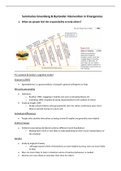
P1: Lantane & Darley’s cognitive model
Graziano (2007)
• Agreeableness is a good predictor of people’s general willingness to help
Altruistic personality
• Definition:
o Rushton 1981: engaging in helpful acts such as donating blood, etc.
o Eisenberg 1989: empathy & taking responsibility for the welfare of others
• Study by Knight 1994
o Grade-school children who generally felt sorry for others misfortune were more
likely to donate money to a burn unit
Individual differences
• People who identify themselves as being normal & helpful are generally more helpful
Political Values
• Political conservatives & liberals endorse different moral foundations
o Making them more or less likely to help depending on their moral interpretation of
the situation
Gender
• Study by Eagly & Crawley
o although women think of themselves as more helpful (survey), men are more likely
to help
• Men are more likely to help in situations where chivalrous behaviour is needed
• Women are more likely to volunteer their time for others
, Obstacles that prevent people from helping
• Self-concern
• Ambiguity: Does the victim really need help or is he just drunk?
• Lack of Competence: I am not trained to do this
• Audience inhibition: I will look like a fool
Biology & Evolution
• Evolutionary social psychology
o Views complex social behaviour as adaptive, helping the individual, kin & the species
as a whole to survive
• Jeffrey Stevens
o two reliable explanations of cooperative behaviour in animals & humans
§ mutualism: a defector will do worse than a co-operator-mindset
§ kin selection: helping spread own genes-mindset
• criticism: lack of convincing human evidence & limited attention given by evolutionary
theorists to the work of social learning theorists
• Buck & Ginsburg
o Altruistic gene = communicative gene
§ disposes animals & humans to communicate
Nature-nurture controversy
• classic debate: Why & when people help each other?
• Nature (genetic): biology & evolutionary theory
• Nurture (environmental factors): social learning theory
Bystander-calculus model (Jane Piliavin)
• Mixture of physiological processes & cognitive processes
• People intervene in an emergency because they find it unpleasantly arousing & they seek
relief
• Three stages/sets of calculations before we respond
1. Being physiologically aroused by another’s distress
2. Labelling arousal as an emotion
3. Evaluating the consequences of helping
Social learning theory (Albert Bandura 1973)
• Human social behaviour is not innate but learnt from appropriate models
• Learning by seen experience
o What happens to the model determines whether or not the observer will help
The impact of attribution
• Just-world hypothesis (Lerner & Miller): good things happen to good people, bad things
happen to bad people & I am a good person-mindset
• Two factor that convince a would-be helper
1. The victim is a special case rather than one of many
2. Need is temporary rather than persistent
1. When do people feel the responsibility to help others?
P1: Lantane & Darley’s cognitive model
Graziano (2007)
• Agreeableness is a good predictor of people’s general willingness to help
Altruistic personality
• Definition:
o Rushton 1981: engaging in helpful acts such as donating blood, etc.
o Eisenberg 1989: empathy & taking responsibility for the welfare of others
• Study by Knight 1994
o Grade-school children who generally felt sorry for others misfortune were more
likely to donate money to a burn unit
Individual differences
• People who identify themselves as being normal & helpful are generally more helpful
Political Values
• Political conservatives & liberals endorse different moral foundations
o Making them more or less likely to help depending on their moral interpretation of
the situation
Gender
• Study by Eagly & Crawley
o although women think of themselves as more helpful (survey), men are more likely
to help
• Men are more likely to help in situations where chivalrous behaviour is needed
• Women are more likely to volunteer their time for others
, Obstacles that prevent people from helping
• Self-concern
• Ambiguity: Does the victim really need help or is he just drunk?
• Lack of Competence: I am not trained to do this
• Audience inhibition: I will look like a fool
Biology & Evolution
• Evolutionary social psychology
o Views complex social behaviour as adaptive, helping the individual, kin & the species
as a whole to survive
• Jeffrey Stevens
o two reliable explanations of cooperative behaviour in animals & humans
§ mutualism: a defector will do worse than a co-operator-mindset
§ kin selection: helping spread own genes-mindset
• criticism: lack of convincing human evidence & limited attention given by evolutionary
theorists to the work of social learning theorists
• Buck & Ginsburg
o Altruistic gene = communicative gene
§ disposes animals & humans to communicate
Nature-nurture controversy
• classic debate: Why & when people help each other?
• Nature (genetic): biology & evolutionary theory
• Nurture (environmental factors): social learning theory
Bystander-calculus model (Jane Piliavin)
• Mixture of physiological processes & cognitive processes
• People intervene in an emergency because they find it unpleasantly arousing & they seek
relief
• Three stages/sets of calculations before we respond
1. Being physiologically aroused by another’s distress
2. Labelling arousal as an emotion
3. Evaluating the consequences of helping
Social learning theory (Albert Bandura 1973)
• Human social behaviour is not innate but learnt from appropriate models
• Learning by seen experience
o What happens to the model determines whether or not the observer will help
The impact of attribution
• Just-world hypothesis (Lerner & Miller): good things happen to good people, bad things
happen to bad people & I am a good person-mindset
• Two factor that convince a would-be helper
1. The victim is a special case rather than one of many
2. Need is temporary rather than persistent


