

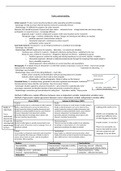
Korte samenvatting
Action research solve current practical problems while expanding scientific knowledge.
- Advantage: it helps to ensure that the business research is practically relevant
- Disadvantage: it is difficult for people to do action research
Elements that should be present: Purpose and value choice – contextual focus – change-based data and sense-making –
participation in research process – knowledge diffusion
- Diagnostic stage = involves collaborative analysis of the social situation by the researcher
- Therapeutic stage = involves collaborative change. Changes are introduced and effects are studied.
o positivist approach: classical action research
o interpretive approach: contemporary action research
o participatory action research:
Case study research purposes is to use empirical evidence to contribute to knowledge.
- Advantage: face validity
- Disadvantage: difficult to gain access to company – takes time – no control over situation
- Teaching cases: written for students – designed to illustrate existing theory - published on its own
- Research cases: written for researchers – designed to illustrate new theory – published in journal
o Positivist approach: method for testing and refining hypotheses in real world. Validity / reliability
o Interpretive approach: attempt to understand phenomena through the meanings that people assign to
them. plausibility important.
o Critical approach: critical reflections on current practices and assumptions
Ethnography in-depth research. Researcher is in the field. Context is important. Cost a lot of time – learns from people
instead of only studying them. framework for theorizing - ->
- Advantage: very in-depth
- Disadvantage: takes a lot of time doing fieldwork – much data
- Holistic school: empathy and identification with group being observed is needed
format concepts
- Semiotic school: researchers don’t need to have empathy
o Netnography = online ethnography. Study of culture on the internet. substantive focus
Theory scope
Grounded theory develops theory grounded in data that is gathered and analysed. Continuous
bounded context
interplay between data collection and analysis. Have to be open minded.
- Advantage: intuitive appeal for advanced researchers – gets researchers analysing data early –
description - interpretation - theory
encourages systematic and detailed analysis of data and provides a method for doing so degree of conceptualisation
- Disadvantage: researchers get overwhelmed at coding level. Evaluation: validity / theory produ
Method of difference: explain difference between cases in dependent variable, independent variables same.
Method of agreement: explain agreement between cases in dependent variable, independent variables differ.
Myers (2020) Justesen & Mik-Meyer (2021)
Positivist: Realist:
Positivist can be seen as a sub stream of realist research. Positivist can be seen as a sub stream of realist research.
Reality is Reality is objectively given and can be observed by a Reality is objectively given and can be observed by a Looking at the world as it is
objectively neutral researcher aiming to explain phenomena and neutral researcher aiming to explain phenomena and
conditions by testing hypothesis about causal relations conditions by testing hypothesis about causal relations
between independent and dependent variables, between independent and dependent variables,
Try to World is not completely real,
generating objective knowledge about objects with generating objective knowledge about objects with
understand inherent, essential characteristics. inherent, essential characteristics.
people have different views
phenomena of what happens in situation
through the Interpretive: Phenomenological:
meaning that Access to reality (given or socially constructed) is only There is no access to reality outside of our subjective Empathy needed / no need for it
people assign through social constructions such as language. Focus on knowledge or interpretation of it. The subjective
to them meaning in context. experience constitutes the object of analysis. There is no real world, we
have to deal with the world
Critical: Constructivist: we have created our self.
Social reality is a historical construction and researchers Social reality is a collective social construction, which Language say our ideas
need to question this status quo critically in order to implies that what we take for granted could always have
expose various forms of social, cultural and political taken different form. Anti-essentialist position.
domination. Ethical position.
Realism Phenomenology Constructivism
Generalizability – reliability – Communicative/ respondent validity Convincing, relevant - reflexivity –
triangulation – quality of craftsmanship quality criteria equals ethical criteria
Credibility (no error) – authenticity Meaningfulness Representativeness – being
(neutral) – representativeness exemplary - reflective/normative
Deductive: Inductive:
, Top down - confirmatory Bottom up – exploratory
Abstract concrete Concrete abstract
Dimensions and Sensitizing concepts
indicators: - open coding = descriptive
- Exhaustive - axial coding = thematic
- Exclusive - selective coding = patterns
Difficult: preparation Difficult: formulating codes
Bring in byecatch in Allowed to bring in new things
discussion
The Field role: the role you must fulfil for being a reliable participant over a longer period of time, in the field
that is object of your research.
The Research role: the role you must fulfil to gather and record valid data about the social situation that is
object of your research.
The Personal role: In fact that is the role you have as a person that is in that specific situation. You are the one
that participates and observes and must deal with that.
Observational memo - -> the description of your observations JMM: descriptive notes
Methodological memo - -> your thoughts about the way of gathering data, filing in your role
Theoretical memo - -> thoughts about the meaning of the results of the observation for the central question
Reflective memo - -> what is the observation doing to you? Reflection of own experience
Procedural memo - -> helps focus on the research process, show what you did and how you did it
Analytical memo - -> show the subject matter, focus on data and show interpretation about meaning of data
Concrete: write down your observations as clearly and concretely as possible. Don’t write your interpretation.
Descriptive: Write down what you observe: facts! Reproduce an event. Interpretation follows later!
Complete: name the lay-out of the room, the persons present, their acts, behaviour and interactions.
Precise: write down exactly what these people do, what they say or what is present
Be explicit: write down your expectations, feelings and interpretations as detailed as possible
Systematic: date, time and place
Coherence: connect to research question
Usability: contributes information to research question?
Types of conversation guides: topic list – interview format – interview protocol (reliability high, validity low)
Accommodating tactic: active silence, humming, question repetition
Encouraging probing tactic: positive comments, expression of comprehension
Challenging probing tactic: negative comments, expression of doubt, request for explanation or asking why?
Interview roles: give intro – ask questions – listen – evaluate – probe – provide structure – summarize – take notes – finish
Roles to avoid: representative – spokesperson – social worker – ally (=bondgenoot)
- Data triangulation: compare observations of different data sources about same social phenomenon
- Methods triangulation: compare observations with different methods of data collection about same
social phenomenon
- Researcher triangulation: compare different observations of same phenomenon by different observers
(same sources and methods)
- Theoretical triangulation: interpret same observations of a social phenomenon from different
theoretical perspectives
Standardization: to what extent can we standardize the measurements of group decision making processes?
Replicability: to what extent is it possible to repeat the data gathering process and the analysis
Action research solve current practical problems while expanding scientific knowledge.
- Advantage: it helps to ensure that the business research is practically relevant
- Disadvantage: it is difficult for people to do action research
Elements that should be present: Purpose and value choice – contextual focus – change-based data and sense-making –
participation in research process – knowledge diffusion
- Diagnostic stage = involves collaborative analysis of the social situation by the researcher
- Therapeutic stage = involves collaborative change. Changes are introduced and effects are studied.
o positivist approach: classical action research
o interpretive approach: contemporary action research
o participatory action research:
Case study research purposes is to use empirical evidence to contribute to knowledge.
- Advantage: face validity
- Disadvantage: difficult to gain access to company – takes time – no control over situation
- Teaching cases: written for students – designed to illustrate existing theory - published on its own
- Research cases: written for researchers – designed to illustrate new theory – published in journal
o Positivist approach: method for testing and refining hypotheses in real world. Validity / reliability
o Interpretive approach: attempt to understand phenomena through the meanings that people assign to
them. plausibility important.
o Critical approach: critical reflections on current practices and assumptions
Ethnography in-depth research. Researcher is in the field. Context is important. Cost a lot of time – learns from people
instead of only studying them. framework for theorizing - ->
- Advantage: very in-depth
- Disadvantage: takes a lot of time doing fieldwork – much data
- Holistic school: empathy and identification with group being observed is needed
format concepts
- Semiotic school: researchers don’t need to have empathy
o Netnography = online ethnography. Study of culture on the internet. substantive focus
Theory scope
Grounded theory develops theory grounded in data that is gathered and analysed. Continuous
bounded context
interplay between data collection and analysis. Have to be open minded.
- Advantage: intuitive appeal for advanced researchers – gets researchers analysing data early –
description - interpretation - theory
encourages systematic and detailed analysis of data and provides a method for doing so degree of conceptualisation
- Disadvantage: researchers get overwhelmed at coding level. Evaluation: validity / theory produ
Method of difference: explain difference between cases in dependent variable, independent variables same.
Method of agreement: explain agreement between cases in dependent variable, independent variables differ.
Myers (2020) Justesen & Mik-Meyer (2021)
Positivist: Realist:
Positivist can be seen as a sub stream of realist research. Positivist can be seen as a sub stream of realist research.
Reality is Reality is objectively given and can be observed by a Reality is objectively given and can be observed by a Looking at the world as it is
objectively neutral researcher aiming to explain phenomena and neutral researcher aiming to explain phenomena and
conditions by testing hypothesis about causal relations conditions by testing hypothesis about causal relations
between independent and dependent variables, between independent and dependent variables,
Try to World is not completely real,
generating objective knowledge about objects with generating objective knowledge about objects with
understand inherent, essential characteristics. inherent, essential characteristics.
people have different views
phenomena of what happens in situation
through the Interpretive: Phenomenological:
meaning that Access to reality (given or socially constructed) is only There is no access to reality outside of our subjective Empathy needed / no need for it
people assign through social constructions such as language. Focus on knowledge or interpretation of it. The subjective
to them meaning in context. experience constitutes the object of analysis. There is no real world, we
have to deal with the world
Critical: Constructivist: we have created our self.
Social reality is a historical construction and researchers Social reality is a collective social construction, which Language say our ideas
need to question this status quo critically in order to implies that what we take for granted could always have
expose various forms of social, cultural and political taken different form. Anti-essentialist position.
domination. Ethical position.
Realism Phenomenology Constructivism
Generalizability – reliability – Communicative/ respondent validity Convincing, relevant - reflexivity –
triangulation – quality of craftsmanship quality criteria equals ethical criteria
Credibility (no error) – authenticity Meaningfulness Representativeness – being
(neutral) – representativeness exemplary - reflective/normative
Deductive: Inductive:
, Top down - confirmatory Bottom up – exploratory
Abstract concrete Concrete abstract
Dimensions and Sensitizing concepts
indicators: - open coding = descriptive
- Exhaustive - axial coding = thematic
- Exclusive - selective coding = patterns
Difficult: preparation Difficult: formulating codes
Bring in byecatch in Allowed to bring in new things
discussion
The Field role: the role you must fulfil for being a reliable participant over a longer period of time, in the field
that is object of your research.
The Research role: the role you must fulfil to gather and record valid data about the social situation that is
object of your research.
The Personal role: In fact that is the role you have as a person that is in that specific situation. You are the one
that participates and observes and must deal with that.
Observational memo - -> the description of your observations JMM: descriptive notes
Methodological memo - -> your thoughts about the way of gathering data, filing in your role
Theoretical memo - -> thoughts about the meaning of the results of the observation for the central question
Reflective memo - -> what is the observation doing to you? Reflection of own experience
Procedural memo - -> helps focus on the research process, show what you did and how you did it
Analytical memo - -> show the subject matter, focus on data and show interpretation about meaning of data
Concrete: write down your observations as clearly and concretely as possible. Don’t write your interpretation.
Descriptive: Write down what you observe: facts! Reproduce an event. Interpretation follows later!
Complete: name the lay-out of the room, the persons present, their acts, behaviour and interactions.
Precise: write down exactly what these people do, what they say or what is present
Be explicit: write down your expectations, feelings and interpretations as detailed as possible
Systematic: date, time and place
Coherence: connect to research question
Usability: contributes information to research question?
Types of conversation guides: topic list – interview format – interview protocol (reliability high, validity low)
Accommodating tactic: active silence, humming, question repetition
Encouraging probing tactic: positive comments, expression of comprehension
Challenging probing tactic: negative comments, expression of doubt, request for explanation or asking why?
Interview roles: give intro – ask questions – listen – evaluate – probe – provide structure – summarize – take notes – finish
Roles to avoid: representative – spokesperson – social worker – ally (=bondgenoot)
- Data triangulation: compare observations of different data sources about same social phenomenon
- Methods triangulation: compare observations with different methods of data collection about same
social phenomenon
- Researcher triangulation: compare different observations of same phenomenon by different observers
(same sources and methods)
- Theoretical triangulation: interpret same observations of a social phenomenon from different
theoretical perspectives
Standardization: to what extent can we standardize the measurements of group decision making processes?
Replicability: to what extent is it possible to repeat the data gathering process and the analysis


