
- Guías de estudio, Notas de estudios & Resúmenes
¿Buscas las mejores guías de estudio, notas de estudio y resúmenes para ? En esta página encontrarás 21 documentos de estudio para .
Examen
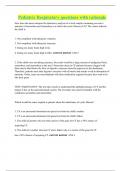
Pediatric Respiratory questions with rationale
How does the nurse interpret the laboratory analysis of a stool sample containing excessive amounts of azotorrhea and steatorrhea in a child with cystic fibrosis (CF)? The values indicate the child is 1. Not compliant with taking her vitamins. 2. Not compliant with taking her enzymes. 3. Eating too many foods high in fat. 4. Eating too many foods high in fiber. correct answer ANS 2 2. If the child were not taking enzymes, the result would be a large amount of undigested food, azotorrhe...
 ARTMAST
Examen
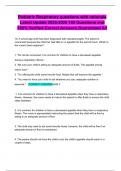
Pediatric Respiratory questions with rationale Latest Update 2025-2026 180 Questions and 100% Verified Correct Answers Guaranteed A+
PopularPediatric Respiratory questions with rationale Latest Update Questions and 100% Verified Correct Answers Guaranteed A+
 Tutordiligent
Lote
Full Package-;;Pediatric Respiratory EXAMS
NuevoPediatric Respiratory: Practice Test 1 (Units 1-7) - Questions with Correct Answers 5 Exam (elaborations) Pediatric Respiratory: Practice Test 2 (Units 8-13) - Questions with Correct Answers 6 Exam (elaborations) Pediatric Respiratory: Exam 1 - Questions with Correct Answers 7 Exam (elaborations) Pediatric Respirator
 TheePlug
Lote
Pediatric Respiratory Exam BUNDLE (Midterm, Exam 1-3 & Final Exam)
NuevoPediatric Respiratory: Exam 3 - Questions with Correct Answers 2 Exam (elaborations) Pediatric Respiratory: Final Exam (Comprehensive) Questions with Correct Answers 3 Exam (elaborations) Pediatric Respiratory: Midterm Exam (Units 1-7) - Questions with Correct Answers 4 Exam (elaborations)
TheePlug
Examen
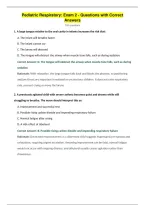
Pediatric Respiratory: Exam 2 - Questions with Correct Answers
Nuevo1. A large tongue relative to the oral cavity in infants increases the risk that: A. The infant will breathe faster B. The infant cannot cry C. The larynx will descend D. The tongue will obstruct the airway when muscle tone falls, such as during sedation Correct Answer: D. The tongue will obstruct the airway when muscle tone falls, such as during sedation Rationale: With relaxation, the large tongue falls back and blocks the pharynx, so positioning and jaw thrust are important in sedated...
TheePlug
Examen
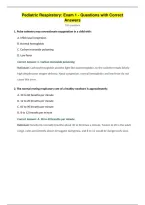
Pediatric Respiratory: Exam 1 - Questions with Correct Answers
Nuevo1. Pulse oximetry may overestimate oxygenation in a child with: A. Mild nasal congestion B. Normal hemoglobin C. Carbon monoxide poisoning D. Low fever Correct Answer: C. Carbon monoxide poisoning Rationale: Carboxyhemoglobin absorbs light like oxyhemoglobin, so the oximeter reads falsely high despite poor oxygen delivery. Nasal congestion, normal hemoglobin and low fever do not cause this error. 2. The normal resting respiratory rate of a healthy newborn is approximately: A. 30 to 60 ...
TheePlug
Examen
Pediatric Respiratory: Practice Test 2 (Units 8-13) - Questions with Correct Answers
Nuevo1. Before stepping up asthma therapy for poor control, the nurse should first check: A. The child's shoe size B. Inhaler technique, adherence and exposure to triggers C. Whether the child likes the inhaler color D. The weather forecast only Correct Answer: B. Inhaler technique, adherence and exposure to triggers Rationale: Poor technique, missed doses and ongoing exposures are common reasons for poor control and should be addressed before adding medication. The other factors are irrele...
TheePlug
Examen
Pediatric Respiratory: Practice Test 1 (Units 1-7) - Questions with Correct Answers
Nuevo1. Cyanosis in a child with respiratory illness is considered: A. An early and reliable sign of mild hypoxemia B. A sign of good perfusion C. A sign seen only in children with heart disease D. A late sign of hypoxemia Correct Answer: D. A late sign of hypoxemia Rationale: Central cyanosis appears only when a large amount of hemoglobin is desaturated, so it is a late finding, and anemia can mask it. It is not an early sign, does not reflect good perfusion, and occurs with severe respirato...
TheePlug
Examen
Pediatric Respiratory: Midterm Exam (Units 1-7) - Questions with Correct Answers
Nuevo1. Compared with an adult, a child's functional residual capacity relative to oxygen demand is: A. Larger, so desaturation is delayed B. Smaller, so oxygen reserve is limited C. Identical D. Unrelated to desaturation Correct Answer: B. Smaller, so oxygen reserve is limited Rationale: A small functional residual capacity combined with high oxygen consumption means children have little reserve and desaturate quickly. Larger or identical reserves would delay desaturation, which is not th...
TheePlug
Examen
Pediatric Respiratory: Final Exam (Comprehensive) Questions with Correct Answers
Nuevo1. Newborn hearing screening is important because: A. Hearing loss cannot be treated B. All hearing loss is caused by otitis media C. Early detection and intervention before 6 months improves language outcomes D. Screening replaces later hearing checks Correct Answer: C. Early detection and intervention before 6 months improves language outcomes Rationale: Identifying hearing loss early allows hearing aids or other help during the key period for language development. Hearing loss can be ...
TheePlug
Examen
Pediatric Respiratory: Exam 3 - Questions with Correct Answers
Nuevo1. Nasal flaring in an infant indicates: A. Normal sleep breathing B. Nasal infection only C. An attempt to reduce airway resistance and increase air intake during distress D. Excess sedation Correct Answer: C. An attempt to reduce airway resistance and increase air intake during distress Rationale: Widening the nostrils lowers resistance in the nasal passages, so flaring is a sign of increased work of breathing. It is not normal at rest, is not specific to nasal infection, and does not...
TheePlug
Examen
Pediatric Respiratory - 2026 Asthma & RSV Management
Nuevo1. According to Poiseuille's law, how does the resistance to airflow in a child's airway compare to that of an adult when mucosal edema occurs? A. Resistance increases linearly with the decrease in airway radius B. Resistance is inversely proportional to the fourth power of the airway radius, meaning a 1 mm reduction in a child's small airway increases resistance exponentially (by up to 16-fold) C. Children have larger airways relative to body size, so they are less affected by ede...
 gradexam
Examen
Pediatric Respiratory Exam Study Guide – Practice Questions with Verified Answers. GRADED A+. Latest 2026/2027 Update.
NuevoPediatric Respiratory Exam Study Guide – Practice Questions with Verified Answers. GRADED A+. Latest 2026/2027 Update. Pediatric Respiratory Exam Study Guide – Practice Questions with Verified Answers. GRADED A+. Latest 2026/2027 Update. Pediatric Respiratory Exam Study Guide – Practice Questions with Verified Answers. GRADED A+. Latest 2026/2027 Update.
 BESTGRADE32
Examen
Pediatric Respiratory Disorders Egans 2026 – Questions on RDS, TTN, MAS, BPD, PPHN, Congenital Defects & RSV
NuevoPediatric Respiratory Disorders Egans 2026 – Questions on RDS, TTN, MAS, BPD, PPHN, Congenital Defects & RSV
 AceExam1
Examen
Pediatric Respiratory Exam Questions & Answers (2026)
Master the critical concepts of pediatric lower respiratory disorders with our updated 2026 test bank. This resource features practice questions and answers on RSV Bronchiolitis, Asthma, Croup, Pneumonia, and Cystic Fibrosis, tailored for nursing students preparing for course exams and the NCLEX-PN® and NCLEX-RN®. Each question includes detailed explanations to solidify your understanding of pediatric assessment, diagnosis, and current treatment guidelines. Stop searching for scattered study m...
 Paulacademia1
Examen
Pediatric Respiratory Questions with Rationale 2025/2026 Exam Questions and Answers | 100% Pass
Pediatric Respiratory Questions with Rationale 2025/2026 Exam Questions and Answers | 100% Pass How does the nurse interpret the laboratory analysis of a stool sample containing excessive amounts of azotorrhea and steatorrhea in a child with cystic fibrosis (CF)? The values indicate the child is 1. Not compliant with taking her vitamins. 2. Not compliant with taking her enzymes. 3. Eating too many foods high in fat. 4. Eating too many foods high in fiber. -
PROFFKERRYMARTIN
Examen
Pediatric Respiratory Quiz Questions And Answers Latest Update 2025-2026 Questions and 100% Verified Correct Answers with Rationale Guaranteed A+
Pediatric Respiratory Quiz Questions And Answers Latest Update Questions and 100% Verified Correct Answers with Rationale Guaranteed A+
Tutordiligent
Lote
Pediatrics: Respiratory Bundle
Pediatrics: Respiratory Bundle
ARTMAST
Examen
pediatric respiratory questions with correct answers
The mother of an infant diagnosed with bronchiolitis asks the nurse what causes this disease. The nurse's response would be based on the knowledge that the majority of infections that cause bronchiolitis are a result of: a. Ribavirin b. Mycoplasma pneumoniae c. RSV d. hemophilus influenzae correct answer c. RSV A child is Brough to the emergency department with suspected epiglottis. Which nursing intervention would be considered unsafe? a. allowing the child to remain in the positi...
ARTMAST
Examen
pediatric respiratory questions with correct answers
The mother of an infant diagnosed with bronchiolitis asks the nurse what causes this disease. The nurse's response would be based on the knowledge that the majority of infections that cause bronchiolitis are a result of: a. Ribavirin b. Mycoplasma pneumoniae c. RSV d. hemophilus influenzae correct answer c. RSV A child is Brough to the emergency department with suspected epiglottis. Which nursing intervention would be considered unsafe? a. allowing the child to remain in the positi...
 cracker