
RNSG 2201 (RNSG2201)
San Jacinto College
Aquí están los mejores recursos para pasar RNSG 2201 (RNSG2201). Encuentra RNSG 2201 (RNSG2201) guías de estudio, notas, tareas, y mucho más.
Libros populares
Wong's Clinical Manual of Pediatric Nursing - E-Book
David Wilson, Marilyn J. Hockenberry
9 documentos
Examen
RNSG 2201 - Pediatrics Exam 1 Study Guide.
RNSG 2201 - Pediatrics Exam 1 Study Guide.
 LECTAYOT
Examen
RNSG 2201 - Pediatrics Exam 1 Study Guide.
PopularRNSG 2201 - Pediatrics Exam 1 Study Guide.
 Toian
Examen
Chapter 25: The Child with Cancer Hockenberry: Wong’s Essentials of Pediatric Nursing, 10th Edition
1. The school nurse is discussing testicular self-examination with adolescent boys. Why is this important? a. Epididymitis is common during adolescence. b. Asymptomatic sexually transmitted diseases may be present. c. Testicular tumors during adolescence are generally malignant. d. Testicular tumors, although usually benign, are common during adolescence. ANS: C Tumors of the testes are not common, but when manifested in adolescence, they are generally malignant and demand immediate eval...
greatsolutions
Examen
Chapter 28: The Child with Endocrine Dysfunction Hockenberry: Wong’s Essentials of Pediatric Nursing, 10th Edition
1. Parents of a toddler with hypopituitarism ask the nurse, “What can we expect with this condition?” The nurse should respond with which statement? a. Growth is normal during the first 3 years of life. b. Weight is usually more retarded than height. c. Skeletal proportions are normal for age. d. Most of these children have subnormal intelligence. ANS: C In children with hypopituitarism, the skeletal proportions are normal. Growth is within normal limits for the first year of life. H...
greatsolutions
Examen
Chapter 16: Health Problems of School-Age Children and Adolescents Hockenberry: Wong’s Essentials of Pediatric Nursing, 10th Edition
1. Which statement is true about smoking in adolescence? a. Smoking is related to other high-risk behaviors. b. Smoking will not continue unless peer pressure continues. c. Smoking is less common when the adolescent’s parent(s) smokes. d. Smoking among adolescents is becoming more prevalent. ANS: A Cigarettes are considered a gateway drug. Teenagers who smoke are 11.4 times more likely to use an illicit drug. Teenagers begin smoking for a variety of reasons, such as imitation of adult ...
greatsolutions
Examen
Chapter 15: Health Promotion of the Adolescent and Family Hockenberry: Wong’s Essentials of Pediatric Nursing, 10th Edition
1. What is the initial indication of puberty in girls? a. Menarche b. Growth spurt c. Growth of pubic hair d. Breast development ANS: D In most girls, the initial indication of puberty is the appearance of breast buds, an event known as thelarche. The usual sequence of secondary sex characteristic development in girls is breast changes, rapid increase in height and weight, growth of pubic hair, appearance of axillary hair, menstruation, and abrupt deceleration of linear growth. DIF: Co...
greatsolutions
Caso
Chapter 19: Family-Centered Care of the Child During Illness and Hospitalization Hockenberry: Wong’s Essentials of Pediatric Nursing, 10th Edition ALL ANSWERS 100% SOLVED 2022/2023 EDITION RATED GRADE A+
1. A nurse is caring for four patients; three are toddlers and one is a preschooler. Which represents the major stressor of hospitalization for these four patients? a. Separation anxiety b. Loss of control c. Fear of bodily injury d. Fear of pain ANS: A The major stressor for children from infancy through the preschool years is separation anxiety, also called anaclitic depression. This is a major stressor of hospitalization. Loss of control, fear of bodily injury, and fear of pain are a...
greatsolutions
Examen
Chapter 17: Quality of Life for Children Living with Chronic and Complex Diseases Hockenberry: Wong’s Essentials of Pediatric Nursing, 10th Edition ALL ANSWERS 100% SOLVED 2022/2023 EDITION RATED GRADE A+
1. The nurse case manager is planning a care conference about a young child who has complex health care needs and will soon be discharged home. Who should the nurse invite to the conference? a. Family and nursing staff b. Social worker, nursing staff, and primary care physician c. Family and key health professionals involved in the child’s care d. Primary care physician and key health professionals involved in the child’s care ANS: C A multidisciplinary conference is necessary for co...
greatsolutions
Examen
Chapter 20: Pediatric Variations of Nursing Interventions Hockenberry: Wong’s Essentials of Pediatric Nursing, 10th Edition
1. Which should the nurse consider when having consent forms signed for surgery and procedures on children? a. Only a parent or legal guardian can give consent. b. The person giving consent must be at least 18 years old. c. The risks and benefits of a procedure are part of the consent process. d. A mental age of 7 years or older is required for a consent to be considered “informed.” ANS: C The informed consent must include the nature of the procedure, benefits and risks, and alterna...
greatsolutions
Examen
Chapter 18: Impact of Cognitive or Sensory Impairment on the Child and Family Hockenberry: Wong’s Essentials of Pediatric Nursing, 10th Edition
1. A young child has an intelligence quotient (IQ) of 45. The nurse should document this finding as: a. within the lower limits of the range of normal intelligence. b. mild cognitive impairment but educable. c. moderate cognitive impairment but trainable. d. severe cognitive impairment and completely dependent on others for care. ANS: C Moderate cognitive impairment IQs range between 35 and 55. The lower limit of normal intelligence is approximately 70. Individuals with IQs of 50 to 70 a...
greatsolutions
Examen
Chapter 06: Childhood Communicable and Infectious Diseases Hockenberry: Wong’s Essentials of Pediatric Nursing, 10th Edition
1. Which term best describes the identification of the distribution and causes of disease, injury, or illness? a. Nursing process b. Epidemiologic process c. Community-based statistics d. Mortality and morbidity statistics ANS: B Epidemiology is the science of population health applied to the detection of morbidity and mortality in a population. It identifies the distribution and causes of diseases across a population. Nursing process is a systematic problem-solving approach for the del...
greatsolutions
Examen
Chapter 14: Health Promotion of the School-Age Child and Family Hockenberry: Wong’s Essentials of Pediatric Nursing, 10th Edition
1. The nurse is teaching a group of 10- to 12-year-old children about physical development during the school-age years. Which statement made by a participant, indicates the correct understanding of the teaching? a. “My body weight will be almost triple in the next few years.” b. “I will grow an average of 2 inches per year from this point on.” c. “There are not that many physical differences among school-age children.” d. “I will have a gradual increase in fat, which may cont...
greatsolutions
Examen
Chapter 05: Pain Assessment and Management in Children Hockenberry: Wong’s Essentials of Pediatric Nursing, 10th Edition
MULTIPLE CHOICE 1. A 2-year-old child has been returned to the nursing unit after an inguinal hernia repair. Which pain assessment tool should the nurse use to assess this child for the presence of pain? a. FACES pain rating tool b. Numeric scale c. Oucher scale d. FLACC tool ANS: D A behavioral pain tool should be used when the child is preverbal or doesn’t have the language skills to express pain. The FLACC (face, legs, activity, cry, consolability) tool should be used with a 2-yea...
greatsolutions
Examen
Chapter 07: Health Promotion of the Newborn and Family Hockenberry: Wong’s Essentials of Pediatric Nursing, 10th Edition
1. Which is the most critical physiologic change required of the newborn? a. Closure of fetal shunts in the heart b. Stabilization of fluid and electrolytes c. Body-temperature maintenance d. Onset of breathing ANS: D The onset of breathing is the most immediate and critical physiologic change required for transition to extrauterine life. Factors that interfere with this normal transition increase fetal asphyxia, which is a condition of hypoxemia, hypercapnia, and acidosis. This affects ...
greatsolutions
Examen
Chapter 04: Communication and Physical Assessment of the Child and Family Hockenberry: Wong’s Essentials of Pediatric Nursing, 10th Edition
1. The nurse is seeing an adolescent boy and his parents in the clinic for the first time. What should the nurse do first? a. Introduce self. b. Make family comfortable. c. Explain purpose of interview. d. Give assurance of privacy. ANS: A The first thing that nurses should do is to introduce themselves to the patient and family. Parents and other adults should be addressed with appropriate titles unless they specify a preferred name. During the initial part of the interview, the nurse ...
greatsolutions
Examen
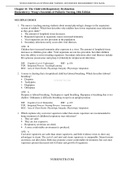
Chapter 30: The Child with Neuromuscular or Muscular Dysfunction Hockenberry: Wong’s Essentials of Pediatric Nursing, 10th Edition
1. The nurse is planning a staff in-service on childhood spastic cerebral palsy. What characterizes spastic cerebral palsy? a. Hypertonicity and poor control of posture, balance, and coordinated motion b. Athetosis and dystonic movements c. Wide-based gait and poor performance of rapid, repetitive movements d. Tremors and lack of active movement ANS: A Hypertonicity and poor control of posture, balance, and coordinated motion are part of the classification of spastic cerebral palsy. Athe...
greatsolutions
Examen
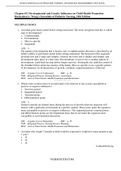
Chapter 21: The Child with Respiratory Dysfunction Hockenberry: Wong’s Essentials of Pediatric Nursing, 10th Edition
1. The nurse is teaching nursing students about normal physiologic changes in the respiratory system of toddlers. Which best describes why toddlers have fewer respiratory tract infections as they grow older? a. The amount of lymphoid tissue decreases. b. Repeated exposure to organisms causes increased immunity. c. Viral organisms are less prevalent in the population. d. Secondary infections rarely occur after viral illnesses. ANS: B Children have increased immunity after exposure to a vi...
greatsolutions
Examen
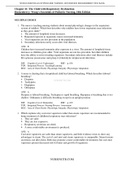
Chapter 03: Developmental and Genetic Influences on Child Health Promotion Hockenberry: Wong’s Essentials of Pediatric Nursing, 10th Edition
1. An infant gains head control before sitting unassisted. The nurse recognizes that this is which type of development? a. Cephalocaudal b. Proximodistal c. Mass to specific d. Sequential ANS: A The pattern of development that is head-to-tail, or cephalocaudal, direction is described by an infant’s ability to gain head control before sitting unassisted. The head end of the organism develops first and is large and complex, whereas the lower end is smaller and simpler, and development ...
greatsolutions
Lote
San Jacinto Community College RNSG 2201 Chapter 01 to chapter 12 Wong’s Essentials of Pediatric Nursing, 10th Edition ALL ANSWERS 100% SOLVED 2022/2023 EDITION RATED GRADE A
San Jacinto Community College RNSG 2201 Chapter 01 to chapter 12 : Hockenberry Wong’s Essentials of Pediatric Nursing, 10th Edition ALL ANSWERS 100% SOLVED 2022/2023 EDITION RATED GRADE A
 Studygreatsolutions
Examen
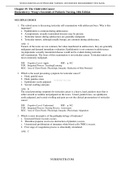
Chapter 25: The Child with Cancer Hockenberry: Wong’s Essentials of Pediatric Nursing, 10th Edition
1. The school nurse is discussing testicular self-examination with adolescent boys. Why is this important? a. Epididymitis is common during adolescence. b. Asymptomatic sexually transmitted diseases may be present. c. Testicular tumors during adolescence are generally malignant. d. Testicular tumors, although usually benign, are common during adolescence. ANS: C Tumors of the testes are not common, but when manifested in adolescence, they are generally malignant and demand immediate eval...
Studygreatsolutions
Examen
Chapter 28: The Child with Endocrine Dysfunction Hockenberry: Wong’s Essentials of Pediatric Nursing, 10th Edition
1. Parents of a toddler with hypopituitarism ask the nurse, “What can we expect with this condition?” The nurse should respond with which statement? a. Growth is normal during the first 3 years of life. b. Weight is usually more retarded than height. c. Skeletal proportions are normal for age. d. Most of these children have subnormal intelligence. ANS: C In children with hypopituitarism, the skeletal proportions are normal. Growth is within normal limits for the first year of life. H...
Studygreatsolutions
Examen
Chapter 15: Health Promotion of the Adolescent and Family Hockenberry: Wong’s Essentials of Pediatric Nursing, 10th Edition
1. What is the initial indication of puberty in girls? a. Menarche b. Growth spurt c. Growth of pubic hair d. Breast development ANS: D In most girls, the initial indication of puberty is the appearance of breast buds, an event known as thelarche. The usual sequence of secondary sex characteristic development in girls is breast changes, rapid increase in height and weight, growth of pubic hair, appearance of axillary hair, menstruation, and abrupt deceleration of linear growth. DIF: Co...
Studygreatsolutions