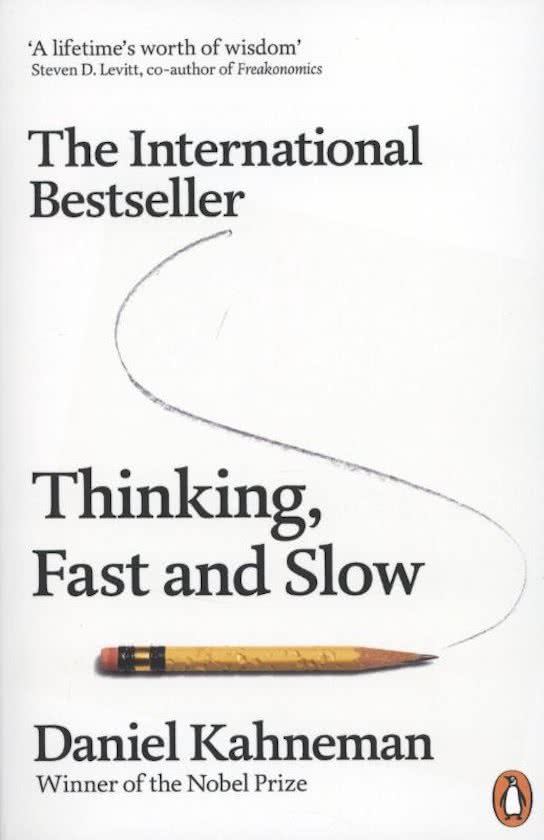
Thinking Fast and Slow
0HV50
Summary of Kahneman’s book.
BakedToast
EINDHOVEN UNIVERSITY OF TECHNOLOGY
,Lecture 5 – Kahneman Part 1 (chapter 1 – 9)
What is a good decision: Rational decision, based on probability theory and decision theory.
Homo Economicus → Rational, no mistakes, uses all information, selfish, complete will power.
Rationality?
- Being reasonable,
- Satisfying formal logical requirements
- 2 major requirements:
1. Consistency: If A is preferred to B, B cannot be preferred over A.
2. Transitivity: If A is preferred to B, and B to C, A must be preferred to C.
However, characteristics of decisions are:
- That they are based on reason (rationality and pseudo-rationality)
- They are shaped by perceptual processes (e.g. framing)
- They are a challenge to rationality assumption: they are influenced by emotion (e.g. greed,
fear, etc.). Hot/cold decision making
o This is shown by the dividing-money (or officially ‘Ultimatum Game’) experiment and
the NY Cabdriver problem.
Kahneman now calls it system 1.
Bounded rationality:
Short-cut strategies that work well (Heuristics), that are satisficing rather than maximizing. 2
approaches:
1. Heuristics and biases (Tversky & Kahneman)
2. Fast and Frugal heuristics (Gigerenzer et al.)
Normative decisions: How we ought to make decisions; based on reflection, using analytics, logic and
formal theories.
Descriptive decisions: How we actually make decisions; based on observation, using mathematical
adaptations or heuristics.
Chapter 1: The characters of the story
Prescriptive: How to improve our decision making à based on design, providing rules to improve
decision making. E.g. beter leven / gezondere keuze labels.
- System 1: automatic, quick, effortless. (e.g. skills, procedural and implicit memory).
• This system runs automatically and generates suggestions for system 2.
- System 2: effortful, deliberative, complex. (e.g. reasoning, logic and explicit memory) System
2 (in low effort mode) often accepts these suggestions. Only system 2 can construct thoughts
in an orderly fashion and sometimes can override system 1.
Chapter 2 – Attention & Effort
-Pupil dilation = cognitive effort
-System 1 takes over in emergencies, self-protective
o “Law of least effort”
- System 2 follows rules, compare & deliberate
“Task sets”, override habitual response → executive control
, Chapter 3: Effort & Self-control
- State of flow: focused attention = no exertion of self-control
- Ego-depletion: system 2 work depletes resources to control other things (mental energy)
- System 2 made of two parts:
o Algorithmic mind: slow thinking & demanding computation
o Rational mind: ability to resist biases
Ego-depletion: the idea that self-control or willpower draws upon a limited pool of mental
‘power’/resources. System 2 work requires this effort and thus depletes these resources. E.g. When
you have to make a series of choices that involve conflict, you are less likely to keep your diet.
Chapter 4 – Priming
- Priming effect: word exposure effect on related words
- “Lady Macbeth effect”: stained soul = desire to cleanse body
- Arises in system 1, no conscious access to priming
Associative memory: A word generates associations to other concepts, that facilitate other words
and concepts (through a network). E.g. Eat→SO_P (soup) and Wash→SO_P (soap). However, lot of
debate on priming.
- The associative system resolves ambiguity outside of your awareness.
Chapter 5: Cognitive ease
- System 1 assesses cognitive ease/ is system 2 necessary
- Pastness: illusion of familiarity, greater cognitive ease to familiarity
- Truth illusion: making something believable (legibility and simplicity)
- Mere exposure effect: link repetition and affection
- Mood affects operation of system 1: unhappy (less intuitive) vs happy (loosens system 2)
Chapter 6: Norms, suprises and causes
- Surprise indicates how well system 1 maintains/updates world
- Impressions of causality by system 1
- Norm theory has many aspects of PDP model → what is normal → Default assignment
(CH8).
Norm theory: What is normal, what isn’t? Similarity to parallel distributed processing
- Moses Illusion: ‘How many animals of each kind did Moses take into the ark?’ → People fail
to notice inconsistencies in a text. System 1 fixing the wrong error.
- I.e. After spending a day exploring beautiful sights in NY, Jane discovered her wallet was
missing. False memory: Pickpocket more associated than sights in a recall test.
Chapter 7: A machine for jumping to conclusions
- Daniel Gilbert: first believe (system 1), then unbelieve (system 2)
- Associative memory contributes to confirmation bias
- Halo effect: tendency to like/dislike everything about a person. Sequence important.
- Associate system (1) resolves ambiguity outside awareness (compare PDP, perception…)
- Believing and unbelieving: You can only reject (unbelieve) a statement after you ‘believe’ it.
o Unbelieving is system 2: Hard when occupied.
- Associative machine only represents activated ideas. System 1 & WYSIATI facilitates
coherence/ cognitive ease accepting truth
o Overconfidence: no possibility missing evidence
0HV50
Summary of Kahneman’s book.
BakedToast
EINDHOVEN UNIVERSITY OF TECHNOLOGY
,Lecture 5 – Kahneman Part 1 (chapter 1 – 9)
What is a good decision: Rational decision, based on probability theory and decision theory.
Homo Economicus → Rational, no mistakes, uses all information, selfish, complete will power.
Rationality?
- Being reasonable,
- Satisfying formal logical requirements
- 2 major requirements:
1. Consistency: If A is preferred to B, B cannot be preferred over A.
2. Transitivity: If A is preferred to B, and B to C, A must be preferred to C.
However, characteristics of decisions are:
- That they are based on reason (rationality and pseudo-rationality)
- They are shaped by perceptual processes (e.g. framing)
- They are a challenge to rationality assumption: they are influenced by emotion (e.g. greed,
fear, etc.). Hot/cold decision making
o This is shown by the dividing-money (or officially ‘Ultimatum Game’) experiment and
the NY Cabdriver problem.
Kahneman now calls it system 1.
Bounded rationality:
Short-cut strategies that work well (Heuristics), that are satisficing rather than maximizing. 2
approaches:
1. Heuristics and biases (Tversky & Kahneman)
2. Fast and Frugal heuristics (Gigerenzer et al.)
Normative decisions: How we ought to make decisions; based on reflection, using analytics, logic and
formal theories.
Descriptive decisions: How we actually make decisions; based on observation, using mathematical
adaptations or heuristics.
Chapter 1: The characters of the story
Prescriptive: How to improve our decision making à based on design, providing rules to improve
decision making. E.g. beter leven / gezondere keuze labels.
- System 1: automatic, quick, effortless. (e.g. skills, procedural and implicit memory).
• This system runs automatically and generates suggestions for system 2.
- System 2: effortful, deliberative, complex. (e.g. reasoning, logic and explicit memory) System
2 (in low effort mode) often accepts these suggestions. Only system 2 can construct thoughts
in an orderly fashion and sometimes can override system 1.
Chapter 2 – Attention & Effort
-Pupil dilation = cognitive effort
-System 1 takes over in emergencies, self-protective
o “Law of least effort”
- System 2 follows rules, compare & deliberate
“Task sets”, override habitual response → executive control
, Chapter 3: Effort & Self-control
- State of flow: focused attention = no exertion of self-control
- Ego-depletion: system 2 work depletes resources to control other things (mental energy)
- System 2 made of two parts:
o Algorithmic mind: slow thinking & demanding computation
o Rational mind: ability to resist biases
Ego-depletion: the idea that self-control or willpower draws upon a limited pool of mental
‘power’/resources. System 2 work requires this effort and thus depletes these resources. E.g. When
you have to make a series of choices that involve conflict, you are less likely to keep your diet.
Chapter 4 – Priming
- Priming effect: word exposure effect on related words
- “Lady Macbeth effect”: stained soul = desire to cleanse body
- Arises in system 1, no conscious access to priming
Associative memory: A word generates associations to other concepts, that facilitate other words
and concepts (through a network). E.g. Eat→SO_P (soup) and Wash→SO_P (soap). However, lot of
debate on priming.
- The associative system resolves ambiguity outside of your awareness.
Chapter 5: Cognitive ease
- System 1 assesses cognitive ease/ is system 2 necessary
- Pastness: illusion of familiarity, greater cognitive ease to familiarity
- Truth illusion: making something believable (legibility and simplicity)
- Mere exposure effect: link repetition and affection
- Mood affects operation of system 1: unhappy (less intuitive) vs happy (loosens system 2)
Chapter 6: Norms, suprises and causes
- Surprise indicates how well system 1 maintains/updates world
- Impressions of causality by system 1
- Norm theory has many aspects of PDP model → what is normal → Default assignment
(CH8).
Norm theory: What is normal, what isn’t? Similarity to parallel distributed processing
- Moses Illusion: ‘How many animals of each kind did Moses take into the ark?’ → People fail
to notice inconsistencies in a text. System 1 fixing the wrong error.
- I.e. After spending a day exploring beautiful sights in NY, Jane discovered her wallet was
missing. False memory: Pickpocket more associated than sights in a recall test.
Chapter 7: A machine for jumping to conclusions
- Daniel Gilbert: first believe (system 1), then unbelieve (system 2)
- Associative memory contributes to confirmation bias
- Halo effect: tendency to like/dislike everything about a person. Sequence important.
- Associate system (1) resolves ambiguity outside awareness (compare PDP, perception…)
- Believing and unbelieving: You can only reject (unbelieve) a statement after you ‘believe’ it.
o Unbelieving is system 2: Hard when occupied.
- Associative machine only represents activated ideas. System 1 & WYSIATI facilitates
coherence/ cognitive ease accepting truth
o Overconfidence: no possibility missing evidence