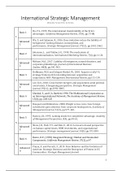
International Strategic Management
Weekly Scientific Articles
Hu, Y.S., 1995. The international transferability of the firm's
Basic 1
advantages. California Management Review, 37(4), pp.73-88.
1
Wu, Z. and Salomon, R., 2016. Does imitation reduce the liability of
Advanced
foreignness? Linking distance, isomorphism, and
1
performance. Strategic Management Journal, 37(12), pp.2441-2462.
Johanson, J., and Vahlne, J-E., 1990. The mechanism of
Basic 2
internationalisation. International Marketing Review, 7(4), pp.11-24.
2
Mithani, M.A., 2017. Liability of foreignness, natural disasters, and
Advanced
corporate philanthropy. Journal of International Business
2
Studies, 48(8), pp.941-963.
Hoffmann, W.H. and Schaper-Rinkel, W., 2001. Acquire or ally?-A
Basic 3 strategy framework for deciding between acquisition and
cooperation. MIR: Management International Review, pp.131-159.
3
Lee, K.H., 2018. Cross‐border mergers and acquisitions amid political
Advanced
uncertainty: A bargaining perspective. Strategic Management
3
Journal, 39(11), pp.2992-3005.
Ghoshal, S., and C.A. Bartlett, 1990. The Multinational Corporation as
Basic 4 an Interorganizational Network, The Academy of Management Review,
15(4), pp. 603-625
4
Bouquet and Birkinshaw, 2008. Weight versus voice: how foreign
Advanced
subsidiaries gain attention from corporate headquarters, Academy of
4
Management Journal, 51(3), pp.577–601.
Barney, J.B., 1995. Looking inside for competitive advantage. Academy
Basic 5
of Management Perspectives, 9(4), pp.49-61.
5
Shaw, J.D., Park, T.Y. and Kim, E., 2013. A resource‐based perspective
Advanced
on human capital losses, HRM investments, and organizational
5
performance. Strategic management journal, 34(5), pp.572-589.
Baron, D.P., (1995) Integrated Strategy: Market and Nonmarket
Basic 6
Components, California Management Review, 37(2), p.47
6
Piazza, A. and Perretti, F., 2019. Firm Behavior and the Evolution of
Advanced
Activism: Strategic Decisions and the Emergence of Protest in US
6
Communities. Strategic Management Journal.
1
,Contents
Basic 1: The international transferability of the firm's advantages. ....................................................... 3
Advanced 1: Does Imitation Reduce The Liability Of Foreignness? Linking Distance, Isomorphism, And
Performance ............................................................................................................................................ 8
Basic 2: The mechanisms of internationalization .................................................................................. 13
Advanced 2: Liability of foreignness, natural disasters, and corporate philanthropy .......................... 17
Basic 3: Acquire or Ally? -A Strategy Framework for Deciding Between Acquisition and Cooperation 22
Advanced 3: Cross-border mergers and acquisitions amid political uncertainty: A bargaining
perspective ............................................................................................................................................ 30
Basic 4: The Multinational Corporation as an Interorganizational Network ........................................ 33
Advanced 4: Weight Versus Voice: How Foreign Subsidiaries Gain Attention From Corporate
Headquarters......................................................................................................................................... 40
Basic 5: Looking inside for competitive advantage ............................................................................... 43
Advanced 5: A Resource-based Perspective On Human Capital Losses, HRM Investments, And
Organizational Performance ................................................................................................................. 48
Basic 6: Integrated Strategy; Market And Nonmarket Components .................................................... 53
Advanced 6: Firm behavior and the evolution of activism: Strategic decisions and the emergence of
protest in US communities .................................................................................................................... 55
Yellow Marked Text: Important!
Green Marked Text: Sources that you may need to cite in the exam.
2
,Basic 1: The international transferability of the firm's advantages.
• Issue of the link between a firm's competitive advantages at home and its advantages
abroad
• Why is it that enterprises from the newly industrialized economies (NIEs) are
successful in their operations in certain foreign countries but not in others?
• To what extent can a firm with a strong position at home utilize its domestic strengths
to create a strong competitive position abroad?
This article explores the concept of the international transfer and transferability of the firm’s
advantages.
The firm's advantages and disadvantages are defined as its strengths and weaknesses
either relative to the competition in a specific competitive arena or relative to an alternative to
the firm (from the viewpoint of the other party) in a particular context.
• First of all, advantage is always relative
• Second, advantages are also relative to the arena or context—what counts as an
advantage in one milieu may not count in another because the competitors may not
be the same, the ways of doing business and of competing may not be the same, or
the needs of the customers may not be the same
• Third, while the concept of advantages relative to competitors is easy to understand,
the concept of advantages relative to alternatives refers, for example, to joint
ventures (JVs) in which they is no direct competition between the two partners but in
which the other side always has the alternative of doing without the JV or of seeking
another partner.
• Fourth, the relevant competition against which advantages are defined includes both
actual and potential competition—the actual competition from existing rivals and the
potential competition from new entry.
• Fifth, the definition proposed here focuses on the firm's ability to compete rather than
the achievement of "rent" or superior (i.e. above-average) profitability; the sum of the
firm's advantages and disadvantages may be termed its competitiveness.
For the purpose of exploring the international transferability of the firm's advantages,
however, there are two main distinctions in the concept of advantages that are particularly
useful
• The first distinction is between the different levels at which advantages can be
identified or defined. Dynamic advantages
• The second distinction in the concept of advantages, which is key to the thinking of
this article, is that between the firm's advantages in domestic competition and its
advantages in international competition.
3
, The advantages that a firm possesses relative to firms in its own country need not be
identical to (and may be quite different from) the advantages that it will have relative to firms
in another country in which it undertakes operations. There are three reasons for this.
• First, advantages being always relative, the advantages that matter will vary between
countries and competitive arenas because the players, the customers, and the
circumstances are different.
• Second, superiority relative to the firm's domestic rivals need not mean superiority
relative to foreign firms.
• Third, there are general factors and characteristics—arising at the level of the nation,
the industry, and even the local communities—that confer on the nation's firms
powerful advantages relative to foreign firms in international competition
The distinction between advantages at home and advantages abroad are illustrated in the
following three case:
• Domestic strengths do not necessarily mean competitive advantages and success in
a foreign country. This clearly indicates that HSBC, which depicts itself as an efficient,
aggressive, global bank, is still more competitive and more successful in Hong Kong
than abroad (US) more advanced banking and financial sector).
• The company that operates most successfully abroad may not be the strongest firm in
the industry at home. Consider the case of the Japanese automotive industry and its
penetration of the U.S. market. In Japan, Honda's market share (10 percent in 1992
and 1993) is dwarfed by that of Toyota (around 35 percent) and trails that of Nissan
(around 20 percent), yet until 1993 Honda had for many years sold more cars in the
U.S. market than either Toyota or Nissan. On the other hand, Honda's "core
competence" in car engines and its receptivity to novel marketing ideas from the West
Coast ofthe U.S. have been advantages that have put it ahead of Toyota and Nissan
in the U.S. market. It is these second order advantages that explain the different
international performances of firms from the same originating country.
• For the same firm with international operations, the advantage that matters most in
the home nation may not be the same as the advantage that has the most value in a
foreign country. Electrolux, the Swedish electrical goods manufacturer with
operations in almost all European nations, was rated as being particularly strong in
distribution and product design at home, but particularly strong in product quality and
new product introduction in 12 foreign markets.
4
Weekly Scientific Articles
Hu, Y.S., 1995. The international transferability of the firm's
Basic 1
advantages. California Management Review, 37(4), pp.73-88.
1
Wu, Z. and Salomon, R., 2016. Does imitation reduce the liability of
Advanced
foreignness? Linking distance, isomorphism, and
1
performance. Strategic Management Journal, 37(12), pp.2441-2462.
Johanson, J., and Vahlne, J-E., 1990. The mechanism of
Basic 2
internationalisation. International Marketing Review, 7(4), pp.11-24.
2
Mithani, M.A., 2017. Liability of foreignness, natural disasters, and
Advanced
corporate philanthropy. Journal of International Business
2
Studies, 48(8), pp.941-963.
Hoffmann, W.H. and Schaper-Rinkel, W., 2001. Acquire or ally?-A
Basic 3 strategy framework for deciding between acquisition and
cooperation. MIR: Management International Review, pp.131-159.
3
Lee, K.H., 2018. Cross‐border mergers and acquisitions amid political
Advanced
uncertainty: A bargaining perspective. Strategic Management
3
Journal, 39(11), pp.2992-3005.
Ghoshal, S., and C.A. Bartlett, 1990. The Multinational Corporation as
Basic 4 an Interorganizational Network, The Academy of Management Review,
15(4), pp. 603-625
4
Bouquet and Birkinshaw, 2008. Weight versus voice: how foreign
Advanced
subsidiaries gain attention from corporate headquarters, Academy of
4
Management Journal, 51(3), pp.577–601.
Barney, J.B., 1995. Looking inside for competitive advantage. Academy
Basic 5
of Management Perspectives, 9(4), pp.49-61.
5
Shaw, J.D., Park, T.Y. and Kim, E., 2013. A resource‐based perspective
Advanced
on human capital losses, HRM investments, and organizational
5
performance. Strategic management journal, 34(5), pp.572-589.
Baron, D.P., (1995) Integrated Strategy: Market and Nonmarket
Basic 6
Components, California Management Review, 37(2), p.47
6
Piazza, A. and Perretti, F., 2019. Firm Behavior and the Evolution of
Advanced
Activism: Strategic Decisions and the Emergence of Protest in US
6
Communities. Strategic Management Journal.
1
,Contents
Basic 1: The international transferability of the firm's advantages. ....................................................... 3
Advanced 1: Does Imitation Reduce The Liability Of Foreignness? Linking Distance, Isomorphism, And
Performance ............................................................................................................................................ 8
Basic 2: The mechanisms of internationalization .................................................................................. 13
Advanced 2: Liability of foreignness, natural disasters, and corporate philanthropy .......................... 17
Basic 3: Acquire or Ally? -A Strategy Framework for Deciding Between Acquisition and Cooperation 22
Advanced 3: Cross-border mergers and acquisitions amid political uncertainty: A bargaining
perspective ............................................................................................................................................ 30
Basic 4: The Multinational Corporation as an Interorganizational Network ........................................ 33
Advanced 4: Weight Versus Voice: How Foreign Subsidiaries Gain Attention From Corporate
Headquarters......................................................................................................................................... 40
Basic 5: Looking inside for competitive advantage ............................................................................... 43
Advanced 5: A Resource-based Perspective On Human Capital Losses, HRM Investments, And
Organizational Performance ................................................................................................................. 48
Basic 6: Integrated Strategy; Market And Nonmarket Components .................................................... 53
Advanced 6: Firm behavior and the evolution of activism: Strategic decisions and the emergence of
protest in US communities .................................................................................................................... 55
Yellow Marked Text: Important!
Green Marked Text: Sources that you may need to cite in the exam.
2
,Basic 1: The international transferability of the firm's advantages.
• Issue of the link between a firm's competitive advantages at home and its advantages
abroad
• Why is it that enterprises from the newly industrialized economies (NIEs) are
successful in their operations in certain foreign countries but not in others?
• To what extent can a firm with a strong position at home utilize its domestic strengths
to create a strong competitive position abroad?
This article explores the concept of the international transfer and transferability of the firm’s
advantages.
The firm's advantages and disadvantages are defined as its strengths and weaknesses
either relative to the competition in a specific competitive arena or relative to an alternative to
the firm (from the viewpoint of the other party) in a particular context.
• First of all, advantage is always relative
• Second, advantages are also relative to the arena or context—what counts as an
advantage in one milieu may not count in another because the competitors may not
be the same, the ways of doing business and of competing may not be the same, or
the needs of the customers may not be the same
• Third, while the concept of advantages relative to competitors is easy to understand,
the concept of advantages relative to alternatives refers, for example, to joint
ventures (JVs) in which they is no direct competition between the two partners but in
which the other side always has the alternative of doing without the JV or of seeking
another partner.
• Fourth, the relevant competition against which advantages are defined includes both
actual and potential competition—the actual competition from existing rivals and the
potential competition from new entry.
• Fifth, the definition proposed here focuses on the firm's ability to compete rather than
the achievement of "rent" or superior (i.e. above-average) profitability; the sum of the
firm's advantages and disadvantages may be termed its competitiveness.
For the purpose of exploring the international transferability of the firm's advantages,
however, there are two main distinctions in the concept of advantages that are particularly
useful
• The first distinction is between the different levels at which advantages can be
identified or defined. Dynamic advantages
• The second distinction in the concept of advantages, which is key to the thinking of
this article, is that between the firm's advantages in domestic competition and its
advantages in international competition.
3
, The advantages that a firm possesses relative to firms in its own country need not be
identical to (and may be quite different from) the advantages that it will have relative to firms
in another country in which it undertakes operations. There are three reasons for this.
• First, advantages being always relative, the advantages that matter will vary between
countries and competitive arenas because the players, the customers, and the
circumstances are different.
• Second, superiority relative to the firm's domestic rivals need not mean superiority
relative to foreign firms.
• Third, there are general factors and characteristics—arising at the level of the nation,
the industry, and even the local communities—that confer on the nation's firms
powerful advantages relative to foreign firms in international competition
The distinction between advantages at home and advantages abroad are illustrated in the
following three case:
• Domestic strengths do not necessarily mean competitive advantages and success in
a foreign country. This clearly indicates that HSBC, which depicts itself as an efficient,
aggressive, global bank, is still more competitive and more successful in Hong Kong
than abroad (US) more advanced banking and financial sector).
• The company that operates most successfully abroad may not be the strongest firm in
the industry at home. Consider the case of the Japanese automotive industry and its
penetration of the U.S. market. In Japan, Honda's market share (10 percent in 1992
and 1993) is dwarfed by that of Toyota (around 35 percent) and trails that of Nissan
(around 20 percent), yet until 1993 Honda had for many years sold more cars in the
U.S. market than either Toyota or Nissan. On the other hand, Honda's "core
competence" in car engines and its receptivity to novel marketing ideas from the West
Coast ofthe U.S. have been advantages that have put it ahead of Toyota and Nissan
in the U.S. market. It is these second order advantages that explain the different
international performances of firms from the same originating country.
• For the same firm with international operations, the advantage that matters most in
the home nation may not be the same as the advantage that has the most value in a
foreign country. Electrolux, the Swedish electrical goods manufacturer with
operations in almost all European nations, was rated as being particularly strong in
distribution and product design at home, but particularly strong in product quality and
new product introduction in 12 foreign markets.
4