Term 2 - 2020/2021
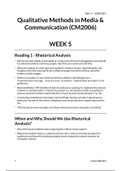
Qualitative Methods in Media &
Communication (CM2006)
WEEK 5
Reading 1 - Rhetorical Analysis
- We do not seek simply to persuade or create (new) forms of propaganda, but instead
to understand what convinces people, how they are convinced and why.
- Often the impact of a text upon the audience remains elusive, unpredictable, and
complex. Even the most perfectly crafted message may fail to achieve what the
sender initially sought.
- Rhetorical analysis is one of the tools best suited for identifying how a
communicative message – and, of course, its authors –seeksto have an impact on its
audiences.
- Bush and Boller (1991) define rhetorical analysis as seeking to “explicate the manner
in which a communicator’s rhetorical purpose (i.e. persuasive intent) is manifest in
various semantic and structural elements of a persuasive communication” (p. 31).
- Convincing an audience may imply various things: buying a product, agreeing to a
particular version of the events, adopting a certain perspective, supporting a policy,
etc.
- The best persuasive messages are those whose persuasive sway goes unnoticed.
When and Why Should We Use Rhetorical
Analysis?
- One of the best methods when analysing the effects of persuasion
- Rhetorical analysis helps us understand how ads create an emotional appeal for
audiences and how this emotional appeal works along side rational reasons for
consumer choices
1 Laura Sehnem
, Term 2 - 2020/2021
Reading 2 - Rhetorical Analysis
- The three pillars of rhetorical analysis:
• Logos or rational reasoning;
- Usually presented as if A then B. You can reach B through C.
- Portrayed as a larger statement in an advertisement
• Pathos or emotional appeal;
- Facial/body expressions in an advertisement
• Ethos or the reputation of the speaker.
- Claims regarding convenience, expertise
• Researchers using rhetorical analysis need to
• thestructure of argumentation(e.g. What are the premises and what are the
conclusions? What is the logic of moving from the premises to the conclusion? Are
there any missing elements to this argument that the audience is invited to fill in?
What proof is invoked to justify positions, solutions, etc.? Which examples are
used? Etc.);
• theuse of emotions(e.g. What emotions are stirred by the use of certain words,
stories, or images? How is the audience referred to, and thus prompted to identify
with the text?);
• the mechanisms through which the speaker builds and invokes their credibility(e.g.
How is the speaker demonstrating their expertise? How are they demonstrating
‘good character’? Why should we trust them?).
- How to do Rhetorical Analysis?
• Start your analysis by reading the text and carefully assessing words and phrases,
visuals, sentence structure, the use of figures of speech, the use of taken for
granted knowledge or practices, punctuation, layout, etc.
• Ex. If you are analysing film, you want to pay attention to: spoken and written
language (including vocalics such as pitch, pace, stress, etc.), sound (e.g. music,
sound effects), visuals (not only what is being showed in a frame, but also camera
techniques, such as zoom or pan angles), and the sequence of visuals (how images
succeed each other to create a story).
• Rhetorical analysis works well for texts with a persuasive intent:
- Electoral campaigns
- Public speeches
- Advertisements
2 Laura Sehnem
Qualitative Methods in Media &
Communication (CM2006)
WEEK 5
Reading 1 - Rhetorical Analysis
- We do not seek simply to persuade or create (new) forms of propaganda, but instead
to understand what convinces people, how they are convinced and why.
- Often the impact of a text upon the audience remains elusive, unpredictable, and
complex. Even the most perfectly crafted message may fail to achieve what the
sender initially sought.
- Rhetorical analysis is one of the tools best suited for identifying how a
communicative message – and, of course, its authors –seeksto have an impact on its
audiences.
- Bush and Boller (1991) define rhetorical analysis as seeking to “explicate the manner
in which a communicator’s rhetorical purpose (i.e. persuasive intent) is manifest in
various semantic and structural elements of a persuasive communication” (p. 31).
- Convincing an audience may imply various things: buying a product, agreeing to a
particular version of the events, adopting a certain perspective, supporting a policy,
etc.
- The best persuasive messages are those whose persuasive sway goes unnoticed.
When and Why Should We Use Rhetorical
Analysis?
- One of the best methods when analysing the effects of persuasion
- Rhetorical analysis helps us understand how ads create an emotional appeal for
audiences and how this emotional appeal works along side rational reasons for
consumer choices
1 Laura Sehnem
, Term 2 - 2020/2021
Reading 2 - Rhetorical Analysis
- The three pillars of rhetorical analysis:
• Logos or rational reasoning;
- Usually presented as if A then B. You can reach B through C.
- Portrayed as a larger statement in an advertisement
• Pathos or emotional appeal;
- Facial/body expressions in an advertisement
• Ethos or the reputation of the speaker.
- Claims regarding convenience, expertise
• Researchers using rhetorical analysis need to
• thestructure of argumentation(e.g. What are the premises and what are the
conclusions? What is the logic of moving from the premises to the conclusion? Are
there any missing elements to this argument that the audience is invited to fill in?
What proof is invoked to justify positions, solutions, etc.? Which examples are
used? Etc.);
• theuse of emotions(e.g. What emotions are stirred by the use of certain words,
stories, or images? How is the audience referred to, and thus prompted to identify
with the text?);
• the mechanisms through which the speaker builds and invokes their credibility(e.g.
How is the speaker demonstrating their expertise? How are they demonstrating
‘good character’? Why should we trust them?).
- How to do Rhetorical Analysis?
• Start your analysis by reading the text and carefully assessing words and phrases,
visuals, sentence structure, the use of figures of speech, the use of taken for
granted knowledge or practices, punctuation, layout, etc.
• Ex. If you are analysing film, you want to pay attention to: spoken and written
language (including vocalics such as pitch, pace, stress, etc.), sound (e.g. music,
sound effects), visuals (not only what is being showed in a frame, but also camera
techniques, such as zoom or pan angles), and the sequence of visuals (how images
succeed each other to create a story).
• Rhetorical analysis works well for texts with a persuasive intent:
- Electoral campaigns
- Public speeches
- Advertisements
2 Laura Sehnem