Term 2, 2020-2021
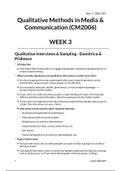
Qualitative Methods in Media &
Communication (CM2006)
WEEK 3
Qualitative Interviews & Sampling - Dumitrica &
Pridmore
- Introduction
• Interviews allow researchers to engage with people’s meaning-making practices in
a more natural setting.
- When and why should you use qualitative interviews to collect your data?
• It is thus important that you understand when your research question can be
answered by using a survey, a focus group, or an interview.
• List of people’s attitudes, beliefs, preferences, or even simple knowledge —>
surveys may be a better option.
• If your aim is to understand how people’s understanding of a topic is formulated,
offered, and discussed with others, then focus groups may be a better option.
• If your aim is to understand not only what, but primarily how people make sense of
a topic, then interviews are your choice.
• Interviews can be used for other research interests
- Accounts and explanations of behaviour
- Motivations behind certain actions
- Responses to an event or phenomenon
- Interpretations of texts, events, phenomena, etc.
- Life stories
- Views and opinions on an event or phenomenon, etc.
- Types of Interviews
• Factual interviews: aim to collect people’s account of what is going on in a field or
during an event
• Conceptual Interviews: seek to clarify how people understand an abstract concept
such as ‘democracy’ or, if you check the example in the box above, ‘trolling’
1 Laura Sehnem
, Term 2, 2020-2021
• Narrative Interviews: focus on how participants talk about their lives or about
specific events
• Discursive Interviews: interested in how participants select specific symbols and
arguments to explain their own position
- Sampling & Access
• The Sampling Process
- Define sample with the help of sampling criteria
- Decide upon sample size
- Select Sampling Strategy
- Sample Sourcing (recruitment)
• You are advised to also consider whether your sample should be homogeneous or
heterogeneous in some aspects. Robinson (2014) for instance talks of five
dimensions of homogeneity: demography, geographic, physical, psychological, and
life history.
• Qualitative research, on the other hand, opts for purposive sampling. That is the
case because “sampling in qualitative research in most cases is [...] conceived as a
way of setting up a collection of deliberately selected cases, materials or events
for constructing a corpus of empirical examples for studying the phenomenon of
interest in the most instructive way”
• Purposive Sampling Methods
- Extreme samples: include cases that are at the extremes of the topic under
investigation.
- Typical samples: the opposite of the previous one, this sample includes the
average cases in relation to the topic under investigation.
- Maximal variation: focus on achieving as much variety among participants (again,
in relation to the topic) as possible.
- Critical sample: include individuals whose experiences provide most expertise
(e.g. experts in a field).
- Sensitive samples: focus on selecting individuals in precarious positions, although
the ethics of that needs to be carefully considered.
- Convenience samples: include the individuals who are most accessible to the
researcher. It is important to remember that such samples are the least
accepted in social research, and not recommended for student assignments.
- Snowball sample: in this type of sample, the initial participants recommend
other potential participants that meet the sampling criteria.
- Ethical
2 Laura Sehnem
Qualitative Methods in Media &
Communication (CM2006)
WEEK 3
Qualitative Interviews & Sampling - Dumitrica &
Pridmore
- Introduction
• Interviews allow researchers to engage with people’s meaning-making practices in
a more natural setting.
- When and why should you use qualitative interviews to collect your data?
• It is thus important that you understand when your research question can be
answered by using a survey, a focus group, or an interview.
• List of people’s attitudes, beliefs, preferences, or even simple knowledge —>
surveys may be a better option.
• If your aim is to understand how people’s understanding of a topic is formulated,
offered, and discussed with others, then focus groups may be a better option.
• If your aim is to understand not only what, but primarily how people make sense of
a topic, then interviews are your choice.
• Interviews can be used for other research interests
- Accounts and explanations of behaviour
- Motivations behind certain actions
- Responses to an event or phenomenon
- Interpretations of texts, events, phenomena, etc.
- Life stories
- Views and opinions on an event or phenomenon, etc.
- Types of Interviews
• Factual interviews: aim to collect people’s account of what is going on in a field or
during an event
• Conceptual Interviews: seek to clarify how people understand an abstract concept
such as ‘democracy’ or, if you check the example in the box above, ‘trolling’
1 Laura Sehnem
, Term 2, 2020-2021
• Narrative Interviews: focus on how participants talk about their lives or about
specific events
• Discursive Interviews: interested in how participants select specific symbols and
arguments to explain their own position
- Sampling & Access
• The Sampling Process
- Define sample with the help of sampling criteria
- Decide upon sample size
- Select Sampling Strategy
- Sample Sourcing (recruitment)
• You are advised to also consider whether your sample should be homogeneous or
heterogeneous in some aspects. Robinson (2014) for instance talks of five
dimensions of homogeneity: demography, geographic, physical, psychological, and
life history.
• Qualitative research, on the other hand, opts for purposive sampling. That is the
case because “sampling in qualitative research in most cases is [...] conceived as a
way of setting up a collection of deliberately selected cases, materials or events
for constructing a corpus of empirical examples for studying the phenomenon of
interest in the most instructive way”
• Purposive Sampling Methods
- Extreme samples: include cases that are at the extremes of the topic under
investigation.
- Typical samples: the opposite of the previous one, this sample includes the
average cases in relation to the topic under investigation.
- Maximal variation: focus on achieving as much variety among participants (again,
in relation to the topic) as possible.
- Critical sample: include individuals whose experiences provide most expertise
(e.g. experts in a field).
- Sensitive samples: focus on selecting individuals in precarious positions, although
the ethics of that needs to be carefully considered.
- Convenience samples: include the individuals who are most accessible to the
researcher. It is important to remember that such samples are the least
accepted in social research, and not recommended for student assignments.
- Snowball sample: in this type of sample, the initial participants recommend
other potential participants that meet the sampling criteria.
- Ethical
2 Laura Sehnem