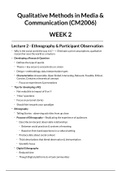
Qualitative Methods in Media &
Communication (CM2006)
WEEK 2
Lecture 2 - Ethnography & Participant Observation
- Why is the social world the way it is? —> Eliminate a priori assumptions, qualitative
researcher sees the world as a mystery
- Developing a Research Question
- Defines the type of puzzle
- Theory = key areas to concentrate on; vision
- Design = methodology, data interpretation types
- Characteristics: Answerable, Open Ended, Interesting, Relevant, Feasible, Ethical,
Concise, Contains a theoretical concept
- Focus on experiences & perceptions
- Tips for developing a RQ
- Not reducible to impact of X on Y
- “How” questions
- Focus on personal stories
- Should hint towards your paradigm
- Ethnography
- Telling Stories - observing activities from up close
- Purpose of Ethnography = Replicating the experience of audiences
- Describe & interpret observable relationships
- Between social practices & systems of meaning
- Based on first-hand experience in a cultural setting
- Produce date about social context
- Thick descriptions that blend observation & interpretation
- Scientific focus
- Digital Ethnography
- Reduced time
- Though Digital platforms & virtual communities
, - Issue with Ethnography
- Access
- Key Roles = gatekeepers (some authority) & sponsors (“this person is with me and I
want you to talk to them”)
- Need a Good Story
- Boring research = limited access
- Enthusiastic research story
- Ethics
- Participation
- Be specific about involvement
- Define when subjects are ‘on’ and ‘off’
- Be aware of relationship with research subjects
- Maintain rapport - relational process
- Method built on trust
- Auto ethnography
- Displays multiple layers of the social world + your own experience
- Characteristics
- Written in first person
- Usually single case - what is particular and what may be universal
- Strengths & Weaknesses of Ethnography
- Strengths
- Flexible & Emergent design
- Social Processes over time
- Richer & Fuller description of Phenomena
- Great to use with other methods
- Relatively unobtrusive
- Can create new ideas and validate other research
- Weakness
- Not everything can be directly observed
- Time consuming
- Transferability issues
- Dependent on observer’s abilities
- Requires an accounting of researcher’s positionally
- Participant Observation (method within Ethnography)
Communication (CM2006)
WEEK 2
Lecture 2 - Ethnography & Participant Observation
- Why is the social world the way it is? —> Eliminate a priori assumptions, qualitative
researcher sees the world as a mystery
- Developing a Research Question
- Defines the type of puzzle
- Theory = key areas to concentrate on; vision
- Design = methodology, data interpretation types
- Characteristics: Answerable, Open Ended, Interesting, Relevant, Feasible, Ethical,
Concise, Contains a theoretical concept
- Focus on experiences & perceptions
- Tips for developing a RQ
- Not reducible to impact of X on Y
- “How” questions
- Focus on personal stories
- Should hint towards your paradigm
- Ethnography
- Telling Stories - observing activities from up close
- Purpose of Ethnography = Replicating the experience of audiences
- Describe & interpret observable relationships
- Between social practices & systems of meaning
- Based on first-hand experience in a cultural setting
- Produce date about social context
- Thick descriptions that blend observation & interpretation
- Scientific focus
- Digital Ethnography
- Reduced time
- Though Digital platforms & virtual communities
, - Issue with Ethnography
- Access
- Key Roles = gatekeepers (some authority) & sponsors (“this person is with me and I
want you to talk to them”)
- Need a Good Story
- Boring research = limited access
- Enthusiastic research story
- Ethics
- Participation
- Be specific about involvement
- Define when subjects are ‘on’ and ‘off’
- Be aware of relationship with research subjects
- Maintain rapport - relational process
- Method built on trust
- Auto ethnography
- Displays multiple layers of the social world + your own experience
- Characteristics
- Written in first person
- Usually single case - what is particular and what may be universal
- Strengths & Weaknesses of Ethnography
- Strengths
- Flexible & Emergent design
- Social Processes over time
- Richer & Fuller description of Phenomena
- Great to use with other methods
- Relatively unobtrusive
- Can create new ideas and validate other research
- Weakness
- Not everything can be directly observed
- Time consuming
- Transferability issues
- Dependent on observer’s abilities
- Requires an accounting of researcher’s positionally
- Participant Observation (method within Ethnography)