STRATEGY – book summary
Chapter 1 – the tools of strategic analysis
Strategy (of a firm) = its theory about how to gain competitive advantages. A good strategy is a
strategy that generates such advantages
A strategy can be;
- Product differentiation
- Cost leadership
- Corporate diversification
- Product development
- Market development
- Market segmentation
o And all other theories are based on a set of assumptions and hypotheses about the way
competition in an industry is likely to evolve and how that evolution can be exploited to earn
a profit
o The greater the extent to which these assumptions and hypotheses accurately reflect how
competition in this industry evolves -> the more likely it is that the firm will gain a
competitive advantage from implementing its strategies
However, it is very difficult to predict how competition works and will evolve in an industry -> so it is
almost never possible to know for sure that a firm is choosing the correct strategy
o So a firm’s strategy is more a theory
o This theory is the best bet about how competition will evolve and how to exploit it for
competitive advantage in return
Reduce mistakes to choose the wrong theory by implementing a strategic management process = a
sequential set of analyses and choices that can increase the likelihood that a firm will choose a good
strategy (one that gives competitive advantage).
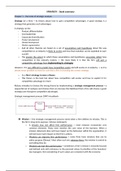
Strategic management process (SMP) visualised=
Mission -> the strategic management process starts when a firm defines its mission. This is
the firm’s long-term purpose. Mission statements
o A mission may not affect firm performance = most missions incorporate very
common elements. Many even mention the core value of the business. When a
mission statement does not have impact on the behaviour within the organisation, it
will not have much impact on the firm’s actions
o Missions can improve firm performance = some firms have missions that are its
entire purpose (Disney). Most often such are visionary firms, the mission is central to
everything they do
o Missions can hurt firm performance = sometimes a firm’s mission is inwardly focused
and defined only with reference to the personal values & priorities of the founders/
top managers. Not considering of such values are consistent with the economy
, Objectives -> specific measurable targets a firm can use to evaluate the extent to which it is
realising its mission. High-quality objectives are tightly connected to elements of a firm’s
mission and easy to measure + track over time
External & internal analysis -> these are 2 phases in the strategic management process, but
happen somewhat simultaneously.
o External analysis = firm identifies the critical threats and opportunities in its
competitive environment. It also looks at how competition in its environment is likely
to evolve and what implications that evolution has for the T and O a firm is facing
o Internal analysis = helps the firm identify its organisational strengths and
weaknesses. Help understand which of its resources and capabilities are likely to be
sources of competitive advantage and which are less likely. Internal analysis is used
for firms to see which areas need improvement change
1) Conduct a SWOT analysis
Strategic choice -> firm’s choice of which theory to follow to gain competitive advantage. All
strategic choices fall into 2 main categories
Business-level strategies = actions firms take to gain competitive advantage in a
single market or industry (cost leadership, product differentiation, flexibility)
Corporate-level strategies = actions firms take to gain competitive advantage by
operating in multiple markets or industries at the same time (vertical integration
strategies, diversification, strategic alliance strategies)
Strategy implementation -> occurs when a firm adopts organisational policies and practices
that are consistent with its strategy. There are 3 specific organisational policies and practices
that are important when implementing a strategy;
a firm’s formal organisational structure
formal and informal management control systems
employee compensation policies
Competitive advantage = is achieved by a firm when it can create more economic value than rival
firms do. Economic value is the difference between what customers are willing to pay for a firm’s
products or services and the total costs of producing these products/services
o size of a firm’s competitive advantage is the difference between the economic value of a
firm and the economic value of its rivals
Competitive advantage can be temporarily but also sustained
1. temporary competitive advantage lasts for a short time
2. sustained competitive advantage lasts a long time
note -> economic value is not always easy to measure directly. The benefits of a firms product are for
instance dependent on the perception of a customer, perceptions aren’t easy to be measured. Also
the total costs for producing a product, may not always be easy to identify
Firms that create the same economic value as their rivals, experience competitive rivalry. But firms
that create less economic value as their rivals, experience competitive disadvantage (= just the
opposite of competitive advantage, it has less economic value / the lesser firm)
Competitive disadvantage ca also be temporarily or also sustained
Accounting performance = is a tool that can help estimate a firm’s competitive advantage. It is a
measure of a firm’s competitive advantage calculated by using information from a firm’s published
profit and loss balance sheet statements
o this allows to compare the accounting performance of 1 firm with another firm, even when
they aren’t located in the same industry
, a firm’s accounting statements can be used to measure its competitive advantage, by implementing
accounting ratios = numbers taken from a firm’s financial statements that are manipulated in ways
that describe various aspects of a firm’s performance. Examples of such ratios are;
- profitability ratios
- liquidity ratios
- leverage ratios
- activity ratios
to determine how a firm is performing, accounting ratios must be compared with some
standard. Such standard is the average of accounting ratios of other firms in the industry
by using a ratio analysis a firm earns above-average accounting performance when its
performance is greater than the industry average -> these firms have most often a
competitive advantage
1) an average accounting performance = when performance is equal to the industry
average -> firms have obtained competitive parity
2) a below-average accounting performance = when performance is less than industry
average -> firms experience competitive disadvantage
accounting measures of competitive advantage do have a limitation, which is that one component of
cost is most often not included in accounting measures of competitive advantage -> the cost of the
capital a firm employs to produce and sell its products/ services = cost of capital – is the rate of
return that a firm promises to pay its suppliers.
- But economic measures of competitive advantage compare a firm’s level of return to its cost
of capital instead of to the level of return in the industry
2 sources of capital = debt (capital from banks/ bondholders) + equity (capital from individuals,
institutions that purchase stock)
- Cost of debt = equal to interest that a firm must pay its debt holders to induce those debt
holders to lend money to a firm
- Cost of equity = equal to the rate of return a firm must promise its equity holders to induce
these individuals/ institutions to invest in a firm
- Weighted average cost of capital (WACC) = % of firm total debt * cost of debt + % of firm
total equity * cost of equity
Emergent strategies = theories of how to gain competitive advantage in an industry that emerge
over time or that have been radically reshaped once they are initially implemented
- It can be argued that emergent strategies are only necessary when the firm fails to
implement the strategic management process effectively
- However in reality, it is often the case that a firm chooses it strategies, but information to
complete the strategic management process is not (yet) available -> in this case the firm has
to make its ‘best bet’ about how competition in the industry will emerge
Chapter 1 – the tools of strategic analysis
Strategy (of a firm) = its theory about how to gain competitive advantages. A good strategy is a
strategy that generates such advantages
A strategy can be;
- Product differentiation
- Cost leadership
- Corporate diversification
- Product development
- Market development
- Market segmentation
o And all other theories are based on a set of assumptions and hypotheses about the way
competition in an industry is likely to evolve and how that evolution can be exploited to earn
a profit
o The greater the extent to which these assumptions and hypotheses accurately reflect how
competition in this industry evolves -> the more likely it is that the firm will gain a
competitive advantage from implementing its strategies
However, it is very difficult to predict how competition works and will evolve in an industry -> so it is
almost never possible to know for sure that a firm is choosing the correct strategy
o So a firm’s strategy is more a theory
o This theory is the best bet about how competition will evolve and how to exploit it for
competitive advantage in return
Reduce mistakes to choose the wrong theory by implementing a strategic management process = a
sequential set of analyses and choices that can increase the likelihood that a firm will choose a good
strategy (one that gives competitive advantage).
Strategic management process (SMP) visualised=
Mission -> the strategic management process starts when a firm defines its mission. This is
the firm’s long-term purpose. Mission statements
o A mission may not affect firm performance = most missions incorporate very
common elements. Many even mention the core value of the business. When a
mission statement does not have impact on the behaviour within the organisation, it
will not have much impact on the firm’s actions
o Missions can improve firm performance = some firms have missions that are its
entire purpose (Disney). Most often such are visionary firms, the mission is central to
everything they do
o Missions can hurt firm performance = sometimes a firm’s mission is inwardly focused
and defined only with reference to the personal values & priorities of the founders/
top managers. Not considering of such values are consistent with the economy
, Objectives -> specific measurable targets a firm can use to evaluate the extent to which it is
realising its mission. High-quality objectives are tightly connected to elements of a firm’s
mission and easy to measure + track over time
External & internal analysis -> these are 2 phases in the strategic management process, but
happen somewhat simultaneously.
o External analysis = firm identifies the critical threats and opportunities in its
competitive environment. It also looks at how competition in its environment is likely
to evolve and what implications that evolution has for the T and O a firm is facing
o Internal analysis = helps the firm identify its organisational strengths and
weaknesses. Help understand which of its resources and capabilities are likely to be
sources of competitive advantage and which are less likely. Internal analysis is used
for firms to see which areas need improvement change
1) Conduct a SWOT analysis
Strategic choice -> firm’s choice of which theory to follow to gain competitive advantage. All
strategic choices fall into 2 main categories
Business-level strategies = actions firms take to gain competitive advantage in a
single market or industry (cost leadership, product differentiation, flexibility)
Corporate-level strategies = actions firms take to gain competitive advantage by
operating in multiple markets or industries at the same time (vertical integration
strategies, diversification, strategic alliance strategies)
Strategy implementation -> occurs when a firm adopts organisational policies and practices
that are consistent with its strategy. There are 3 specific organisational policies and practices
that are important when implementing a strategy;
a firm’s formal organisational structure
formal and informal management control systems
employee compensation policies
Competitive advantage = is achieved by a firm when it can create more economic value than rival
firms do. Economic value is the difference between what customers are willing to pay for a firm’s
products or services and the total costs of producing these products/services
o size of a firm’s competitive advantage is the difference between the economic value of a
firm and the economic value of its rivals
Competitive advantage can be temporarily but also sustained
1. temporary competitive advantage lasts for a short time
2. sustained competitive advantage lasts a long time
note -> economic value is not always easy to measure directly. The benefits of a firms product are for
instance dependent on the perception of a customer, perceptions aren’t easy to be measured. Also
the total costs for producing a product, may not always be easy to identify
Firms that create the same economic value as their rivals, experience competitive rivalry. But firms
that create less economic value as their rivals, experience competitive disadvantage (= just the
opposite of competitive advantage, it has less economic value / the lesser firm)
Competitive disadvantage ca also be temporarily or also sustained
Accounting performance = is a tool that can help estimate a firm’s competitive advantage. It is a
measure of a firm’s competitive advantage calculated by using information from a firm’s published
profit and loss balance sheet statements
o this allows to compare the accounting performance of 1 firm with another firm, even when
they aren’t located in the same industry
, a firm’s accounting statements can be used to measure its competitive advantage, by implementing
accounting ratios = numbers taken from a firm’s financial statements that are manipulated in ways
that describe various aspects of a firm’s performance. Examples of such ratios are;
- profitability ratios
- liquidity ratios
- leverage ratios
- activity ratios
to determine how a firm is performing, accounting ratios must be compared with some
standard. Such standard is the average of accounting ratios of other firms in the industry
by using a ratio analysis a firm earns above-average accounting performance when its
performance is greater than the industry average -> these firms have most often a
competitive advantage
1) an average accounting performance = when performance is equal to the industry
average -> firms have obtained competitive parity
2) a below-average accounting performance = when performance is less than industry
average -> firms experience competitive disadvantage
accounting measures of competitive advantage do have a limitation, which is that one component of
cost is most often not included in accounting measures of competitive advantage -> the cost of the
capital a firm employs to produce and sell its products/ services = cost of capital – is the rate of
return that a firm promises to pay its suppliers.
- But economic measures of competitive advantage compare a firm’s level of return to its cost
of capital instead of to the level of return in the industry
2 sources of capital = debt (capital from banks/ bondholders) + equity (capital from individuals,
institutions that purchase stock)
- Cost of debt = equal to interest that a firm must pay its debt holders to induce those debt
holders to lend money to a firm
- Cost of equity = equal to the rate of return a firm must promise its equity holders to induce
these individuals/ institutions to invest in a firm
- Weighted average cost of capital (WACC) = % of firm total debt * cost of debt + % of firm
total equity * cost of equity
Emergent strategies = theories of how to gain competitive advantage in an industry that emerge
over time or that have been radically reshaped once they are initially implemented
- It can be argued that emergent strategies are only necessary when the firm fails to
implement the strategic management process effectively
- However in reality, it is often the case that a firm chooses it strategies, but information to
complete the strategic management process is not (yet) available -> in this case the firm has
to make its ‘best bet’ about how competition in the industry will emerge