Geschreven door studenten die geslaagd zijn Direct beschikbaar na je betaling Online lezen of als PDF Verkeerd document? Gratis ruilen 4,6 TrustPilot
logo-home
Tentamen (uitwerkingen)

BTE2601 Assignment 3 (ANSWERS) 2025 - DISTINCTION GUARANTEED

Beoordeling
-
Verkocht
-
Pagina's
16
Cijfer
A+
Geüpload op
09-08-2025
Geschreven in
2025/2026

Achieve a distinction with this comprehensive and well-organized set of BTE2601 Assignment 3 (ANSWERS) 2025 - DISTINCTION GUARANTEED. Ensure accuracy and excellence in your submission!!!! BTE2601 ASSESSMENT 03/2025 QUESTION 1 1.1. White Paper 6 showed a commitment to providing equal education opportunities for learners who had been excluded because the education and training system did not accommodate their special needs. The teacher can use the following to ensure an inclusive learning environment: • A transformative approach • A caring pedagogy • Awareness of Intrinsic and Extrinsic factors • A broader approach to support BTE2601 ASSESSMENT 03/2025 1.1.1. What is inclusive learning environment? (3) 1.1.2. Explain the transformative approach. 2) 1.1.3. Why do we have broader approach to support? Provide three reasons for broader approach to support. (3) 1.1.4. Differentiate between disruptive behaviour and learning difficult. Provide one example for each (5) 1.1.5. How can the teacher develop a classroom system that supports learners so that all learners can learn? Provide examples to illustrate your answer. (5) BTE2601 ASSESSMENT 03/2025 Question 2 2.1 Describe how the teacher can ensure diversity through assessment? (5) 2.2. Identify from the list of the roles of the teacher a role that promotes diversity and explain how the teacher apply this role (5) 2.3. Describe the levels and types of educational support for inclusivity. (12) 2.4. Discuss the key strategies for implementing White Paper 6 Policy. (10) Answer all the questions in this section Question 3 3.1. Use your own words to describe benefits of applying a caring pedagogy. (10) 3.2. List and explain with practical examples the key elements that should be included in the learning programme. Demonstrate your answer with practical examples from the CAPS document. (10) 3.3. Tabulate the most common intrinsic and extrinsic barriers to learning in the South African context. (10) 3.4. Explain the difference between formative assessment and summative assessment in your own words. (4) BTE2601/101 41 Question 4 Plan and prepare a lesson for “The grade and topic of your choice” topic. (The topic should be the one prescribed in the CAPS document). HINT:LESSONPLANASSESSMENTRUBRIC Use this lesson plan assessment rubric as a guide to compile the lesson. Do not redraw this rubric or complete the one below. It only serves as a guide to help you to plan your lesson. Assessment rubric for lesson plan Components of lesson Detailed criteria / information Marks Marks allocated 1. Localising details Subject Grade Time allocation Number of learners 1 mark 2. Learning objectives Provide knowledge, skills and values 3 marks 3. Curriculum topic Topic from the CAPS document 1 mark 4. Lesson theme (curriculum sub- theme) A curriculum sub-theme or lesson content theme 1 mark 5. Introduction Linking learners’ background knowledge with the new content 2 marks 6. Teacher activities What will the teacher be doing 3 marks 42 7. Learners’ activities What will learners be doing 3 marks 8. Method(s), teaching support aids and learning material a) Motivate your choice of teaching methods/techniques/strategies b) Teaching aids 2 marks 2 marks 9. Place of the lesson in the curriculum a) Indicate where theme fits into the curriculum b) Lesson content 1 mark 1 mark TOTAL MARKS 20 marks 1.1 As a student teacher preparing to teach a diverse Grade 9 classroom in a South African school, you are required to: a) Define the concept of a teaching strategy and explain its importance in lesson planning. marks) b) Select one of the following teaching strategies and briefly describe how you would implement them in your lesson to develop critical thinking and problem-solving skills: • Cooperative Learning • Discovery Learning • Problem-Based Learning • Direct Instruction In your answer, provide: • A brief description of a chosen strategy • An explanation of why teaching strategies are important. • A clear description of the chosen strategy • A practical classroom example of how you would use it with diverse learners. Rubric Criterion Marks Clear definition of teaching strategy 2 Explanation of why teaching strategies are important 3 Clear description of the chosen strategy 2 Practical classroom application 3 Total 10 (Total: 10 marks) 1.2 In your own words, explain the difference between the formal, informal, and hidden curriculum. For each type, provide one relevant example from a school context. (9 marks) Criterion Description Marks Formal Curriculum - 1 mark: Clear and accurate definition - 2 marks: Relevant and practical example from a school context 3 Formal Curriculum - 1 mark: Clear and accurate definition - 2 marks: Relevant and practical example from a school context 3 Informal - 1 mark: Clear and accurate definition 3 BTE2601 ASSESSMENT 03/2024 6 Curriculum - 2 marks: Relevant and practical example from a school context Hidden Curriculum - 1 mark: Clear and accurate definition in the student’s own words - 2 marks: Relevant and practical example from a school context 3 Total 9 (Total: 9 marks) 1.3 Briefly explain four steps in Tyler’s model and provide a practical example of how a teacher could apply each step in planning a lesson. (8 marks) Rubric Criterion Marks Set learning objectives: • 1 mark for correct explanation of the step • 1 mark for a clear, practical example of classroom application 2 Choose learning experiences: • 1 mark for correct explanation of the step • 1 mark for a clear, practical example of classroom application 2 Organise the learning experiences: • 1 mark for correct explanation of the step • 1 mark for a clear, practical example of classroom application 2 Evaluate learning: • 1 mark for correct explanation of the step • 1 mark for a clear, practical example of classroom application 2 Total 8 (Total: 8 marks) 1.4 Briefly explain the three roles a teacher plays in the curriculum process: curriculum interpreter, curriculum designer, and curriculum implementer. For each role, provide one relevant classroom-based example from a South African context to illustrate your understanding. (6 marks) Rubric Criterion Marks Curriculum interpreter • 1 mark for an accurate and clear explanation in own words • 1 mark for a relevant, practical classroom example 2 Curriculum designer • 1 mark for an accurate and clear explanation in own words • 1 mark for a relevant, practical classroom example 2 BTE2601 ASSESSMENT 03/2025 7 Curriculum implementer. • 1 mark for an accurate and clear explanation in own words • 1 mark for a relevant, practical classroom example 2 Total 6 (Total: 6 marks) [ Question 1 total 33 MARKS] BTE2601 ASSESSMENT 03/2024 8 QUESTION 2 Answer all the questions in this section Read the following scenario and answer the questions that follow During a classroom observation, Teacher 2 was teaching Grade 4 English as a First Additional Language (EFAL). The lesson was titled “Following Instructions to Make Party Faces” and was based solely on the textbook, with no visual aids provided. Despite this, learner engagement was high, with active oral responses and group reading. The teacher used several effective strategies, including repetition, vocabulary in context, modeling pronunciation, encouraging learner-given examples, and group reading. Pedagogically, the teacher supported visual learners by writing the topic and date on the board and introducing modal verbs such as can, may, must, and should. Grammar and vocabulary were explained contextually, which helped learners connect meaning to usage. However, some challenges were observed: learners struggled with the pronunciation of words like “smarties” and “ingredients,” one learner did not participate in group reading, and several lacked basic tools like pens. Homework was assigned but not supported with necessary resources, and notably, no formal assessment or rubric was used during or after the lesson. Questions 2.1. Did the teacher use formative assessment during the lesson? Support your answer with evidence from the scenario. (3 marks) 2.2. The learners in this class lacked basic tools like pens. Which principle of assessment is greatly compromised by this lack? Support your answer. (3 marks) 2.3. Would it have been justified for the teacher to use summative assessment in this lesson? Support your answer. (3 marks) 2.4. Based on the case study, explain the importance of feedback in supporting learner progress. Refer to specific examples from the above scenario to support your answer. (3 marks) 2.5. Which three questions should a teacher ask to ensure effective assessment in the classroom? (3 marks) 2.6. Based on the above scenario, do you think the learners demonstrated deep learning rather than surface learning? Support your answer with examples from the scenario ( 4 marks ). 2.7. Why is peer and self-assessment particularly important in large classes? Briefly discuss two reasons. (4 marks) BTE2601 ASSESSMENT 03/2024 9 2.8. Do you think the teacher could have used group feedback in this lesson? Briefly explain two ways it could have benefited the learners. (5 marks) 2.9. Discuss the importance of using rubrics in assessment for both teachers and learners, with reference to the above scenario. (5 marks) [ Question 2 total 33 MARKS] BTE2601 ASSESSMENT 03/2024 10 QUESTION 3 Answer all the questions in this section 3.1 An inclusive learning environment is a classroom or educational setting where all learners, regardless of their background, abilities, or characteristics, feel valued, respected, and supported. 3.1.1 In relation to the above statement, define inclusive education. (2) 3.1.2 Briefly explain how an inclusive learning environment can promote a transformative approach, a caring pedagogy, and awareness of intrinsic and extrinsic factors. (6) Rubric Criterion Marks Define/meaning of inclusive education 2 Explain how the transformative approach, caring pedagogy, and intrinsic and extrinsic factors 6 (Total: 8 marks) 3.2 Discuss the three barriers that are hampering the efforts to promote inclusive practices in the South African schools. (6) Rubric Criterion Marks Identification of three barriers 3 Discuss them shortly 4 (Total: 7 marks) 3.3 The advocacy and empowerment in South Africa, targeted explicitly towards learners living with disability, has improved significantly over the years, culminating in groundbreaking pieces of legislation to fast-track inclusive education around the world. Based on your experience and observation, how do advocacy and empowerment benefit learners with disabilities and their peers in the South African context? (7) Rubric Criterion Marks Explanation based on their personal experience/observation 2 Explain examples of advocacy and empowerment in the DBE or South Africa in general 2 How advocacy and empowerment benefit inclusive education implementation in South Africa 3 Total 7 (Total: 7 marks) BTE2601 ASSESSMENT 03/2024 11 3.4 Discuss the importance of collaboration between educators, parents, and support services in creating inclusive learning environments by using practical examples in the South African schooling context. (12) Rubric: Criterion Marks Why is collaboration essential between actors 3 Offer a general understanding of how all these actors must collaborate to advance inclusive education 4 Relevant examples 5 BTE2601 ASSESSMENT 03/2025 QUESTION 1 1.1. White Paper 6 showed a commitment to providing equal education opportunities for learners who had been excluded because the education and training system did not accommodate their special needs. The teacher can use the following to ensure an inclusive learning environment: • A transformative approach • A caring pedagogy • Awareness of Intrinsic and Extrinsic factors • A broader approach to support BTE2601 ASSESSMENT 03/2025 1.1.1. What is inclusive learning environment? (3) 1.1.2. Explain the transformative approach. 2) 1.1.3. Why do we have broader approach to support? Provide three reasons for broader approach to support. (3) 1.1.4. Differentiate between disruptive behaviour and learning difficult. Provide one example for each (5) 1.1.5. How can the teacher develop a classroom system that supports learners so that all learners can learn? Provide examples to illustrate your answer. (5) BTE2601 ASSESSMENT 03/2025 Question 2 2.1 Describe how the teacher can ensure diversity through assessment? (5) 2.2. Identify from the list of the roles of the teacher a role that promotes diversity and explain how the teacher apply this role (5) 2.3. Describe the levels and types of educational support for inclusivity. (12) 2.4. Discuss the key strategies for implementing White Paper 6 Policy. (10) Answer all the questions in this section Question 3 3.1. Use your own words to describe benefits of applying a caring pedagogy. (10) 3.2. List and explain with practical examples the key elements that should be included in the learning programme. Demonstrate your answer with practical examples from the CAPS document. (10) 3.3. Tabulate the most common intrinsic and extrinsic barriers to learning in the South African context. (10) 3.4. Explain the difference between formative assessment and summative assessment in your own words. (4) BTE2601/101 41 Question 4 Plan and prepare a lesson for “The grade and topic of your choice” topic. (The topic should be the one prescribed in the CAPS document). HINT:LESSONPLANASSESSMENTRUBRIC Use this lesson plan assessment rubric as a guide to compile the lesson. Do not redraw this rubric or complete the one below. It only serves as a guide to help you to plan your lesson. Assessment rubric for lesson plan Components of lesson Detailed criteria / information Marks Marks allocated 1. Localising details Subject Grade Time allocation Number of learners 1 mark 2. Learning objectives Provide knowledge, skills and values 3 marks 3. Curriculum topic Topic from the CAPS document 1 mark 4. Lesson theme (curriculum sub- theme) A curriculum sub-theme or lesson content theme 1 mark 5. Introduction Linking learners’ background knowledge with the new content 2 marks 6. Teacher activities What will the teacher be doing 3 marks 42 7. Learners’ activities What will learners be doing 3 marks 8. Method(s), teaching support aids and learning material a) Motivate your choice of teaching methods/techniques/strategies b) Teaching aids 2 marks 2 marks 9. Place of the lesson in the curriculum a) Indicate where theme fits into the curriculum b) Lesson content 1 mark 1 mark TOTAL MARKS 20 marks 1.1 As a student teacher preparing to teach a diverse Grade 9 classroom in a South African school, you are required to: a) Define the concept of a teaching strategy and explain its importance in lesson planning. marks) b) Select one of the following teaching strategies and briefly describe how you would implement them in your lesson to develop critical thinking and problem-solving skills: • Cooperative Learning • Discovery Learning • Problem-Based Learning • Direct Instruction In your answer, provide: • A brief description of a chosen strategy • An explanation of why teaching strategies are important. • A clear description of the chosen strategy • A practical classroom example of how you would use it with diverse learners. Rubric Criterion Marks Clear definition of teaching strategy 2 Explanation of why teaching strategies are important 3 Clear description of the chosen strategy 2 Practical classroom application 3 Total 10 (Total: 10 marks) 1.2 In your own words, explain the difference between the formal, informal, and hidden curriculum. For each type, provide one relevant example from a school context. (9 marks) Criterion Description Marks Formal Curriculum - 1 mark: Clear and accurate definition - 2 marks: Relevant and practical example from a school context 3 Formal Curriculum - 1 mark: Clear and accurate definition - 2 marks: Relevant and practical example from a school context 3 Informal - 1 mark: Clear and accurate definition 3 BTE2601 ASSESSMENT 03/2024 6 Curriculum - 2 marks: Relevant and practical example from a school context Hidden Curriculum - 1 mark: Clear and accurate definition in the student’s own words - 2 marks: Relevant and practical example from a school context 3 Total 9 (Total: 9 marks) 1.3 Briefly explain four steps in Tyler’s model and provide a practical example of how a teacher could apply each step in planning a lesson. (8 marks) Rubric Criterion Marks Set learning objectives: • 1 mark for correct explanation of the step • 1 mark for a clear, practical example of classroom application 2 Choose learning experiences: • 1 mark for correct explanation of the step • 1 mark for a clear, practical example of classroom application 2 Organise the learning experiences: • 1 mark for correct explanation of the step • 1 mark for a clear, practical example of classroom application 2 Evaluate learning: • 1 mark for correct explanation of the step • 1 mark for a clear, practical example of classroom application 2 Total 8 (Total: 8 marks) 1.4 Briefly explain the three roles a teacher plays in the curriculum process: curriculum interpreter, curriculum designer, and curriculum implementer. For each role, provide one relevant classroom-based example from a South African context to illustrate your understanding. (6 marks) Rubric Criterion Marks Curriculum interpreter • 1 mark for an accurate and clear explanation in own words • 1 mark for a relevant, practical classroom example 2 Curriculum designer • 1 mark for an accurate and clear explanation in own words • 1 mark for a relevant, practical classroom example 2 BTE2601 ASSESSMENT 03/2025 7 Curriculum implementer. • 1 mark for an accurate and clear explanation in own words • 1 mark for a relevant, practical classroom example 2 Total 6 (Total: 6 marks) [ Question 1 total 33 MARKS] BTE2601 ASSESSMENT 03/2024 8 QUESTION 2 Answer all the questions in this section Read the following scenario and answer the questions that follow During a classroom observation, Teacher 2 was teaching Grade 4 English as a First Additional Language (EFAL). The lesson was titled “Following Instructions to Make Party Faces” and was based solely on the textbook, with no visual aids provided. Despite this, learner engagement was high, with active oral responses and group reading. The teacher used several effective strategies, including repetition, vocabulary in context, modeling pronunciation, encouraging learner-given examples, and group reading. Pedagogically, the teacher supported visual learners by writing the topic and date on the board and introducing modal verbs such as can, may, must, and should. Grammar and vocabulary were explained contextually, which helped learners connect meaning to usage. However, some challenges were observed: learners struggled with the pronunciation of words like “smarties” and “ingredients,” one learner did not participate in group reading, and several lacked basic tools like pens. Homework was assigned but not supported with necessary resources, and notably, no formal assessment or rubric was used during or after the lesson. Questions 2.1. Did the teacher use formative assessment during the lesson? Support your answer with evidence from the scenario. (3 marks) 2.2. The learners in this class lacked basic tools like pens. Which principle of assessment is greatly compromised by this lack? Support your answer. (3 marks) 2.3. Would it have been justified for the teacher to use summative assessment in this lesson? Support your answer. (3 marks) 2.4. Based on the case study, explain the importance of feedback in supporting learner progress. Refer to specific examples from the above scenario to support your answer. (3 marks) 2.5. Which three questions should a teacher ask to ensure effective assessment in the classroom? (3 marks) 2.6. Based on the above scenario, do you think the learners demonstrated deep learning rather than surface learning? Support your answer with examples from the scenario ( 4 marks ). 2.7. Why is peer and self-assessment particularly important in large classes? Briefly discuss two reasons. (4 marks) BTE2601 ASSESSMENT 03/2024 9 2.8. Do you think the teacher could have used group feedback in this lesson? Briefly explain two ways it could have benefited the learners. (5 marks) 2.9. Discuss the importance of using rubrics in assessment for both teachers and learners, with reference to the above scenario. (5 marks) [ Question 2 total 33 MARKS] BTE2601 ASSESSMENT 03/2024 10 QUESTION 3 Answer all the questions in this section 3.1 An inclusive learning environment is a classroom or educational setting where all learners, regardless of their background, abilities, or characteristics, feel valued, respected, and supported. 3.1.1 In relation to the above statement, define inclusive education. (2) 3.1.2 Briefly explain how an inclusive learning environment can promote a transformative approach, a caring pedagogy, and awareness of intrinsic and extrinsic factors. (6) Rubric Criterion Marks Define/meaning of inclusive education 2 Explain how the transformative approach, caring pedagogy, and intrinsic and extrinsic factors 6 (Total: 8 marks) 3.2 Discuss the three barriers that are hampering the efforts to promote inclusive practices in the South African schools. (6) Rubric Criterion Marks Identification of three barriers 3 Discuss them shortly 4 (Total: 7 marks) 3.3 The advocacy and empowerment in South Africa, targeted explicitly towards learners living with disability, has improved significantly over the years, culminating in groundbreaking pieces of legislation to fast-track inclusive education around the world. Based on your experience and observation, how do advocacy and empowerment benefit learners with disabilities and their peers in the South African context? (7) Rubric Criterion Marks Explanation based on their personal experience/observation 2 Explain examples of advocacy and empowerment in the DBE or South Africa in general 2 How advocacy and empowerment benefit inclusive education implementation in South Africa 3 Total 7 (Total: 7 marks) BTE2601 ASSESSMENT 03/2024 11 3.4 Discuss the importance of collaboration between educators, parents, and support services in creating inclusive learning environments by using practical examples in the South African schooling context. (12) Rubric: Criterion Marks Why is collaboration essential between actors 3 Offer a general understanding of how all these actors must collaborate to advance inclusive education 4 Relevant examples 5 Total 12 (Total: 12 marks)

Meer zien Lees minder
Instelling
Vak

Voorbeeld van de inhoud

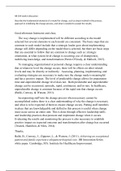
BTE2601 Assignment 3 2025
2 2025
Unique Number:
Due date: 20 August 2025
QUESTION 1

1.1.

Teaching Strategies for a Diverse Grade 9 Classroom

Teaching Strategy and its Importance in Lesson Planning

A teaching strategy is a planned method that a teacher uses to help learners understand the
lesson content and achieve specific learning goals. It is the approach that guides how
information will be presented, how learners will engage with it, and how they will apply their
knowledge. Teaching strategies are important in lesson planning because they shape how
learning will take place and help the teacher choose the most effective way to meet the
needs of all learners. In a diverse Grade 9 classroom, learners have different cultural
backgrounds, abilities, and learning styles. By carefully selecting suitable strategies, the
teacher ensures that each learner can participate meaningfully and develop skills such as
critical thinking and problem-solving (BTE2601 Study guide, 2020). Effective strategies also
make lessons more engaging and relevant, helping learners connect the classroom content
to real-life situations.

DISCLAIMER & TERMS OF USE
 Educational Aid: These study notes are intended to be used as educational resources and should not be seen as a
replacement for individual research, critical analysis, or professional consultation. Students are encouraged to perform
their own research and seek advice from their instructors or academic advisors for specific assignment guidelines.
 Personal Responsibility: While every effort has been made to ensure the accuracy and reliability of the information in
these study notes, the seller does not guarantee the completeness or correctness of all content. The buyer is
responsible for verifying the accuracy of the information and exercising their own judgment when applying it to their
assignments.
 Academic Integrity: It is essential for students to maintain academic integrity and follow their institution's policies
regarding plagiarism, citation, and referencing. These study notes should be used as learning tools and sources of
inspiration. Any direct reproduction of the content without proper citation and acknowledgment may be considered
academic misconduct.
 Limited Liability: The seller shall not be liable for any direct or indirect damages, losses, or consequences arising from
the use of these notes. This includes, but is not limited to, poor academic performance, penalties, or any other negative
consequences resulting from the application or misuse of the information provided.

, For additional support +27 81 278 3372

QUESTION 1

1.1.

Teaching Strategies for a Diverse Grade 9 Classroom

Teaching Strategy and its Importance in Lesson Planning

A teaching strategy is a planned method that a teacher uses to help learners
understand the lesson content and achieve specific learning goals. It is the approach
that guides how information will be presented, how learners will engage with it, and
how they will apply their knowledge. Teaching strategies are important in lesson
planning because they shape how learning will take place and help the teacher
choose the most effective way to meet the needs of all learners. In a diverse Grade 9
classroom, learners have different cultural backgrounds, abilities, and learning
styles. By carefully selecting suitable strategies, the teacher ensures that each
learner can participate meaningfully and develop skills such as critical thinking and
problem-solving (BTE2601 Study guide, 2020). Effective strategies also make
lessons more engaging and relevant, helping learners connect the classroom
content to real-life situations.

Cooperative Learning

Cooperative learning is a strategy where learners work together in small groups to
complete a shared task. In this approach, each group member is responsible for their
own learning and for helping others in the group succeed. The aim is for all learners
to gain the same understanding, skills, and values about a topic. This strategy
encourages communication, teamwork, and the sharing of ideas, which supports the
development of critical thinking because learners must listen to different perspectives
and consider alternative solutions (Gravett, De Beer & Du Plessis, 2019).

In a Grade 9 Life Sciences lesson about environmental pollution, I would divide the
class into mixed-ability groups. Each group would receive a different case study
about a type of pollution, such as water, air, or soil pollution. The learners would
work together to research the causes, effects, and possible solutions to their
assigned type of pollution. They would then present their findings to the class,
making sure that each member of the group speaks during the presentation. This
approach ensures that learners learn from one another and that they are all actively


Gekoppeld boek

Geschreven voor

Instelling
Vak

Documentinformatie

Geüpload op
9 augustus 2025
Aantal pagina's
16
Geschreven in
2025/2026
Type
Tentamen (uitwerkingen)
Bevat
Vragen en antwoorden

Onderwerpen

€3,99
Krijg toegang tot het volledige document:

Verkeerd document? Gratis ruilen Binnen 14 dagen na aankoop en voor het downloaden kun je een ander document kiezen. Je kunt het bedrag gewoon opnieuw besteden.
Geschreven door studenten die geslaagd zijn
Direct beschikbaar na je betaling
Online lezen of als PDF

Maak kennis met de verkoper

Seller avatar
De reputatie van een verkoper is gebaseerd op het aantal documenten dat iemand tegen betaling verkocht heeft en de beoordelingen die voor die items ontvangen zijn. Er zijn drie niveau’s te onderscheiden: brons, zilver en goud. Hoe beter de reputatie, hoe meer de kwaliteit van zijn of haar werk te vertrouwen is.
Edge
Volgen Je moet ingelogd zijn om studenten of vakken te kunnen volgen
Verkocht
10361
Lid sinds
2 jaar
Aantal volgers
4255
Documenten
3094
Laatst verkocht
1 uur geleden

4,2

1291 beoordelingen

5
725
4
263
3
194
2
31
1
78

Populaire documenten

Recent door jou bekeken

Waarom studenten kiezen voor Stuvia

Gemaakt door medestudenten, geverifieerd door reviews

Kwaliteit die je kunt vertrouwen: geschreven door studenten die slaagden en beoordeeld door anderen die dit document gebruikten.

Niet tevreden? Kies een ander document

Geen zorgen! Je kunt voor hetzelfde geld direct een ander document kiezen dat beter past bij wat je zoekt.

Betaal zoals je wilt, start meteen met leren

Geen abonnement, geen verplichtingen. Betaal zoals je gewend bent via iDeal of creditcard en download je PDF-document meteen.

Student with book image

“Gekocht, gedownload en geslaagd. Zo makkelijk kan het dus zijn.”

Alisha Student

Veelgestelde vragen