Problem 5 – Goldstein, (Coren, Gazzaniga, Blake)
Difficulties with perception
- Stimulus on receptors are ambiguous
o Inverse projection problem: a particular image on the retina can be created
by many different objects
- Objects are hidden or blurred
- Objects look different from different viewpoints
o Viewpoint invariance: ability to recognize an object seen from different
perspectives
Gestalt: the basic idea is the whole differs from the sum of its parts
- Gestalt psychologists rejected the idea that perception is built up of sensations
- The principle began with apparent movement:
- Apparent movement: an illusion when 2 stimuli that are in slightly different positions
are flashed one after another with the correct timing
o it’s an illusion because there is actually no movement even though it seems
like it and thus no sensations
o A modern example is electronic light that display advertisements
Gestalt Laws of perceptual organization
- Perceptual organization: involves grouping elements in an image to create larger
objects
- Pragnanz:
o Also called law of simplicity or good figure
o Every stimulus pattern is seen in such a way that the resulting
structure is as simple as possible
o E.g. 5.13 we see 5 circles and not the larger number of more
complicated shapes
- Similarity:
o Similar things appear to be grouped together
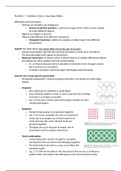
o E.g. 5.14 in part a) people see rows or columns of
circles but in b) people see vertical columns of
circles because the same colored circles are
grouped together
o Grouping can occur because of shape, size or
orientation and for auditory stimuli too
- Good continuation:
o Connected points result in straight or smoothly
curving lines that are seen to be belonging together
o The lined tend to be seen in a way as to follow the
smoothest path
o E.g. 5.17 Celtic know pattern: the law assures that we see a continuous
pattern that’s not broken into little pieces every time strands overlap
, - Proximity:
o Things that are near each other appear to be grouped
together
- Common region:
o Elements that are within the same region of space
appear to be grouped together
- Uniform connectedness:
o a connected region of visual properties such as
lightness, color, texture, or motion, is perceived as a
single unit
- Synchrony:
o visual events that occur at the same time are perceived as belonging together
- Common fate:
o Things that are moving in the same direction appear to be grouped together
o E.g. flock of birds flying in the same direction are seen as grouped together
- Meaningfulness or familiarity:
o Things that form patterns that are familiar or meaningful are likely to be
grouped together
o E.g. faces from rocks and trees in painting: at first, it’s difficult to see the faces
but then because of the change in perception organization you see them
Reversible Figure – Ground: can be perceived alternatively either as 2
blue faces looking at each other in front of a white background or as a
white vase on a blue background
- Some properties:
- The vase figure is more memorable than the ground, but when
you see it on a white background it doesn’t look like an object
and so it’s not memorable
- The contour separating the figure from the ground belongs to
the figure and this property is called border ownership
Factors determining which area is figure:
- Lower-Upper: the lower parts of display are more
likely to be perceived as figure
- Right-Left: There is no left or right preference for
determining figure
- Symmetry: symmetrical areas are seen as figure
- Size: smaller areas are more likely to be seen as
figure
- Orientation: vertical-horizontal orientation is more
likely to be seen as figure
- Meaning: more meaning increases the changes of
that area being seen as figure
Gestalt “Laws” as Heuristics
Difficulties with perception
- Stimulus on receptors are ambiguous
o Inverse projection problem: a particular image on the retina can be created
by many different objects
- Objects are hidden or blurred
- Objects look different from different viewpoints
o Viewpoint invariance: ability to recognize an object seen from different
perspectives
Gestalt: the basic idea is the whole differs from the sum of its parts
- Gestalt psychologists rejected the idea that perception is built up of sensations
- The principle began with apparent movement:
- Apparent movement: an illusion when 2 stimuli that are in slightly different positions
are flashed one after another with the correct timing
o it’s an illusion because there is actually no movement even though it seems
like it and thus no sensations
o A modern example is electronic light that display advertisements
Gestalt Laws of perceptual organization
- Perceptual organization: involves grouping elements in an image to create larger
objects
- Pragnanz:
o Also called law of simplicity or good figure
o Every stimulus pattern is seen in such a way that the resulting
structure is as simple as possible
o E.g. 5.13 we see 5 circles and not the larger number of more
complicated shapes
- Similarity:
o Similar things appear to be grouped together
o E.g. 5.14 in part a) people see rows or columns of
circles but in b) people see vertical columns of
circles because the same colored circles are
grouped together
o Grouping can occur because of shape, size or
orientation and for auditory stimuli too
- Good continuation:
o Connected points result in straight or smoothly
curving lines that are seen to be belonging together
o The lined tend to be seen in a way as to follow the
smoothest path
o E.g. 5.17 Celtic know pattern: the law assures that we see a continuous
pattern that’s not broken into little pieces every time strands overlap
, - Proximity:
o Things that are near each other appear to be grouped
together
- Common region:
o Elements that are within the same region of space
appear to be grouped together
- Uniform connectedness:
o a connected region of visual properties such as
lightness, color, texture, or motion, is perceived as a
single unit
- Synchrony:
o visual events that occur at the same time are perceived as belonging together
- Common fate:
o Things that are moving in the same direction appear to be grouped together
o E.g. flock of birds flying in the same direction are seen as grouped together
- Meaningfulness or familiarity:
o Things that form patterns that are familiar or meaningful are likely to be
grouped together
o E.g. faces from rocks and trees in painting: at first, it’s difficult to see the faces
but then because of the change in perception organization you see them
Reversible Figure – Ground: can be perceived alternatively either as 2
blue faces looking at each other in front of a white background or as a
white vase on a blue background
- Some properties:
- The vase figure is more memorable than the ground, but when
you see it on a white background it doesn’t look like an object
and so it’s not memorable
- The contour separating the figure from the ground belongs to
the figure and this property is called border ownership
Factors determining which area is figure:
- Lower-Upper: the lower parts of display are more
likely to be perceived as figure
- Right-Left: There is no left or right preference for
determining figure
- Symmetry: symmetrical areas are seen as figure
- Size: smaller areas are more likely to be seen as
figure
- Orientation: vertical-horizontal orientation is more
likely to be seen as figure
- Meaning: more meaning increases the changes of
that area being seen as figure
Gestalt “Laws” as Heuristics