Problem 9 – Wolfe
The vestibular organs are a set of specialized sense organs located in the inner ear next to the
cochlea
- senses of tilt and self-motion contribute our sense of spatial orientation
Problems with spatial orientation:
- dizziness: any form of spatial disorientation with or without instability
- vertigo: sensation of rotation or spinning
- spatial disorientation: impairment of spatial orientation
- imbalance: unsteadiness
Our spatial orientation is based on 3 sensory modalities:
- angular motion: rotation motion
- linear motion: translational motion
- tilt: head inclination with respect to gravity
The 3 stimulation energies are sensed by 2 types of vestibular sense organs:
- semicircular canals
o sense angular acceleration (change in angular velocity)
- otolith organs
o transduce both linear acceleration (change of linear velocity) and gravity (provide
contribution to sense of head tilt)
Each of the 3 spatial orientation modalities include 2 qualities: amplitude & direction
1) amplitude:
o rotation motion can be perceived as having high amplitude (vigorously shaking
head) or low amplitude
o translational motion can be perceived as having high velocity (car speeding on
highway) or low velocity
o tilt can be perceived with small amplitudes (nodding head) or large amplitudes
(hang upside down)
2) direction:
- coordinate system: x-axis always points forward, y-axis always point to left ear, and z-axis
always points out the top of the head
- these 3 directions define our sense of angular motion
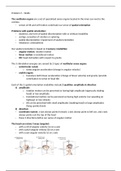
The head can rotate 3 ways (angular):
- with a roll of angular velocity (a) on x-axis
- with a pitch angular velocity (b) on y-axis
- with a yaw angular velocity (c) on z-axis
, There are also 3 directions for our sense of linear motion (translational):
- stepping forward or backward along x-axis
- sliding left or right along the y-axis
- translating up or down along the z-axis
Each orientation has 2 tilt directions:
- a pitch tilt forward or backward (a)
- roll tilt to left or right (b)
- 3rd direction would be yaw rotation but this wouldn’t cause change in the head with
respect to gravity
The vestibular system
- the inner ear has one vestibula labyrinth and each vestibular labyrinth includes 5 sense
organs: three semicircular canals that sense rotational motion and 2 otolith organs that
sense gravity and linear acceleration
- both organs respond to changes in velocity: acceleration
- the vestibular system is principally sensitive to changes in motion, constant motion doesn’t
result in signals
Hair cells: mechanical transducers
- hair cells act as mechanoreceptors in each of the 5 vestibular organs
> head motion causes hair cell stereocilia to deflect
> stereocilia deflection causes a change in the hair cell voltage
> when a hair cell bends toward the tallest stereocilia the hair cell voltage becomes less
negative – also called depolarization
> changes in hair cell voltage: called receptor potential are proportional to the bending of
the hair cell bundles and control the rate at which hair cells release neurotransmitters
> the change in hair voltage increases neurotransmitter release and increases action
potential rate called excitation
> afferent neurons carry the action potentials to the brain
> if the hair cell is bent away from the tallest stereocilia, the cell potential becomes more
negative (hyperpolarization) causing a decrease in neurotransmitter release thus decrease
in action potential (inhibition)
The vestibular organs are a set of specialized sense organs located in the inner ear next to the
cochlea
- senses of tilt and self-motion contribute our sense of spatial orientation
Problems with spatial orientation:
- dizziness: any form of spatial disorientation with or without instability
- vertigo: sensation of rotation or spinning
- spatial disorientation: impairment of spatial orientation
- imbalance: unsteadiness
Our spatial orientation is based on 3 sensory modalities:
- angular motion: rotation motion
- linear motion: translational motion
- tilt: head inclination with respect to gravity
The 3 stimulation energies are sensed by 2 types of vestibular sense organs:
- semicircular canals
o sense angular acceleration (change in angular velocity)
- otolith organs
o transduce both linear acceleration (change of linear velocity) and gravity (provide
contribution to sense of head tilt)
Each of the 3 spatial orientation modalities include 2 qualities: amplitude & direction
1) amplitude:
o rotation motion can be perceived as having high amplitude (vigorously shaking
head) or low amplitude
o translational motion can be perceived as having high velocity (car speeding on
highway) or low velocity
o tilt can be perceived with small amplitudes (nodding head) or large amplitudes
(hang upside down)
2) direction:
- coordinate system: x-axis always points forward, y-axis always point to left ear, and z-axis
always points out the top of the head
- these 3 directions define our sense of angular motion
The head can rotate 3 ways (angular):
- with a roll of angular velocity (a) on x-axis
- with a pitch angular velocity (b) on y-axis
- with a yaw angular velocity (c) on z-axis
, There are also 3 directions for our sense of linear motion (translational):
- stepping forward or backward along x-axis
- sliding left or right along the y-axis
- translating up or down along the z-axis
Each orientation has 2 tilt directions:
- a pitch tilt forward or backward (a)
- roll tilt to left or right (b)
- 3rd direction would be yaw rotation but this wouldn’t cause change in the head with
respect to gravity
The vestibular system
- the inner ear has one vestibula labyrinth and each vestibular labyrinth includes 5 sense
organs: three semicircular canals that sense rotational motion and 2 otolith organs that
sense gravity and linear acceleration
- both organs respond to changes in velocity: acceleration
- the vestibular system is principally sensitive to changes in motion, constant motion doesn’t
result in signals
Hair cells: mechanical transducers
- hair cells act as mechanoreceptors in each of the 5 vestibular organs
> head motion causes hair cell stereocilia to deflect
> stereocilia deflection causes a change in the hair cell voltage
> when a hair cell bends toward the tallest stereocilia the hair cell voltage becomes less
negative – also called depolarization
> changes in hair cell voltage: called receptor potential are proportional to the bending of
the hair cell bundles and control the rate at which hair cells release neurotransmitters
> the change in hair voltage increases neurotransmitter release and increases action
potential rate called excitation
> afferent neurons carry the action potentials to the brain
> if the hair cell is bent away from the tallest stereocilia, the cell potential becomes more
negative (hyperpolarization) causing a decrease in neurotransmitter release thus decrease
in action potential (inhibition)