INTRODUCTION TO BUSINESS ECONOMICS, MANAGEMENT AND MARKETING
LECTURE 1 – ENTERPRENEURSHIP AND BUSINESS PLAN
Entrepreneurship It is the process of designing, launching and running a new business, which is often
initially a small business. The people who create these businesses are called entrepreneurs.
Entrepreneurship refers to the capacity and willingness to develop, organize and manage a business
venture along with any of its risks to make a profit.
The aim of entrepreneurship is to maintain a profitable business in a dynamic environment. A dynamic and
changing environment requires anticipation companies need to react to developments in the
environment by introducing innovations, new products and services, new production processes, by
entering new markets and by using new raw materials.
Trends in agricultural entrepreneurship
- Company size is increasing and also the level of mechanization
- There is a negative farm results the average rate of returns for agricultural companies in 2020
was -2€ (or 98€ of revenues and 100€ of costs)
- Agricultural entrepreneurship is characterized by changing legislations (e.g. on pesticide use), and
changing consumer perceptions and demands (e.g. more interest for animal welfare)
- Agricultural entrepreneurship is characterized by diversification of activities, e.g. agritourism,
nature management, social farming.
Entrepreneurship in the NL
- In NL, 20% of workers are entrepreneurs, but only 8% of these start with a unique idea/business
- The main reasons for becoming entrepreneurs in the NL are: the desire to be your own boss,
challenge, dissatisfaction when employed in another company
- The total number of entrepreneurs in NL is over 1.9 million.
- There are about 650000 small and medium-size enterprises (formed by 2-250 people), and 1000
large-size (>250 people employed)
- There are about 80600 agricultural enterprises
- Survival rate ¼ of the entrepreneurs stops within 2 years, while 60% still exists after 5 years
o In the agricultural sector, 77% of enterprises still exists after 5 years
- Problems encountered by entrepreneurs late payments from customers, strong competition,
yields are too low, pricing, developing a sales area.
Business plan
Business plan = a plan for starting up a new business or for renewing an existing business. Business plans
increase the viability of a company
Having a business plan is necessary e.g. to ask loans to a bank (you have to show the bank your business
plan, to check if you are able to repay the money), and is also useful to increase the confidence of suppliers
and insurers in your business, because it tells them what you are doing, how and your financial activities.
The main parts included in the business plan are:
- Strategic plan: it tells why, what and how the entrepreneur will perform his business? It also
includes an environmental analysis analysis of environmental factors that influence the business,
e.g. economic environment, social, laws, technologies, and also who are the stakeholders.
, - Marketing plan: it tells who are the customers and what do they want? What is the best way to
approach these customers?
- Financial plan: it tells what needs to be purchased to run the business? How much needs to be
invested? How are we going to fund the business? How much profit do we need?
LECTURE 2 – STRATEGY 1
STRATEGIC POSITION
Strategy = it defines the purpose of an organization, its goals and plans. There are different ways to define
the purpose of the organization (elements of a strategy):
- Vision = what the company wants to be
- Mission = the reason of existence and purpose of a company
- Goals = what the company must achieve to be successful
- Values = what values the company wants to maintain, expressed in ethical terms
- Objectives = specific measurable outcomes, they are specific and short-term goals (e.g. how much
profit)
- Targets = define the desired level of performance of the company and timelines
Horizons for strategy
Horizon 1 extend and defend the core business. It refers to the fact
that ideas provide continuous innovation to a business in the short-
term.
- What are you going to do, how and within what time?
Horizon 2 build the emerging business. It refers to the fact that
ideas extend the existing business and its capabilities to new
customers, markets or targets. It refers to the mid-term survival of the organization.
- How are we going to extend?
Horizon 3 create viable options. It refers to the creation of new capabilities and new business to take
advantage of disruptive opportunities, or to counter (combattere) disruption. It refers to the long-term
survival of the organization.
- How do you create options that are beneficial for you? What are you going to do to remain in the
business for the next 20 years?
Levels of strategy
- Corporate level the corporate strategy tells what is
the overall scope of the organization and how value is
added to the business units that compose the
corporate. It also tells where the company is going to
compete, in which markets. (ricorda: corporate è tipo
Unilever, business units sono tutti I business che ne
fanno parte).
- Business level the business unit strategy tells how the business units want to compete in a
certain market.
, - Functional level each business unit is composed of different parts (e.g. marketing department,
technology, research and development department). Each part has its own strategy, which tells
how each part will perform its daily operations and activities to make the business work.
The “Exploring strategy model”
The Exploring strategy model includes understanding the strategic
position of a company, evaluating the strategic choices for the future,
and managing strategy in action. (We focus on strategic position and
strategic choices.)
Strategic position it is concerned with the external environment, the
strategic capabilities of the company (resources and compentences),
the organization’s goals and the organization’s culture.
- What are the opportunities and threats? What are strengths
and weaknesses of the company? What is the basic purpose of the company?
Strategic choices they refer to the choices that the company has to make to ensure it will survive on the
long term. These choices include the business strategy, the corporate strategy, the international strategy,
innovation, and acquisitions and alliances.
- How should business units compete in the market? Where should the company compete
internationally? Should the company buy other companies, form alliances or work alone?
Strategy in action it refers to structuring an organization to support a successful performance. Systems
are required to control how strategy is being implemented/applied. (do not focus on this part)
- Which strategies are suitable? What are structures and systems required in the company?
Strategy development
- The rational-analytic view sees strategy development as a linear and planned process, which is
typically done by top managers.
- The emergent view sees strategy development as an incremental adaptation, which is often
inspired by actions occurring in the lowest parts of the organization (bottom managers,
employees).
- Both views are valid, so companies should not rely on just one.
MACRO-ENVIRONMENT
The macro-environment refers to the environment outside of the
company, and includes different factors that influence the company.
Companies also need to consider the market environment (suppliers,
customers, competitors), and the non-market environment e.g.
stakeholders.
PESTEL analysis it can be used to analyze the macro-environment. The
PESTEL defines 6 external environmental factors that influence the company:
- Political include e.g. government policies, regulations for trade, taxation changes
- Economic e.g. interest and unemployment rates, business cycles (economic situation in general)
, - Social e.g. demographics, income distribution, lifestyle changes
- Technological new technology developments, e.g. nanotechnology, new materials
- Ecological e.g. environmental issues like pollution, climate change, waste disposal, recycling.
Companies may take into account pollution obligations to minimize production of pollutants and
dispose wastes, and sustainable development of the company.
- Legal e.g. laws about labor, environment and consumers, taxations
How to use PESTEL
- Identify specific factors that influence the sector, market and company.
- Identify factors that are important now, but also consider which will become important in the
future.
- Identify opportunities and threats for the company
Scenario analysis scenarios are plausible views of how the environment and the company might develop
in the future. Companies make scenario analysis to evaluate which strategies to apply in the future. How to
carry out a scenario analysis:
1. Identify the scope of the analysis, e.g. the product, market and time span to consider
2. Identify key drivers of change, i.e. the PESTEL factors that will have most impact in the future
3. Develop distinct scenarios, i.e. possible future situations based on the PESTEL factors in step 2
4. Identify how these possible scenarios will impact on your company, and then adapt your
strategies accordingly.
INDUSTRY AND SECTOR ENVIRONMENT
Industry = a group of firms producing products and services that are similar, e.g. automobile industry, food
industry.
Market = group of customers for specific products or services that are similar, e.g. market for luxury cars
Sector = it is defined as a broad industry group (or group of markets), especially in the public sector (e.g.
health sector).
Five-forces analysis of Porter
5 forces that determine how attractive is the market:
1) Competitive rivalry
refers to the competition between companies with similar
products and services, that target the same customers, and are
competitors in the same industry/market.
The degree of rivalry depends on: competitor concentration,
industry growth rate, high fixed costs, low differentiation.
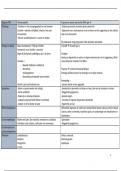
The table shows the rivalry between existing competitors homogeneous goods are e.g. oil or milk;
heterogeneous products are e.g. cellphones of different brands. Companies want to move to the right and
bottom of the table, i.e. they want to have monopoly of heterogeneous products.
2) Potential entrants/threat of new entries
LECTURE 1 – ENTERPRENEURSHIP AND BUSINESS PLAN
Entrepreneurship It is the process of designing, launching and running a new business, which is often
initially a small business. The people who create these businesses are called entrepreneurs.
Entrepreneurship refers to the capacity and willingness to develop, organize and manage a business
venture along with any of its risks to make a profit.
The aim of entrepreneurship is to maintain a profitable business in a dynamic environment. A dynamic and
changing environment requires anticipation companies need to react to developments in the
environment by introducing innovations, new products and services, new production processes, by
entering new markets and by using new raw materials.
Trends in agricultural entrepreneurship
- Company size is increasing and also the level of mechanization
- There is a negative farm results the average rate of returns for agricultural companies in 2020
was -2€ (or 98€ of revenues and 100€ of costs)
- Agricultural entrepreneurship is characterized by changing legislations (e.g. on pesticide use), and
changing consumer perceptions and demands (e.g. more interest for animal welfare)
- Agricultural entrepreneurship is characterized by diversification of activities, e.g. agritourism,
nature management, social farming.
Entrepreneurship in the NL
- In NL, 20% of workers are entrepreneurs, but only 8% of these start with a unique idea/business
- The main reasons for becoming entrepreneurs in the NL are: the desire to be your own boss,
challenge, dissatisfaction when employed in another company
- The total number of entrepreneurs in NL is over 1.9 million.
- There are about 650000 small and medium-size enterprises (formed by 2-250 people), and 1000
large-size (>250 people employed)
- There are about 80600 agricultural enterprises
- Survival rate ¼ of the entrepreneurs stops within 2 years, while 60% still exists after 5 years
o In the agricultural sector, 77% of enterprises still exists after 5 years
- Problems encountered by entrepreneurs late payments from customers, strong competition,
yields are too low, pricing, developing a sales area.
Business plan
Business plan = a plan for starting up a new business or for renewing an existing business. Business plans
increase the viability of a company
Having a business plan is necessary e.g. to ask loans to a bank (you have to show the bank your business
plan, to check if you are able to repay the money), and is also useful to increase the confidence of suppliers
and insurers in your business, because it tells them what you are doing, how and your financial activities.
The main parts included in the business plan are:
- Strategic plan: it tells why, what and how the entrepreneur will perform his business? It also
includes an environmental analysis analysis of environmental factors that influence the business,
e.g. economic environment, social, laws, technologies, and also who are the stakeholders.
, - Marketing plan: it tells who are the customers and what do they want? What is the best way to
approach these customers?
- Financial plan: it tells what needs to be purchased to run the business? How much needs to be
invested? How are we going to fund the business? How much profit do we need?
LECTURE 2 – STRATEGY 1
STRATEGIC POSITION
Strategy = it defines the purpose of an organization, its goals and plans. There are different ways to define
the purpose of the organization (elements of a strategy):
- Vision = what the company wants to be
- Mission = the reason of existence and purpose of a company
- Goals = what the company must achieve to be successful
- Values = what values the company wants to maintain, expressed in ethical terms
- Objectives = specific measurable outcomes, they are specific and short-term goals (e.g. how much
profit)
- Targets = define the desired level of performance of the company and timelines
Horizons for strategy
Horizon 1 extend and defend the core business. It refers to the fact
that ideas provide continuous innovation to a business in the short-
term.
- What are you going to do, how and within what time?
Horizon 2 build the emerging business. It refers to the fact that
ideas extend the existing business and its capabilities to new
customers, markets or targets. It refers to the mid-term survival of the organization.
- How are we going to extend?
Horizon 3 create viable options. It refers to the creation of new capabilities and new business to take
advantage of disruptive opportunities, or to counter (combattere) disruption. It refers to the long-term
survival of the organization.
- How do you create options that are beneficial for you? What are you going to do to remain in the
business for the next 20 years?
Levels of strategy
- Corporate level the corporate strategy tells what is
the overall scope of the organization and how value is
added to the business units that compose the
corporate. It also tells where the company is going to
compete, in which markets. (ricorda: corporate è tipo
Unilever, business units sono tutti I business che ne
fanno parte).
- Business level the business unit strategy tells how the business units want to compete in a
certain market.
, - Functional level each business unit is composed of different parts (e.g. marketing department,
technology, research and development department). Each part has its own strategy, which tells
how each part will perform its daily operations and activities to make the business work.
The “Exploring strategy model”
The Exploring strategy model includes understanding the strategic
position of a company, evaluating the strategic choices for the future,
and managing strategy in action. (We focus on strategic position and
strategic choices.)
Strategic position it is concerned with the external environment, the
strategic capabilities of the company (resources and compentences),
the organization’s goals and the organization’s culture.
- What are the opportunities and threats? What are strengths
and weaknesses of the company? What is the basic purpose of the company?
Strategic choices they refer to the choices that the company has to make to ensure it will survive on the
long term. These choices include the business strategy, the corporate strategy, the international strategy,
innovation, and acquisitions and alliances.
- How should business units compete in the market? Where should the company compete
internationally? Should the company buy other companies, form alliances or work alone?
Strategy in action it refers to structuring an organization to support a successful performance. Systems
are required to control how strategy is being implemented/applied. (do not focus on this part)
- Which strategies are suitable? What are structures and systems required in the company?
Strategy development
- The rational-analytic view sees strategy development as a linear and planned process, which is
typically done by top managers.
- The emergent view sees strategy development as an incremental adaptation, which is often
inspired by actions occurring in the lowest parts of the organization (bottom managers,
employees).
- Both views are valid, so companies should not rely on just one.
MACRO-ENVIRONMENT
The macro-environment refers to the environment outside of the
company, and includes different factors that influence the company.
Companies also need to consider the market environment (suppliers,
customers, competitors), and the non-market environment e.g.
stakeholders.
PESTEL analysis it can be used to analyze the macro-environment. The
PESTEL defines 6 external environmental factors that influence the company:
- Political include e.g. government policies, regulations for trade, taxation changes
- Economic e.g. interest and unemployment rates, business cycles (economic situation in general)
, - Social e.g. demographics, income distribution, lifestyle changes
- Technological new technology developments, e.g. nanotechnology, new materials
- Ecological e.g. environmental issues like pollution, climate change, waste disposal, recycling.
Companies may take into account pollution obligations to minimize production of pollutants and
dispose wastes, and sustainable development of the company.
- Legal e.g. laws about labor, environment and consumers, taxations
How to use PESTEL
- Identify specific factors that influence the sector, market and company.
- Identify factors that are important now, but also consider which will become important in the
future.
- Identify opportunities and threats for the company
Scenario analysis scenarios are plausible views of how the environment and the company might develop
in the future. Companies make scenario analysis to evaluate which strategies to apply in the future. How to
carry out a scenario analysis:
1. Identify the scope of the analysis, e.g. the product, market and time span to consider
2. Identify key drivers of change, i.e. the PESTEL factors that will have most impact in the future
3. Develop distinct scenarios, i.e. possible future situations based on the PESTEL factors in step 2
4. Identify how these possible scenarios will impact on your company, and then adapt your
strategies accordingly.
INDUSTRY AND SECTOR ENVIRONMENT
Industry = a group of firms producing products and services that are similar, e.g. automobile industry, food
industry.
Market = group of customers for specific products or services that are similar, e.g. market for luxury cars
Sector = it is defined as a broad industry group (or group of markets), especially in the public sector (e.g.
health sector).
Five-forces analysis of Porter
5 forces that determine how attractive is the market:
1) Competitive rivalry
refers to the competition between companies with similar
products and services, that target the same customers, and are
competitors in the same industry/market.
The degree of rivalry depends on: competitor concentration,
industry growth rate, high fixed costs, low differentiation.
The table shows the rivalry between existing competitors homogeneous goods are e.g. oil or milk;
heterogeneous products are e.g. cellphones of different brands. Companies want to move to the right and
bottom of the table, i.e. they want to have monopoly of heterogeneous products.
2) Potential entrants/threat of new entries