Problem 1: Hospital accreditation in Denmark
PRESS RELEASE 20 April 2015 – Paperwork out for hospitals
Taken from: http://gpaccess.uk/news/hospital-accreditation-to-end-in-denmark/ (Links to
an external site.)Links to an external site. (translated from original press release from
Danish Ministry of Health)
The health minister and chairman of Danish regions both want more quality and less
bureaucracy and therefore now want to change the way hospital quality is measured.
Doctors and nurses employed in public hospitals have said in recent years. ‘We are
drowning in manuals and paperwork and have no time for patients’.
The criticism has sometimes been harsh as health professionals find that there are more
guides and documentation requirements in health services. A major source of frustration is
the way in which quality is measured, as hospitals must be accredited in accordance with
the Danish Quality Model.
Health Minister Nick Haekkerup and President of Danish Regions Bent Hansen understand
the frustrations of hospital staff and announce changes in the model:
“The quality of our health care system must be in order, and there is nothing wrong with the
intention behind the system of giving hospitals the seal of approval if they meet a number of
quality requirements. But when hospital staff can no longer see the point of filling out
paperwork, review guides and standards and call for a different and less cumbersome way
to work with quality, of course I listen. And I believe that it is time to drop the quality model
in hospitals, so staff have more time for patients,” says Nick Haekkerup. Today he presents a
new national quality program, which he will discuss with the Danish regions, local
government and other relevant parties.
“In the Danish regions we are completely in line with the minister,” declares president Bent
Hansen. He is preparing to phase out accreditation by the Danish Quality Model and make
quality work at hospitals more for the benefit of staff and patients: “Quality work must be
simplified and focused. The time has come to strengthen it by putting the patient at the
centre, rather than focusing on compliance with a variety of standards. Accreditation has
been justified and useful, but we move on. We need a few national targets to be met locally
with strong commitment from the staff and with room for local solutions,” says Bent
Hansen.
Specifically, the Minister of Health and Danish Regions is phasing out the Danish Quality
Model, so management and medical staff at the hospitals from the turn of the year no
longer have to go through an often lengthy process to get the certificate of accreditation.
The Danish Quality Model was introduced in 2005 and is based on the Institute for Quality
and Accreditation in Healthcare (IKAS). The quality model is run in cooperation between
Danish Regions, the Ministry of Health, Health Protection Agency, KL, Danish Pharmaceutical
Association and the Danish Chamber of Commerce.
, Make sure to write a couple of sentences in the heading on the relevance of the text to the
learning goal and sub-questions.
Learning goal: What is the role and effect of formal structures in quality improvements
efforts?
Sub-questions: What are advantages and dis-advantages of hospital accreditation? How
could you develop a structure which supports ‘putting the patient at the centre’ in quality
work? How can we know that a structure is effective in improving quality work?
Literature Week 1 Q&S
As a reading guide for the literature, please answer the following questions for yourself:
1. Why is this literature relevant for this problem and for the course as a whole?
2. Where in the literature (e.g. at what page) did you discover this relevance?
3. Bromley & Powell make a distinction between two kinds of ‘decoupling’.
a) What is ‘decoupling’?
b) Which two types of decoupling do the authors distinguish and which do they find more
important?
c) Why does this last kind of decoupling occur in organizations?
d) How does the notion of decoupling relate to the structural challenge of Bate et al.?
4. Dixon-Woods et al. argue for ‘ex post theory’ to assess the implementation of quality
improvement efforts.
a) What do Dixon-Woods et al. mean with ‘ex post theory’ and how is this notion related to
the ‘cargo cult’ that they describe as one of the problems of quality improvement?
b) Which are the explanations the authors give for the success of the Michigan program?
c) How do these explanations relate to the different challenges posed by Bate et al.?
Bate et al. (2008) Towards a process model of organizing for quality,
Chapter 10
There’s a need for quality research to move from a focus on factors to one on processes.
Key factors which contributed to the success of a couple of high-performing hospitals:
developing the right culture, attracting and retaining the right people, devising and updating
the right in-house processes, and giving staff the right tools to do the job.
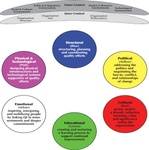
Important: change and improvement models tell us little about process, because process is
not the sequence or steps that it takes to get somewhere, but its about what happens in
PRESS RELEASE 20 April 2015 – Paperwork out for hospitals
Taken from: http://gpaccess.uk/news/hospital-accreditation-to-end-in-denmark/ (Links to
an external site.)Links to an external site. (translated from original press release from
Danish Ministry of Health)
The health minister and chairman of Danish regions both want more quality and less
bureaucracy and therefore now want to change the way hospital quality is measured.
Doctors and nurses employed in public hospitals have said in recent years. ‘We are
drowning in manuals and paperwork and have no time for patients’.
The criticism has sometimes been harsh as health professionals find that there are more
guides and documentation requirements in health services. A major source of frustration is
the way in which quality is measured, as hospitals must be accredited in accordance with
the Danish Quality Model.
Health Minister Nick Haekkerup and President of Danish Regions Bent Hansen understand
the frustrations of hospital staff and announce changes in the model:
“The quality of our health care system must be in order, and there is nothing wrong with the
intention behind the system of giving hospitals the seal of approval if they meet a number of
quality requirements. But when hospital staff can no longer see the point of filling out
paperwork, review guides and standards and call for a different and less cumbersome way
to work with quality, of course I listen. And I believe that it is time to drop the quality model
in hospitals, so staff have more time for patients,” says Nick Haekkerup. Today he presents a
new national quality program, which he will discuss with the Danish regions, local
government and other relevant parties.
“In the Danish regions we are completely in line with the minister,” declares president Bent
Hansen. He is preparing to phase out accreditation by the Danish Quality Model and make
quality work at hospitals more for the benefit of staff and patients: “Quality work must be
simplified and focused. The time has come to strengthen it by putting the patient at the
centre, rather than focusing on compliance with a variety of standards. Accreditation has
been justified and useful, but we move on. We need a few national targets to be met locally
with strong commitment from the staff and with room for local solutions,” says Bent
Hansen.
Specifically, the Minister of Health and Danish Regions is phasing out the Danish Quality
Model, so management and medical staff at the hospitals from the turn of the year no
longer have to go through an often lengthy process to get the certificate of accreditation.
The Danish Quality Model was introduced in 2005 and is based on the Institute for Quality
and Accreditation in Healthcare (IKAS). The quality model is run in cooperation between
Danish Regions, the Ministry of Health, Health Protection Agency, KL, Danish Pharmaceutical
Association and the Danish Chamber of Commerce.
, Make sure to write a couple of sentences in the heading on the relevance of the text to the
learning goal and sub-questions.
Learning goal: What is the role and effect of formal structures in quality improvements
efforts?
Sub-questions: What are advantages and dis-advantages of hospital accreditation? How
could you develop a structure which supports ‘putting the patient at the centre’ in quality
work? How can we know that a structure is effective in improving quality work?
Literature Week 1 Q&S
As a reading guide for the literature, please answer the following questions for yourself:
1. Why is this literature relevant for this problem and for the course as a whole?
2. Where in the literature (e.g. at what page) did you discover this relevance?
3. Bromley & Powell make a distinction between two kinds of ‘decoupling’.
a) What is ‘decoupling’?
b) Which two types of decoupling do the authors distinguish and which do they find more
important?
c) Why does this last kind of decoupling occur in organizations?
d) How does the notion of decoupling relate to the structural challenge of Bate et al.?
4. Dixon-Woods et al. argue for ‘ex post theory’ to assess the implementation of quality
improvement efforts.
a) What do Dixon-Woods et al. mean with ‘ex post theory’ and how is this notion related to
the ‘cargo cult’ that they describe as one of the problems of quality improvement?
b) Which are the explanations the authors give for the success of the Michigan program?
c) How do these explanations relate to the different challenges posed by Bate et al.?
Bate et al. (2008) Towards a process model of organizing for quality,
Chapter 10
There’s a need for quality research to move from a focus on factors to one on processes.
Key factors which contributed to the success of a couple of high-performing hospitals:
developing the right culture, attracting and retaining the right people, devising and updating
the right in-house processes, and giving staff the right tools to do the job.
Important: change and improvement models tell us little about process, because process is
not the sequence or steps that it takes to get somewhere, but its about what happens in