Hamlet - Act 5 – Denouement
Scene 1
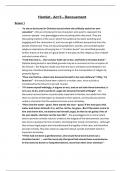
- “Is she to be buried in Christian burial when she willfully seeks her own
salvation” - We are introduced to two characters who exist to represent the
common people – two gravediggers who are joking while they work. They are
discussing matters of the court, which the audience has been watching and
engaging with the characters of, and now we get a different perspective from the
people of Denmark. They are discussing Ophelia’s suicide, and considering the
religious implications of burying her in “christian burial” (on sanctified grounds)-
further draws on the idea of a good death in the play and the religious view of death
and what comes after it.
- “I tell thee she is... the crowner hath sat on her, and finds it christian burial” -
Ophelia being buried in sanctified grounds may be a comment on the corruption of
the Church – the King has made sure that she has a christian burial despite it not
being one, therefore Shakespeare commenting on the manipulation of religion by
powerful figures
- “How can that be, unless she drowned herself in her own defence? / Why, ‘tis
found so” - this would have been a plea in a murder case, since suicide is
considered by the Church to be self-murder
- “If I drown myself wittingly, it argues an act, and an act hath three branches; it
is to act, to do, and to perform: argal she drowned herself wittingly” - the
discussion around action is particularly important to Hamlet, but aside from that
there is a sense of disrespect or distaste to their speech, as they discuss almost
rudely a character that the audience knows more intimately.
- “Here lies the water – good. Here stands the man – good. If the man go to this
water and drown himself, it is, will he, nill he, he goes...But if the water come to
him and drown him, he drowns not himself; argal, he that is not guilty of his of
his own death, shortens not his own life” - the gravediggers do to some extent
exist to provide comedic value to undercut the tragedy of the denouement, but they
also serve a purpose for the narrative, this being their social commentary – although
they misuse legal jargon and misunderstand the legality of this case, and therefore
provide comedy, they also make an argument about suicide and death which is
important to Hamlet
- “If this had not been a gentlewoman, she would have been buried out a
christian burial / ... and the more pity that great folk should have countenance
in this world to drown or hang themselves, more than their even-christian" -
, strangely summarises part of the issue of the play – the characters the audience
has been watching are almost all of high rank, and all have leave to act in any way
they want, Claudius and even Hamlet getting away with more than others would
have – Claudius is rewarded for his treason, and Hamlet is not punished for killing
Polonius, but for being a threat to Claudius. The gravediggers argue that religious
ruling is essentially not applicable to characters of high rank. This idea is also
explored by Claudius, who recognises in Act 3 that in heaven a man’s sin “lies in his
true nature” - “there is no shuffling there”
The gravediggers joke for a while longer about Adam digging and the gallows – more morbid
humour with no significance to Hamlet outside of the finality of death in “a gravemaker, the
houses that he makes last till doomsday”
- “Has this fellow no feeling of his business that ‘a sings at grave-making? /
Custom hath made it in him a property of easiness” - Death has become a
custom to the gravemaker, which is a strange idea for Hamlet who has as of now
considered death and feared it – he cannot grasp the idea of death as a simple and
customary matter
- “That skull had a tongue in it, and could sing once, how the knave jowls it to the
ground, as if ‘twere Cain’s jawbone that did the first murder” - So far for Hamlet
death has been a mental concept, one that he considered often and fretted over.
The skull has introduced a sense of physicality to death that Hamlet has not
considered
- “This might be the pate of a politician...one that would circumvent God, might it
not / Or of a courtier, which could say ‘Good morrow sweet lord, how dost thou
sweet lord?’. This might be my lord such-a-one, that praised my lord such-a-
one's horse when a’ meant to beg it, might it not” - Hamlet creates for all of the
skulls their own personhood, making stories and characters for them as an attempt
to contend the skull with the idea of a real living person – he is starting to
understand the idea of life ending and deteriorating into nothing – at this point
becomes a fatalist?
- “Did these bones cost no more the breeding, but to play at loggats with them?
Mine ache to think on’t” - The bones grown and used so that they are worthless
now – all of the time and effort spent on the self, all of the growing and breeding, is
wasted when we all come to the same dreary end – Hamlet understanding the
futility of everything we do
Hamlet speaks to the gravedigger, who is jokingly very pedantic and is perhaps the first
character in the play to outmatch Hamlet in his witticism. Hamlet learns that a woman is to
Scene 1
- “Is she to be buried in Christian burial when she willfully seeks her own
salvation” - We are introduced to two characters who exist to represent the
common people – two gravediggers who are joking while they work. They are
discussing matters of the court, which the audience has been watching and
engaging with the characters of, and now we get a different perspective from the
people of Denmark. They are discussing Ophelia’s suicide, and considering the
religious implications of burying her in “christian burial” (on sanctified grounds)-
further draws on the idea of a good death in the play and the religious view of death
and what comes after it.
- “I tell thee she is... the crowner hath sat on her, and finds it christian burial” -
Ophelia being buried in sanctified grounds may be a comment on the corruption of
the Church – the King has made sure that she has a christian burial despite it not
being one, therefore Shakespeare commenting on the manipulation of religion by
powerful figures
- “How can that be, unless she drowned herself in her own defence? / Why, ‘tis
found so” - this would have been a plea in a murder case, since suicide is
considered by the Church to be self-murder
- “If I drown myself wittingly, it argues an act, and an act hath three branches; it
is to act, to do, and to perform: argal she drowned herself wittingly” - the
discussion around action is particularly important to Hamlet, but aside from that
there is a sense of disrespect or distaste to their speech, as they discuss almost
rudely a character that the audience knows more intimately.
- “Here lies the water – good. Here stands the man – good. If the man go to this
water and drown himself, it is, will he, nill he, he goes...But if the water come to
him and drown him, he drowns not himself; argal, he that is not guilty of his of
his own death, shortens not his own life” - the gravediggers do to some extent
exist to provide comedic value to undercut the tragedy of the denouement, but they
also serve a purpose for the narrative, this being their social commentary – although
they misuse legal jargon and misunderstand the legality of this case, and therefore
provide comedy, they also make an argument about suicide and death which is
important to Hamlet
- “If this had not been a gentlewoman, she would have been buried out a
christian burial / ... and the more pity that great folk should have countenance
in this world to drown or hang themselves, more than their even-christian" -
, strangely summarises part of the issue of the play – the characters the audience
has been watching are almost all of high rank, and all have leave to act in any way
they want, Claudius and even Hamlet getting away with more than others would
have – Claudius is rewarded for his treason, and Hamlet is not punished for killing
Polonius, but for being a threat to Claudius. The gravediggers argue that religious
ruling is essentially not applicable to characters of high rank. This idea is also
explored by Claudius, who recognises in Act 3 that in heaven a man’s sin “lies in his
true nature” - “there is no shuffling there”
The gravediggers joke for a while longer about Adam digging and the gallows – more morbid
humour with no significance to Hamlet outside of the finality of death in “a gravemaker, the
houses that he makes last till doomsday”
- “Has this fellow no feeling of his business that ‘a sings at grave-making? /
Custom hath made it in him a property of easiness” - Death has become a
custom to the gravemaker, which is a strange idea for Hamlet who has as of now
considered death and feared it – he cannot grasp the idea of death as a simple and
customary matter
- “That skull had a tongue in it, and could sing once, how the knave jowls it to the
ground, as if ‘twere Cain’s jawbone that did the first murder” - So far for Hamlet
death has been a mental concept, one that he considered often and fretted over.
The skull has introduced a sense of physicality to death that Hamlet has not
considered
- “This might be the pate of a politician...one that would circumvent God, might it
not / Or of a courtier, which could say ‘Good morrow sweet lord, how dost thou
sweet lord?’. This might be my lord such-a-one, that praised my lord such-a-
one's horse when a’ meant to beg it, might it not” - Hamlet creates for all of the
skulls their own personhood, making stories and characters for them as an attempt
to contend the skull with the idea of a real living person – he is starting to
understand the idea of life ending and deteriorating into nothing – at this point
becomes a fatalist?
- “Did these bones cost no more the breeding, but to play at loggats with them?
Mine ache to think on’t” - The bones grown and used so that they are worthless
now – all of the time and effort spent on the self, all of the growing and breeding, is
wasted when we all come to the same dreary end – Hamlet understanding the
futility of everything we do
Hamlet speaks to the gravedigger, who is jokingly very pedantic and is perhaps the first
character in the play to outmatch Hamlet in his witticism. Hamlet learns that a woman is to