Revision Notes: Vol.1 (Bach)
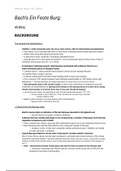
Bach’s Ein Feste Burg:
All Mvts.
BACKGROUND
The cantata & its development:
- Cantata = multi-movement work, for one or more voices, with an instrumental accompaniment
↪ From about 1620, most important form of vocal music of Baroque period outside opera and oratorio
↪ Written often using both sacred and secular texts
↪ In Italy almost every composer of standing cultivated the form
↪ Typically grew from a short piece of recitative + aria accompanied only by continuo into a chain of
recitatives and da capo arias for 1 or 2 voices
- In Germany in Baroque period, canta became associated with Lutheran Church as a
multi-movement piece of liturgical music
↪ Lutheran Church = early protestant denomination, whose services broadly followed
the Catholic Mass, except in German
↪ Lutheran Cantata performed after Gospel reading within service every Sunday
↪ Prior to around 1700, sacred Lutheran music had been based largely on 12th Century music with
biblical text → Erdmann Numeister encouraged absorption of secular music into the church service
↪ Bach developed notion of the chorale-cantata, in which inner movements of recitatives, arias and
ensembles are bookended by an opening choral fantasy on the opening stanza of a hymn and a closing
chorale, harmonisation of a German hymn tune in four-part chordal homophony
↪ e.g Late German Cantata - Ein feste Burg ist unser Gott (first performed between 1727-1731)
→ chorale cantata, in which both text + music are based on an earlier hymn (chorale)
written by Martin Luther
↪ Martin Luther’s chorale = his most famous of his compositions
→ signature tune of reformatory Germany
J.S Bach & the late Baroque style:
- Bach’s musical style is indicative of the late Baroque elevated to its highest level
→ also the result of a number of stylistic influences
- Lutheran German cantata had begun to be composed by a number of Baroque north German
organists/composers prior to Bach
↪ Earlier cantatas were similar in nature but Bach developed the genre into a more substantial extensive form
↪ Bach famously drew relatively little influence from composers outside of Germany
→ exception to this: Vivaldi, also composed cantatas primarily secular + tended to be smaller
in scale, solo arias + recitatives
- Typical Baroque features can be seen in the piece’s ‘chorale cantata’ structure:
Use of cantus firmus, dense intricate fugal counterpoint, cantionale-style chorale textures of the closing
movement, functional tonality + harmony, dramatic harmonic tools: chromatic chords + suspensions, melodic
melisma, combined with orthodox devices such as ornamental sequential writing + the rhythmic moto perpetuo of
mvt. II
↪ Work ∴ demonstrates German Cantata genre was ideal for Bach to portray his late Baroque style
→ vernacular containing many features typical in similar sacred vocal works of the time, but
elevated to new levels of profounding
, Revision Notes: Vol.1 (Bach)
Mvt.1
STRUCTURE (& TONALITY)
Point Explanation Reference(s)
Overall Key= Dmajor Tonal language that modulates 4th mvt. Aria Cantata No.48; Ich
- Modulates to closely related to closely related keys and that Elender Mensch, Bach (1723)
keys , helps helps define structure: - Begins in Eb major
to define structure - Common to Baroque works & - Modulates through Cmin, Fmin
Bach’s other compositions & Bbmin
Chorale-cantata nature - 1st modulation articulates start
- Each movement based on of section B
closing chorale; taken from ------------------------------------ --------------------------------------------
Lutheran hymn Chorale-cantata nature: ‘Christ lag in Todesbanden’, Kuhnau
- Perfected by Bach, but (1700)
not unique to him - Influential on Bach
relevant to all movements
Choir (chorale motet/fantasia) Contrapuntal fugal opening Cantata ‘O Heilige Zeit’ , Kuhnau
reinforced by strings → each individual chorus in cantata: (1704/5)
line of closing chorale stated in fugal - Influence of earlier - Such an opening occurs
manner German Baroque
composer Kuhnau
------------------------------------ --------------------------------------------
Fugal writing: Wir haben ein Gesetz mvt. In his St
- Common to late John’s Passion, Bach (written in Bach’s
Baroque and Bach’s own 1st year @ Leipzig)
sacred vocal works - Fugal writing
BARS 1-16 Use of cantus firmus: Hallelujah chorus of oratorio,
- Starts in tonic key (D) , brief - Very common in ‘Messiah’, Handel (1741)
modulation to Amaj (dominant), Baroque - Most famous example in
returning to tonic sacred vocal music of the time
- Chorale melody cantus firmus, (use of a cantus firmus)
announced as each part enters
- Fugal entries, presented in a
layered manner
- Short modulation to
subdominant (G), passing
through A, returning to tonic
BARS 16-30
- Theme announced, soprano
against countersubject in alto
- Starts in tonic, short
modulation to A and back to D
- Section ends with tonic pedal
note
Bach’s Ein Feste Burg:
All Mvts.
BACKGROUND
The cantata & its development:
- Cantata = multi-movement work, for one or more voices, with an instrumental accompaniment
↪ From about 1620, most important form of vocal music of Baroque period outside opera and oratorio
↪ Written often using both sacred and secular texts
↪ In Italy almost every composer of standing cultivated the form
↪ Typically grew from a short piece of recitative + aria accompanied only by continuo into a chain of
recitatives and da capo arias for 1 or 2 voices
- In Germany in Baroque period, canta became associated with Lutheran Church as a
multi-movement piece of liturgical music
↪ Lutheran Church = early protestant denomination, whose services broadly followed
the Catholic Mass, except in German
↪ Lutheran Cantata performed after Gospel reading within service every Sunday
↪ Prior to around 1700, sacred Lutheran music had been based largely on 12th Century music with
biblical text → Erdmann Numeister encouraged absorption of secular music into the church service
↪ Bach developed notion of the chorale-cantata, in which inner movements of recitatives, arias and
ensembles are bookended by an opening choral fantasy on the opening stanza of a hymn and a closing
chorale, harmonisation of a German hymn tune in four-part chordal homophony
↪ e.g Late German Cantata - Ein feste Burg ist unser Gott (first performed between 1727-1731)
→ chorale cantata, in which both text + music are based on an earlier hymn (chorale)
written by Martin Luther
↪ Martin Luther’s chorale = his most famous of his compositions
→ signature tune of reformatory Germany
J.S Bach & the late Baroque style:
- Bach’s musical style is indicative of the late Baroque elevated to its highest level
→ also the result of a number of stylistic influences
- Lutheran German cantata had begun to be composed by a number of Baroque north German
organists/composers prior to Bach
↪ Earlier cantatas were similar in nature but Bach developed the genre into a more substantial extensive form
↪ Bach famously drew relatively little influence from composers outside of Germany
→ exception to this: Vivaldi, also composed cantatas primarily secular + tended to be smaller
in scale, solo arias + recitatives
- Typical Baroque features can be seen in the piece’s ‘chorale cantata’ structure:
Use of cantus firmus, dense intricate fugal counterpoint, cantionale-style chorale textures of the closing
movement, functional tonality + harmony, dramatic harmonic tools: chromatic chords + suspensions, melodic
melisma, combined with orthodox devices such as ornamental sequential writing + the rhythmic moto perpetuo of
mvt. II
↪ Work ∴ demonstrates German Cantata genre was ideal for Bach to portray his late Baroque style
→ vernacular containing many features typical in similar sacred vocal works of the time, but
elevated to new levels of profounding
, Revision Notes: Vol.1 (Bach)
Mvt.1
STRUCTURE (& TONALITY)
Point Explanation Reference(s)
Overall Key= Dmajor Tonal language that modulates 4th mvt. Aria Cantata No.48; Ich
- Modulates to closely related to closely related keys and that Elender Mensch, Bach (1723)
keys , helps helps define structure: - Begins in Eb major
to define structure - Common to Baroque works & - Modulates through Cmin, Fmin
Bach’s other compositions & Bbmin
Chorale-cantata nature - 1st modulation articulates start
- Each movement based on of section B
closing chorale; taken from ------------------------------------ --------------------------------------------
Lutheran hymn Chorale-cantata nature: ‘Christ lag in Todesbanden’, Kuhnau
- Perfected by Bach, but (1700)
not unique to him - Influential on Bach
relevant to all movements
Choir (chorale motet/fantasia) Contrapuntal fugal opening Cantata ‘O Heilige Zeit’ , Kuhnau
reinforced by strings → each individual chorus in cantata: (1704/5)
line of closing chorale stated in fugal - Influence of earlier - Such an opening occurs
manner German Baroque
composer Kuhnau
------------------------------------ --------------------------------------------
Fugal writing: Wir haben ein Gesetz mvt. In his St
- Common to late John’s Passion, Bach (written in Bach’s
Baroque and Bach’s own 1st year @ Leipzig)
sacred vocal works - Fugal writing
BARS 1-16 Use of cantus firmus: Hallelujah chorus of oratorio,
- Starts in tonic key (D) , brief - Very common in ‘Messiah’, Handel (1741)
modulation to Amaj (dominant), Baroque - Most famous example in
returning to tonic sacred vocal music of the time
- Chorale melody cantus firmus, (use of a cantus firmus)
announced as each part enters
- Fugal entries, presented in a
layered manner
- Short modulation to
subdominant (G), passing
through A, returning to tonic
BARS 16-30
- Theme announced, soprano
against countersubject in alto
- Starts in tonic, short
modulation to A and back to D
- Section ends with tonic pedal
note